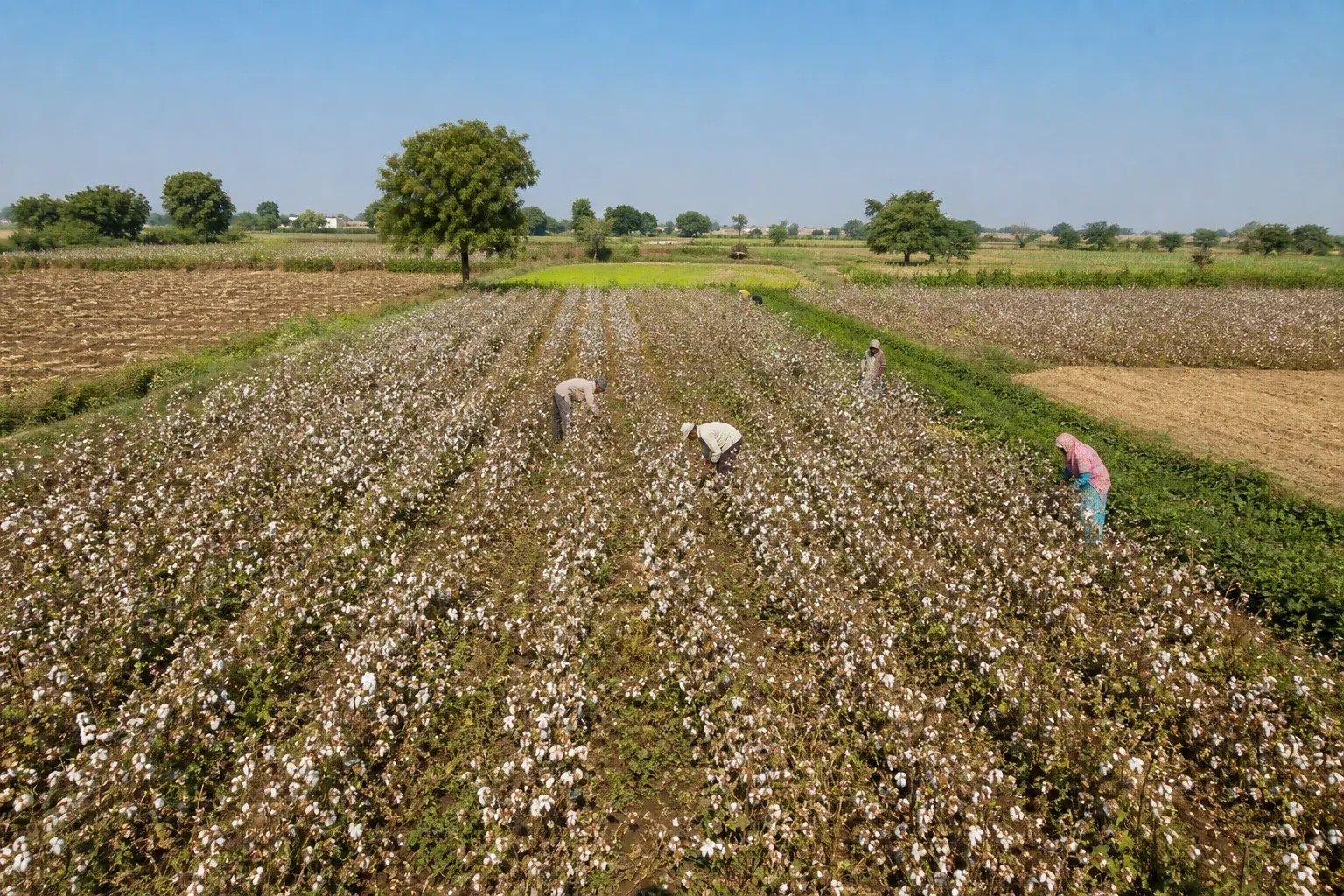
Beetle Biochar Projects in India: Where They Operate and Why
A truckload of cotton stalks that would otherwise be burned in a field in Khargone is, instead, on its way to becoming something else entirely: a black, porous soil amendment that will sit in that same field for centuries. This is the basic mechanics behind Beetle biochar projects in India, and it is worth understanding not just what biochar does, but exactly where these projects run, which farming communities are involved, and how the carbon outcomes get translated into value that textile brands can actually use in their emissions reporting.
So where exactly is this happening? On the Indian side, you'll find these projects rooted in some key cotton-growing regions: Khargone in Madhya Pradesh, where regenerative cotton and biochar work hand in hand, along with Jalgaon, Chhatrapati Sambhajinagar (formerly known as Aurangabad), and Nanded — all in Maharashtra — where regenerative cotton practices are taking hold across farming communities. And the story doesn't stop at India's borders, either. Over in Bangladesh, similar work is underway through sustainable cotton, rice, and carbon-focused projects that follow the same basic principle: turn what would be waste into something that actually gives back to the soil, the farmers, and the climate.
This is not a general explainer on biochar chemistry. It is a location-specific look at how Beetle Regen has built its biochar program across two Indian states, why those particular districts were chosen, and what happens between a farmer's field and a brand's Scope 3 disclosure. If you are a sustainability lead trying to understand where your supply chain's carbon insetting claims actually originate, or a farmer network evaluating whether to participate, this is the ground-level view.
Why Location Matters for Biochar Carbon Insetting
Biochar only creates verifiable climate value if two things line up: a reliable, local source of agricultural biomass, and soil that genuinely benefits from the amendment. A project sourcing feedstock from one region and applying it hundreds of kilometers away loses both cost efficiency and the traceability that brands increasingly demand. That is why Beetle Regen's site selection is not arbitrary. Every location was chosen because it sits inside an active regenerative cotton supply chain, with farmers already engaged in soil health work and crop residue that would otherwise be burned or wasted.
This matters for textile supply chain compliance in India, where buyers are now expected to show not just that a carbon claim exists, but where it came from and how it connects to the fiber in a specific garment. Understanding the geography of these projects is the first step to understanding whether a carbon insetting claim is real or just a line item.
Maharashtra is the anchor state for Beetle Regen's biochar work, concentrated in Sambhaji Nagar, Nagpur and Nanded. These districts are part of India's rainfed cotton belt, where farming is heavily dependent on monsoon timing and where soil degradation has been building for decades due to intensive, input-heavy cotton cultivation.
When it comes to Beetle Regen's biochar work, a few key regions really stand out as the heart of the action. In Madhya Pradesh, Khargone is leading the way with both regenerative cotton and biochar initiatives. Over in Maharashtra, we're seeing great momentum across Jalgaon, Chhatrapati Sambhajinagar (Aurangabad), Nagpur, and Nanded, all part of a growing regenerative cotton movement. And beyond India, Bangladesh is making waves too, with exciting progress in sustainable cotton, rice, and carbon-focused projects. These regions share a common thread: farming communities working hard to restore soil health and build more resilient, sustainable agricultural systems for the future.
Three factors make this region a natural fit for biochar operations. First, cotton stalks and other crop residue are abundant here after each harvest, giving the program a steady, local feedstock supply. Second, smallholder farmer density is high, which means training and support can reach many households within a compact operating radius. Third, many of these farmers were already part of Beetle Regen's regenerative cotton programs before biochar was introduced, so the soil testing, farmer relationships, and field-level trust already existed.
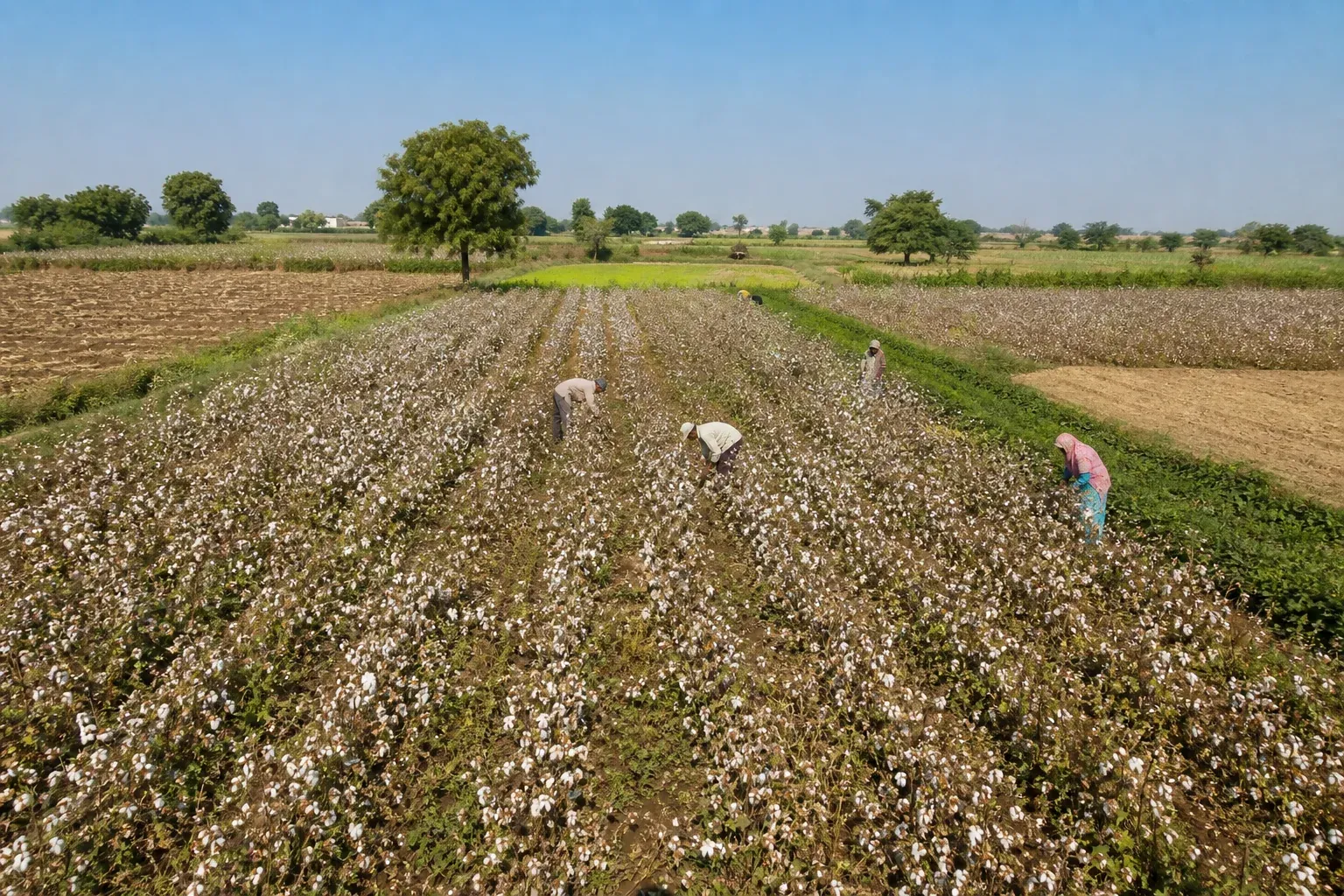
Farming communities in these districts are typically smallholders working two to five acres, often growing cotton in rotation with soybean or pulses. For many of these households, biochar is introduced as an add-on to existing soil health practices rather than a completely new system, which shortens the learning curve considerably.
The second operating geography is Madhya Pradesh, primarily in Khargone.
Feedstock sourcing here draws on cotton stalks as well as other crop residues available after the rabi and kharif harvests. Because Madhya Pradesh's cropping calendar differs slightly from Maharashtra's, running both geographies together gives the program more consistent, year-round biomass availability rather than a single harvest-season bottleneck.
But Madhya Pradesh is just one piece of the puzzle. We're also active across several key districts in Maharashtra, including Jalgaon, Chhatrapati Sambhajinagar (Aurangabad), Nagpur, and Nanded — each contributing to our regenerative cotton efforts in its own way. And beyond India, we've extended our work to Bangladesh, where we're focused on sustainable cotton, rice cultivation, and carbon projects that make a real difference on the ground.
So where does all the feedstock actually come from? A big part of it is cotton stalks, plus other crop residues left over after the rabi and kharif harvests wrap up. Think of hubs like Khargone, Madhya Pradesh (our Regenerative Cotton & Biochar site), alongside the Maharashtra cluster—Jalgaon, Chhatrapati Sambhajinagar (Aurangabad), Nagpur, and Nanded—all running Regenerative Cotton programs. Since Madhya Pradesh's cropping calendar doesn't quite line up with Maharashtra's, working across both regions together actually works in our favor: it smooths out biomass availability throughout the year instead of leaving us stuck waiting on a single harvest season. And zooming out even further, our Sustainable Cotton, Rice & Carbon Projects in Bangladesh add yet another layer of consistency, helping keep the whole supply chain steady no matter what's happening in any one location.
Farmers in Madhya Pradesh's project villages are generally organized through existing agricultural cooperatives, which has made group-based training sessions and collective biochar application scheduling more efficient than door-to-door outreach would allow.
3. Why These Regions Were Chosen: The Site Selection Methodology
Beetle Regen does not select a district simply because cotton grows there. The selection process runs through a set of practical filters before a village is added to the program:
- Biomass availability: Enough crop residue must be locally accessible to make a pyrolysis operation viable without long-haul transport.
- Baseline soil degradation: Districts showing signs of declining organic carbon and yield stagnation are prioritized, since these are the fields where biochar's impact is most measurable.
- Existing farmer relationships: Villages already engaged in regenerative cotton or capacity-building programs onboard faster and with more reliable data collection.
- Proximity to ginning and spinning infrastructure: Shorter distances between farm and first-stage processing support the traceability chain that brands rely on for supply chain compliance.
- Community readiness: Villages with active farmer groups or cooperative structures allow training to scale faster than isolated household outreach.
Before any biochar is applied, fields undergo baseline soil testing, capturing organic carbon percentage, pH, moisture retention, and nutrient levels. This baseline is what later allows the program to measure real change rather than assume it. Readers who want the mechanics of that testing step can review the soil health assessment process Beetle Regen follows across its regenerative programs.
4. How the Biochar Process Works On the Ground
The process starts with collection. Farmers gather cotton stalks and other crop residue that would otherwise be burned in the field, a practice that contributes to regional air pollution and wastes organic material that could improve soil instead. This residue is transported to a local processing point, where it undergoes pyrolysis, a controlled, low-oxygen heating process that converts biomass into stable carbon-rich biochar rather than releasing that carbon back into the atmosphere as it would through open burning.
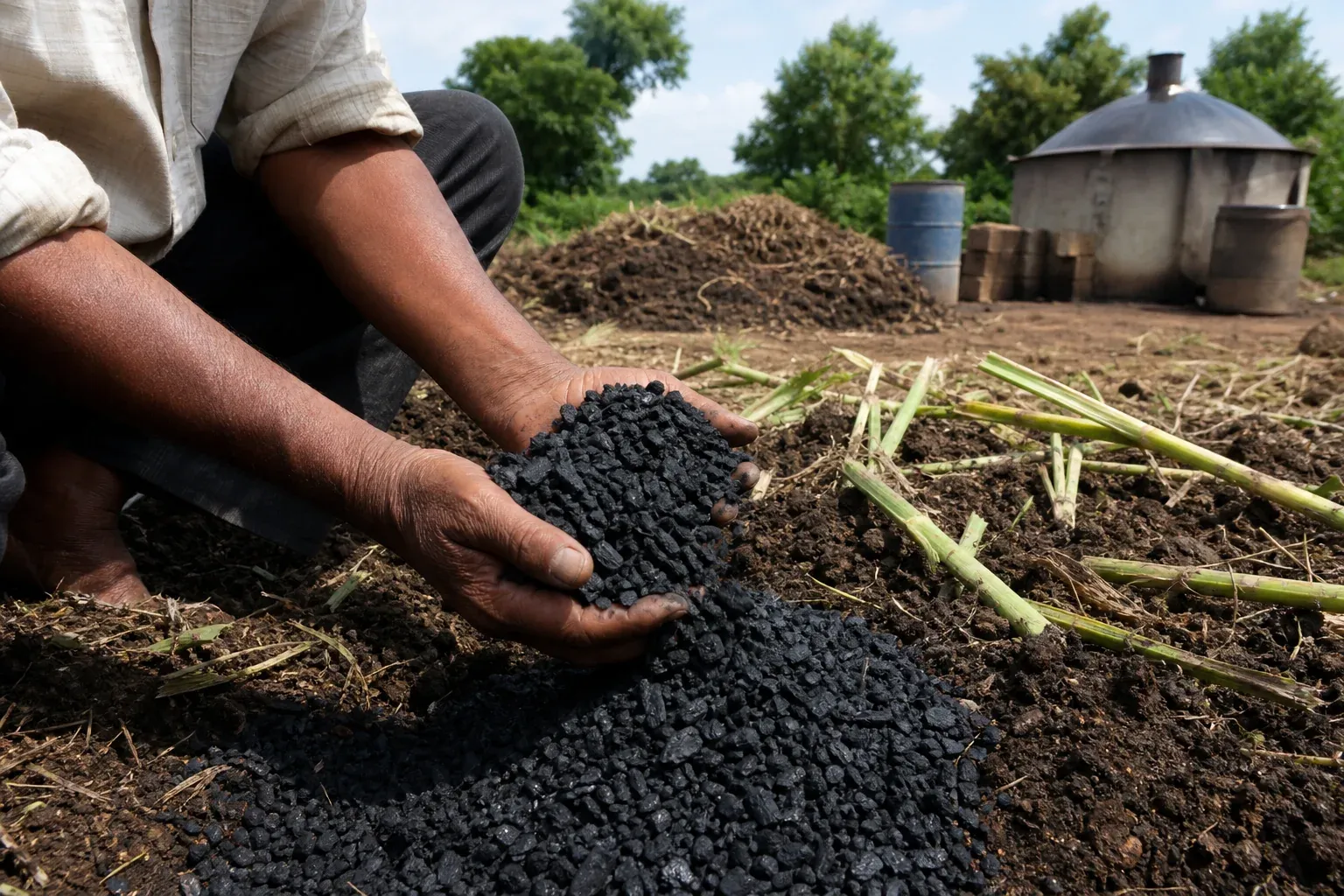
Once produced, the biochar is either applied directly to fields or blended with compost before application, depending on the soil's existing organic matter levels. Application typically happens ahead of sowing, incorporated into the top layer of soil where it can start improving water retention and nutrient-holding capacity from the first growing season onward.
None of this happens without farmer training. Field coordinators walk farmers through application rates, timing, and how biochar interacts with other regenerative practices such as cover cropping and reduced tillage. This is where Beetle Regen's broader regenerative agriculture training model overlaps directly with the biochar program, since biochar performs best as one part of a soil health system rather than a standalone input.
5. Farmer Participation and Community Impact
Participation begins with an initial conversation, usually run through village-level meetings organized with local farmer groups or cooperatives. Farmers who join go through soil baseline testing, a season of training on residue collection and biochar application, and ongoing monitoring visits from field staff.
For most participating households, the appeal is straightforward: better water retention means the crop survives dry spells better, and improved nutrient-use efficiency can reduce how much fertilizer they need to buy each season. Some of that residue that used to go up in smoke as field-burning now becomes a soil input instead, closing a loop that previously just generated pollution.
Carbon co-benefits also open a path to carbon credit monetization for smallholder cotton farmers in India, giving households a potential income stream tied directly to verified soil carbon outcomes, separate from the cotton they sell at harvest. This is a gradual process, dependent on measurement and verification cycles, but it represents a meaningful shift from farming being valued only for yield to farming also being valued for its climate contribution.
Cooperative structures play a large role here. Group-based training and shared processing points reduce costs per farmer and make ongoing monitoring more efficient than trying to reach isolated smallholdings individually.
6. Measurable Soil and Carbon Outcomes
The value of any biochar program rests on whether its outcomes can actually be measured and verified, not just claimed. Beetle Regen's approach tracks several indicators across the project cycle:
- Soil organic carbon (SOC): Measured against baseline levels to track improvement over successive seasons.
- Water retention capacity: Assessed through soil moisture testing, particularly relevant in rainfed districts where dry spells directly threaten yield.
- Nutrient-use efficiency: Tracked through reduced synthetic fertilizer application alongside stable or improved yield.
- Carbon sequestration durability: Biochar's carbon remains stable in soil far longer than most organic amendments, since the pyrolysis process converts biomass carbon into a highly stable form that resists microbial breakdown for long periods.
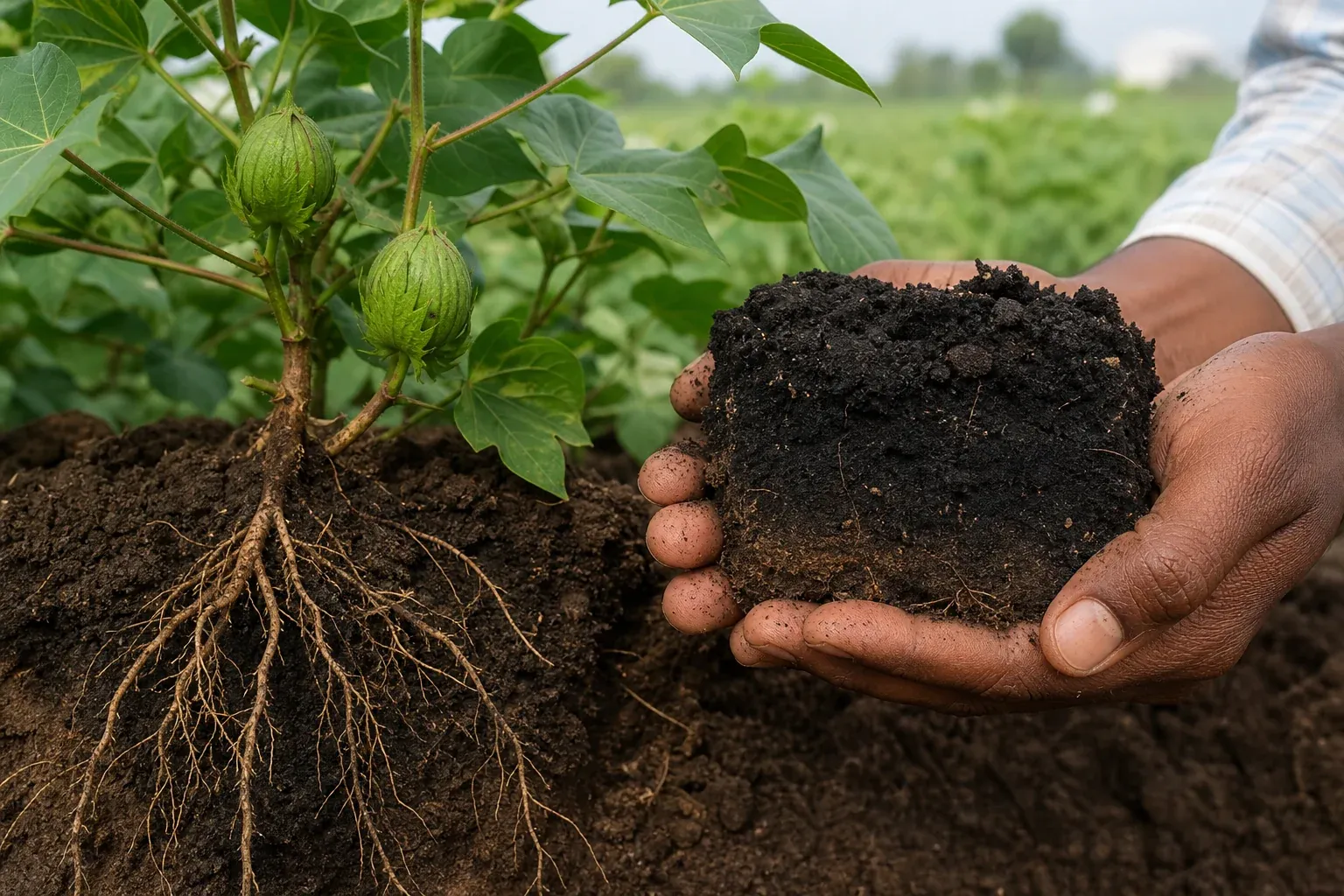
Verification runs through a measurement, reporting, and verification (MRV) process that combines field-level soil sampling with digital record-keeping, so a carbon outcome claimed for a specific plot can be traced back to that plot's baseline data. This is the same rigor detailed in Beetle Regen's MRV and traceability guide, and it is what separates a credible insetting claim from an unverified one.
According to the UN Food and Agriculture Organization, roughly a third of the world's soils are already degraded, which underscores why measurable, durable interventions like biochar matter at scale, not just as a pilot concept.
7. Maharashtra vs Madhya Pradesh: Comparing the Two Project Geographies
While both states run under the same program methodology, the operating conditions differ enough that it helps to compare them directly.
| Attribute | Maharashtra (Vidarbha & Marathwada) | Madhya Pradesh (Nimar & Malwa) |
|---|---|---|
| Primary crop system | Rainfed cotton, soybean rotation | Cotton, soybean, wheat rotation |
| Feedstock source | Cotton stalks, field residue post-harvest | Cotton stalks plus rabi crop residue |
| Typical farm size | 2-5 acres, smallholder dominant | 2-6 acres, cooperative-organized |
| Baseline soil condition | Significant organic carbon decline | Variable, better in irrigated pockets |
| Water access | Predominantly rainfed, monsoon-dependent | Mixed rainfed and irrigated |
| Key co-benefit observed | Improved moisture retention in dry spells | Reduced fertilizer dependency |
Neither region is "better" for biochar in absolute terms; they simply demonstrate different aspects of the same underlying soil chemistry, which is part of why running both geographies gives Beetle Regen a broader evidence base for how biochar performs across varying soil and water conditions.
8. How These Projects Create Carbon Insetting Value for Textile Brands
For a global apparel brand, the connection between a biochar pit in Yavatmal and a Scope 3 emissions line item might not be obvious at first. The link works like this: brands sourcing cotton from regions where Beetle Regen operates can trace a portion of their raw material back to fields undergoing verified soil carbon improvement. That verified carbon outcome is inset, meaning it is credited within the brand's own supply chain rather than purchased as an unrelated offset from an unconnected project elsewhere in the world.
This distinction matters increasingly under frameworks like the EU's Corporate Sustainability Reporting Directive (CSRD), which pushes companies toward disclosures grounded in their own value chains rather than generic offset purchases. Brands such as those sourcing from Indian cotton supply chains, including companies working toward carbon neutral cotton sourcing commitments, need this kind of farm-level traceability to withstand increasing scrutiny from regulators and auditors alike. You can review the mechanics of that reporting shift in Beetle Regen's net zero roadmap guide for textile brands.
Traceability is the connective tissue here. Without a system linking a specific farm's soil carbon data to the fiber that eventually reaches a spinning mill, insetting claims collapse into marketing language. Beetle Regen's approach to this is detailed further in its supply chain traceability guide, which explains how farm-level data moves through ginning, spinning, and into a brand's own emissions accounting.
For textile manufacturers and brands trying to reduce Scope 3 emissions across their cotton supply chain, this model offers something offset markets often cannot: a direct, auditable link between a specific carbon outcome and a specific batch of raw material entering their production line. That is also the foundation for exploring regenerative cotton sourcing across India and Bangladesh as a broader sourcing strategy, since biochar is one component within a larger regenerative system rather than an isolated intervention.
Biochar's long-term carbon stability, combined with farm-level traceability, is what allows a soil intervention in a Vidarbha cotton field to become a defensible line item in a European brand's climate disclosure.
FAQs About Beetle Biochar Projects in India
What is biochar carbon insetting?
Biochar carbon insetting is the process of converting agricultural crop residue into biochar, applying it to farmland to improve soil health, and crediting the resulting carbon sequestration within a brand's own supply chain rather than through an unconnected offset project elsewhere.
Which states does Beetle Regen's biochar program operate in?
Beetle Regen currently runs biochar projects across Maharashtra and Madhya Pradesh. Both geographies were selected for biomass availability, existing farmer relationships, and measurable soil degradation.
How is biochar carbon insetting different from buying carbon offsets?
Offsets are typically purchased from projects unrelated to a company's own supply chain. Insetting ties the carbon outcome directly to a brand's sourcing region, meaning the soil carbon improvement happens on farms actually supplying that brand's raw material, which supports more direct Scope 3 accounting.
Can textile brands verify farm-level biochar outcomes?
Yes. Beetle Regen tracks baseline and post-intervention soil data through an MRV process that ties carbon and soil health outcomes to specific plots and farmer groups, giving brands a traceable data trail from field to fiber.
Does biochar affect crop yield, or only carbon outcomes?
Both. Farmers participating in the program generally see improved water retention and nutrient-use efficiency alongside the carbon benefits, which supports more resilient yields, particularly in rainfed districts prone to dry spells.
Bringing Biochar Insetting Into Your Supply Chain Strategy
Understanding where biochar projects operate is only useful if it translates into a real sourcing or reporting decision. Whether you are a brand evaluating carbon insetting as part of your Scope 3 strategy, a manufacturer preparing for CSRD-aligned disclosures, or a farmer network exploring participation in a regenerative program, the details matter: which district, which farmers, what baseline, and what verification method stands behind the claim.
Beetle Regen works directly with textile brands, manufacturers, and farming communities across Maharashtra and Madhya Pradesh to build these projects from the soil up, with traceable data connecting every stage. If you want to understand how a biochar carbon insetting program could fit into your supply chain compliance or net zero roadmap, contact Beetle Regen's team to start the conversation about where your sourcing regions intersect with active, verifiable soil carbon work.