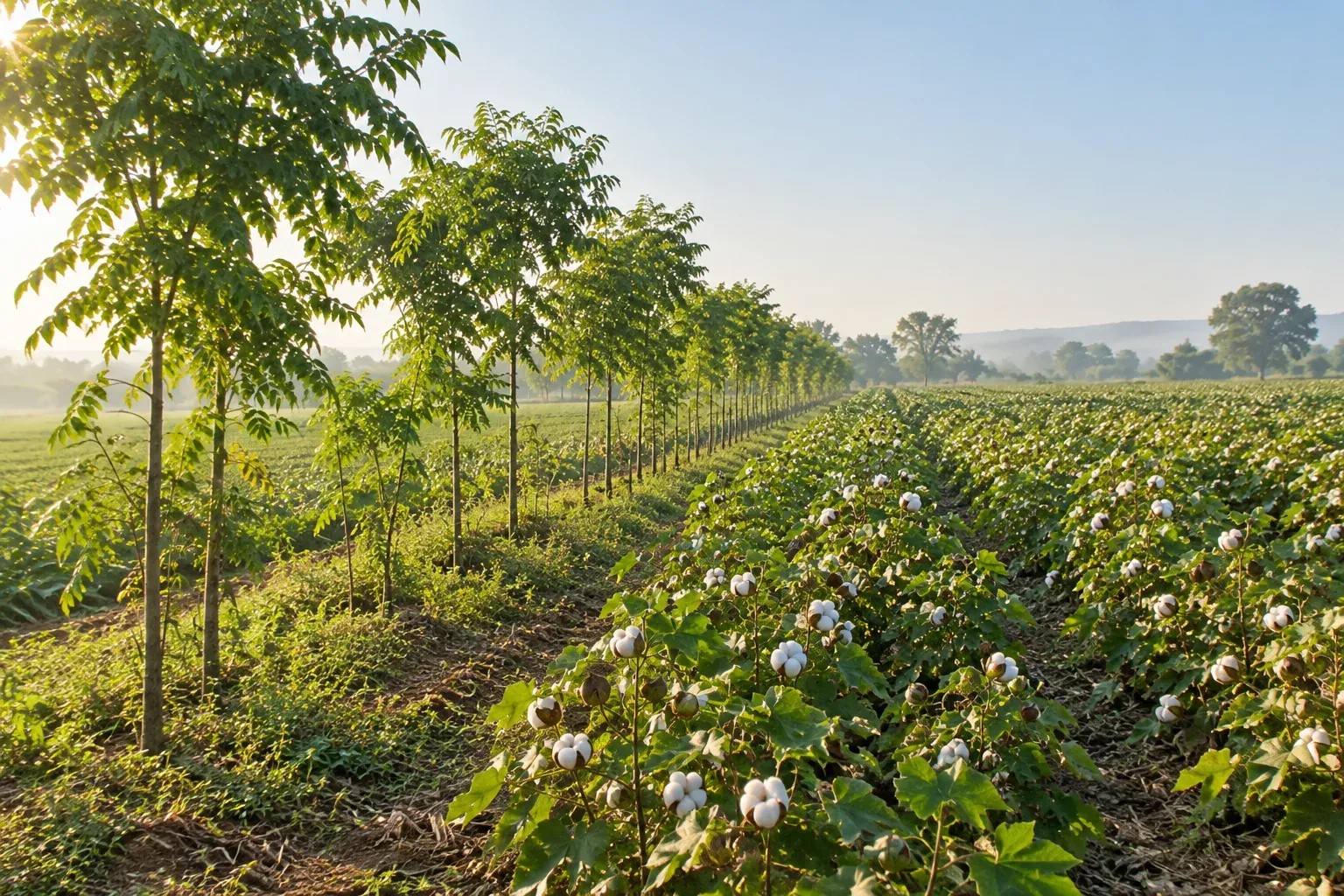
Agroforestry Systems: How Trees on Farmland Support Soil and Income
For cotton and most other field crops in India, the best-fitting agroforestry systems are boundary planting and windbreaks first, then alley cropping with wide tree rows. Silvopasture, forest farming and riparian buffers suit grazing land, shaded plots and stream edges. Start small, keep trees off the crop rows, and judge each system by soil, shade and income.
Key takeaways
- Start at the edge: Trees on field boundaries take almost no cropped area, which makes them the lowest-risk way to add agroforestry to a cotton or rice farm.
- Five systems, one filter: Alley cropping, silvopasture, forest farming, riparian buffers and boundary or windbreak planting each fit a different piece of land. Match the system to the land, not the other way round.
- Benefits build slowly: Soil cover and wind protection show up first; fruit, fodder and timber income usually take several seasons, so the main crop must carry the farm in the early years.
- Trade-offs are real: Trees compete with crops for light, water and nutrients, and they need labour for pruning and protection. Row spacing also matters for systems like HDPS cotton.
- Beetle's on-farm numbers: In 2025-26, 29% of farmers in our programmes adopted boundary plantation, and we anticipate planting approximately 200,000 trees on our farms in the first year.
Agroforestry systems at a glance
| System | What it looks like | Fit with cotton and field crops | Main benefit | Main trade-off |
|---|---|---|---|---|
| Boundary planting | Single or double tree line along field edges and bunds | High. Works on small, rainfed and irrigated plots | Wind protection, fodder, fuelwood, little cropped area lost | Edge rows can be shaded or root-competed |
| Windbreaks and shelterbelts | Taller tree rows placed across the wind direction | High on open, exposed fields | Lower wind damage and soil drying | Needs land and years to mature |
| Alley cropping | Crops grown between rows of trees | Medium. Needs wide spacing and careful pruning | Leaf litter, shade management, a second product | Competition for light and water |
| Silvopasture | Trees with grazing animals and forage | Low for cotton fields, high on grazing land | Shade and fodder for livestock | Animals can damage young trees |
| Forest farming | Shade-loving crops under a managed canopy | Low. Suits wooded plots, not open cotton land | High-value understory crops | Slow to set up |
| Riparian buffers | Trees along streams and drains | Medium. Only where a field meets water | Bank stability and cleaner runoff | Uses the most productive land edge |
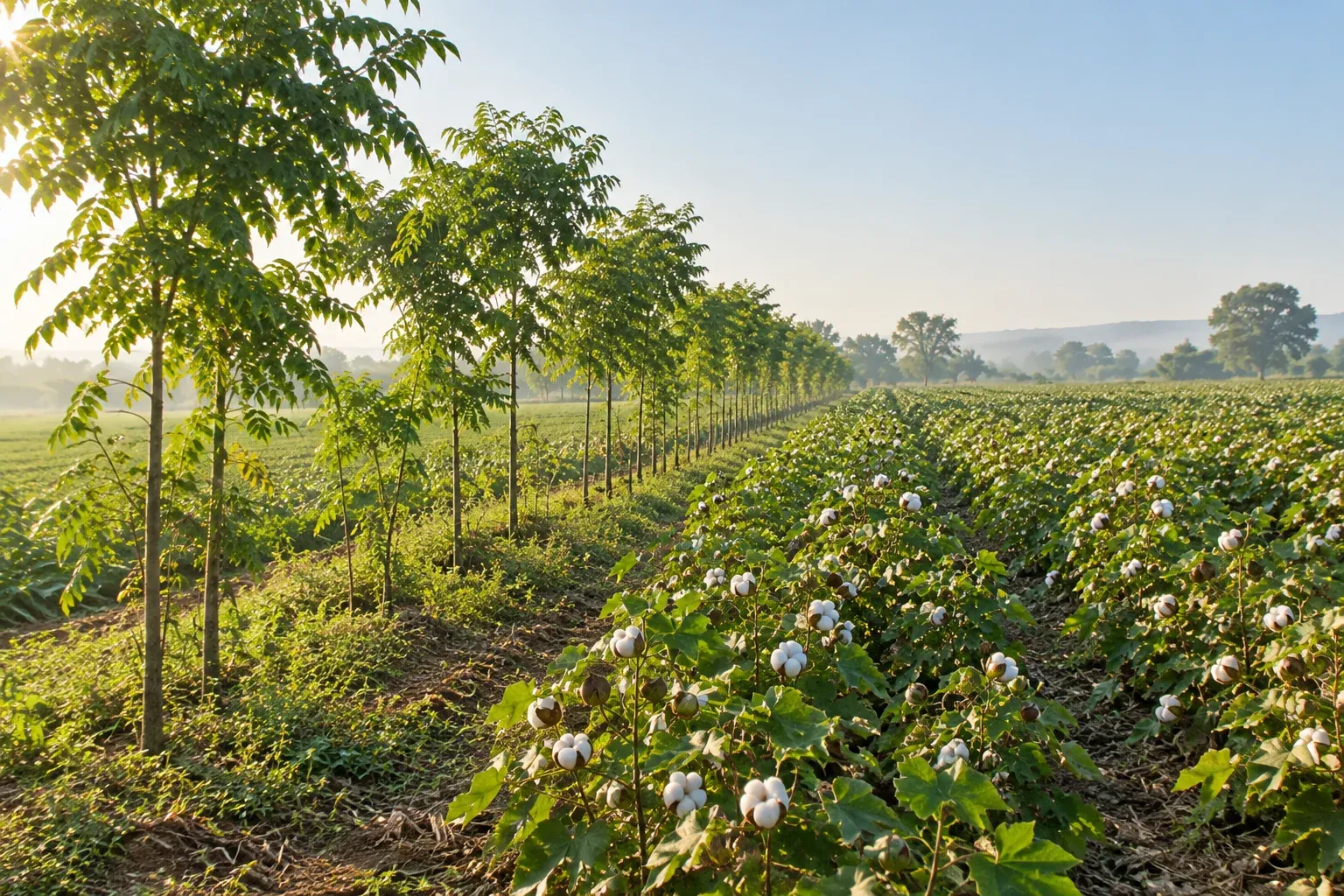
What are agroforestry systems, in field terms?
Agroforestry systems are land-use arrangements in which trees are deliberately grown with crops, livestock or both on the same piece of land. The trees are planned parts of the farm, not leftovers, and they are chosen to give soil cover, shade, fodder, fruit or timber alongside the main crop.
A 2026 review of agroforestry promotion in India describes these systems as land-use arrangements where trees are deliberately integrated with crops and/or livestock, and notes that systems with shade trees can improve food diversity and the sustainability of tree-crop production. That matches what most farmers already see: a neem on the bund, mango trees at the corner, a few babul or subabul trees for fodder.
The difference between that and agroforestry is planning. A farmer who chooses species, decides where they go, and manages them so the crop still performs is running an agroforestry system. A farmer who lets trees grow wherever seeds land is not, and often pays for it in lost yield on the shaded edge.
How agroforestry differs from an orchard or a plantation
An orchard is a block of trees with little else between them. A plantation is trees grown for timber or pulp. Agroforestry keeps the field crop as a working part of the plot. Both the trees and the crop must earn their space, which is why spacing, pruning and species choice matter more here than in either of the other two.
Why the topic matters for cotton regions
Cotton belts in central and western India are mostly rainfed or partly irrigated smallholdings, often between two and six acres. Soils are under pressure from repeated tillage, heavy fertiliser use and crop residue burning. Trees offer a way to add cover and organic matter without taking land out of production, if they are placed with care.
The five common agroforestry systems
Practitioners usually group agroforestry into a handful of designs. Different guides draw the lines slightly differently, but the same core list keeps appearing: alley cropping, silvopasture, forest farming, riparian forest buffers, and shelterbelts or windbreaks. Boundary planting is a close cousin of windbreaks and is the version most Indian smallholders already know.
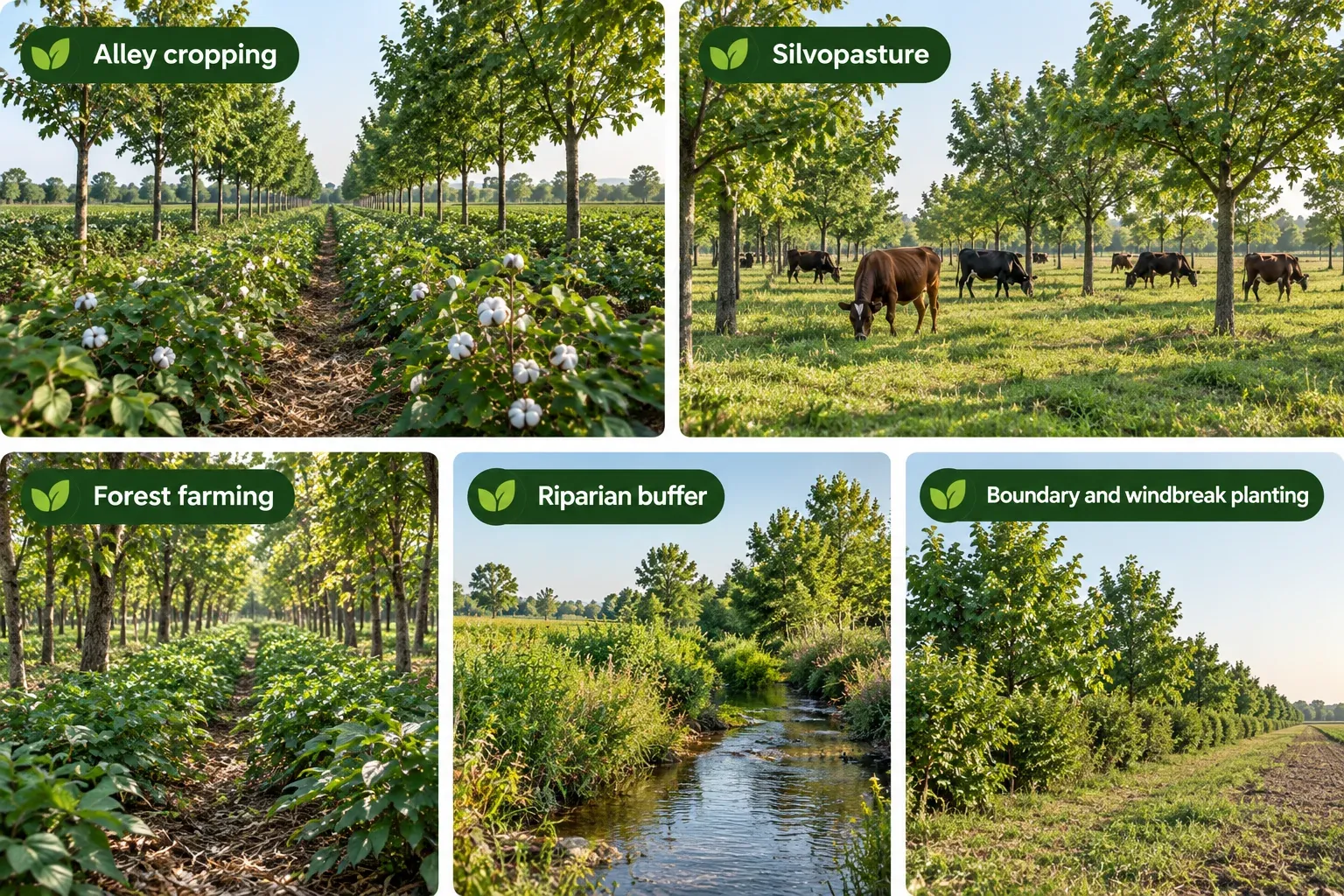
1. Alley cropping
In alley cropping, crops are grown in the "alleys" between rows of trees or shrubs. The trees are pruned so they do not shade the crop too hard, and the prunings go back to the soil as mulch or are used for fodder or fuel.
A simple example is a row of fast-growing legume trees every few metres with pulses or cereals between them. The tree rows give leaf litter and a second product; the crop alleys keep the field productive. The system needs wide spacing and regular pruning, so it suits farmers who can give it steady labour.
2. Silvopasture
Silvopasture combines trees, forage and grazing animals. Trees provide shade and fodder; animals eat the forage and return manure. It fits farms with a dairy or goat enterprise and some pasture or fallow land.
For a cotton farmer, silvopasture is rarely a choice for the cotton plot itself. It is more useful on the grazing patch, the village common or a fallow strip, where fodder trees can reduce the pressure to cut crops or buy feed.
3. Forest farming
Forest farming grows shade-tolerant, often high-value crops under a managed tree canopy. Think spices, medicinal plants or mushrooms under existing trees.
It needs a wooded plot and patience, which makes it a poor match for open black-soil cotton land. Farmers who own a woodlot or shaded corner may find it a useful way to earn from land that field crops cannot use.
4. Riparian forest buffers
Riparian buffers are strips of trees and shrubs planted along streams, drains and ponds. Their roots hold banks together, and the vegetation slows runoff so less soil and fertiliser reaches the water.
Where a cotton or rice field meets a nala or tank, a buffer strip is one of the most practical uses of agroforestry. The cost is the land itself: the strip next to water is often fertile, so farmers need to see a clear benefit before giving it up.
5. Boundary planting, shelterbelts and windbreaks
This is the system most likely to fit a smallholder field. Trees are planted in one or two lines along the edge, on the bund, or across the direction of the prevailing wind. They reduce wind speed, give fodder and fuelwood, and mark the plot clearly.
Because the trees sit at the margin, the main crop loses little area. The lessons are simple: keep trees back from the first crop row, prune the side facing the field, and pick species whose roots do not spread far into the cropped area.
Which agroforestry system fits cotton and other field crops?
For cotton and most field crops in India, boundary planting and windbreaks fit best because they take almost no cropped area and do not shade the crop. Alley cropping works where rows are wide enough to share light. Silvopasture, forest farming and riparian buffers suit grazing land, shaded plots and stream edges rather than the main cotton field.
Fit depends on four things: row spacing, water, labour and who owns the land. The sections below walk through the common cases.
Cotton on rainfed black soil
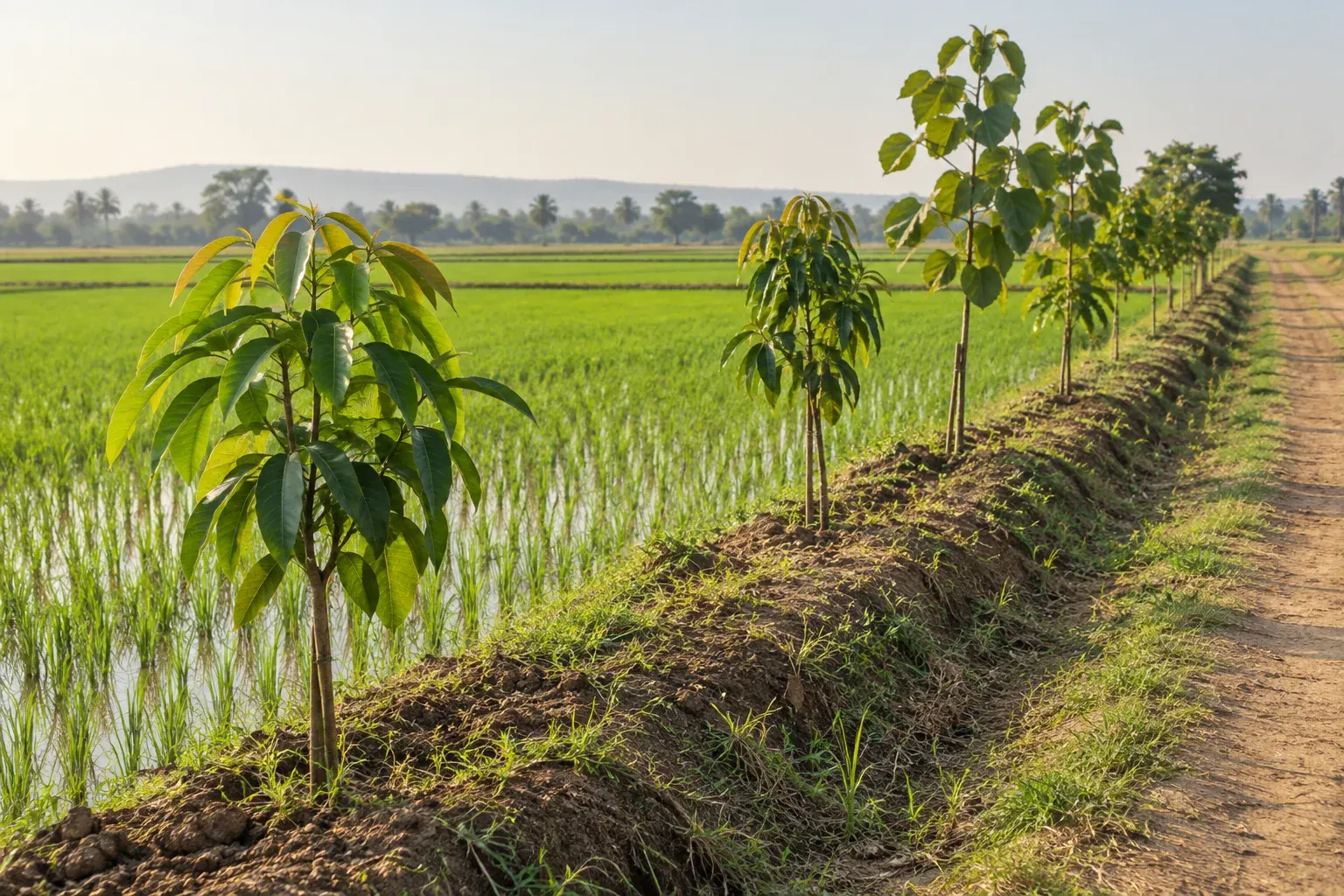
Rainfed cotton has little spare water, so trees inside the field compete directly with the crop in dry spells. Boundary lines and windbreaks are the safer choice. Choose hardy, locally adapted species, and keep them pruned on the field side so roots and shade stay at the edge.
Fruit trees in the corners can work if the farm has some irrigation to establish them. Without that, survival in the first two summers is the risk to plan for.
Cotton under high-density planting
High-density planting (HDPS) puts more cotton plants on each acre by using closer rows and a matched compact variety. That leaves little room for trees between rows. In HDPS plots, agroforestry belongs on the boundary, not inside the planted area.
That is why we keep tree planting separate from the crop rows in our HDPS work. The trees support the edge of the farm; the row spacing supports yield.
Rice and paddy bunds
Paddy fields have raised bunds that are already unused strips of land. Planting fruit or fodder trees on bunds uses that space without touching the crop. In our Alternate Wetting and Drying (AWD) work with rice farmers in Andhra Pradesh, the bund is also where water levels are managed, so tree placement should leave room for walking and field checks.
Pulses, soybean and other field crops
Short-duration field crops can tolerate wider alley cropping more easily than cotton, because they need less season-long light. A farmer who rotates cotton with pulses can use the pulse season to test alley rows on one section before extending.
Farmers who also keep animals
If the household owns cattle, goats or buffalo, fodder trees on the boundary and a silvopasture corner can cut the cost and labour of collecting feed. This is often the first place a tree planting plan pays back, because the benefit is felt in the household budget rather than waiting on a market.
How do trees support soil, shade and income?
Trees support soil by dropping leaf litter and growing deep roots, support crops by breaking wind and giving partial shade to livestock and workers, and support income through fruit, fodder, fuelwood and timber. The gains build slowly over several years, and they depend on choosing species and spacing that do not compete heavily with the crop.
Soil benefits
Leaf litter and fallen twigs feed soil life and add organic matter at the surface. Roots hold soil in place against wind and heavy rain, and deeper roots can bring up nutrients that shallow crop roots miss. A tree line on a slope slows runoff and keeps topsoil in the field.
Research on cotton-tree systems points the same way. A January 2026 paper on cotton tree crop agroforestry reports that the system is gaining attention in semiarid and tropical regions because it increases productivity and improves soil fertility. Results still vary by site, species and management, so local trials matter more than any single paper.
Soil carbon is a related but separate subject. We cover how trees store carbon in our complete guide to agroforestry and carbon sequestration; this article stays focused on what fits in the field.
Shade and microclimate
A windbreak lowers wind speed across the field, which reduces moisture loss from soil and leaf. Partial shade helps animals and field workers in peak summer. For the crop itself, shade is a cost as much as a benefit: cotton is a sun-loving crop, so shade should fall outside the crop rows.
Income streams
Tree income comes in layers. Fodder and leaf mulch help early. Fuelwood from prunings saves household spending. Fruit, nuts and pods follow after a few years, and timber comes last. A farmer who plants a mix of fast and slow species spreads the wait and the risk.
For context, our programme data on the full set of regenerative practices shows what a combined approach can do. In 2025-26, farmers in our programmes reported an average yield about 18% higher and net annual income about 38% higher than control group farmers, with each farmer adopting four to five regenerative practices. Those numbers reflect the whole package, not trees alone, and we do not claim a tree-specific share of them.
What trees can do for a brand's supply chain
Brands sourcing cotton care about soil health, biodiversity and farmer resilience. Trees on sourcing farms add visible biodiversity and cover, and they can feed into farm-level practice records. They only count in a sourcing story when they are recorded plot by plot, which is why traceability and tree planting belong in the same conversation.
Trade-offs to weigh before planting
Agroforestry is not free of cost. Every tree on the farm takes light, water, nutrients, land and labour from something else, and the return arrives later than the cost. A fair decision weighs both sides.
Competition with the crop
Roots and canopy compete with the crop for light, water and nutrients, especially in dry years. The edge rows nearest a tree line usually show it first. Give trees distance, prune the field side every year, and avoid species with wide, shallow root spreads next to cotton.
Time to income
A smallholder with two to six acres cannot wait seven years for a pay-off. Plant fast, useful species alongside slow ones, and keep the main crop strong so the household is never short while trees mature.
Labour and protection
Young trees need watering, fencing against animals and weeding. Pruning adds work every year. If the household is already stretched at sowing and harvest, plant fewer trees and look after them well rather than planting many and losing them.
Land rights and tenure
Tenant farmers may not be able to plant trees that outlast the lease. Check who owns the trees, who can cut them, and who gets the income before any planting day. Group plantings on common or bund land need a clear agreement in advance.
Pests, diseases and species choice
Some trees host pests that can move into the crop, and some are poor neighbours for specific crops. Choose species recommended by local agricultural or forestry extension for your area, and avoid planting a single species everywhere. What counts as a good neighbour for cotton in one district may not hold in another, and that is one point where local advice beats general guidance.
Spacing conflicts with other practices
Row spacing for HDPS, planter width, irrigation lines and the path of harvest equipment all set limits. Draw the plot on paper first and mark where each of these must pass.
Beetle Regen's on-farm tree planting experience
Tree planting is part of how we run farmer programmes, alongside regenerative practices, HDPS and biochar. We are actively promoting tree plantation on our farms and anticipate planting approximately 200,000 trees in the first year. That is a plan, and we report it as such.
In our 2025-26 programme data, 29% of farmers adopted boundary plantation, with parallel efforts towards improved crop diversification. Each farmer is adopting four to five regenerative practices on their farm. Boundary planting sits within that set, which is why we treat it as one practice among several rather than a standalone fix.
How trees connect with HDPS and biochar
Our HDPS initiative focuses on optimising land use and boosting crop yields through strategic planting. Early results show an average cotton yield increase of approximately 25% compared with conventional planting among participating farmers. Because HDPS uses most of the plot, trees go on the edges.
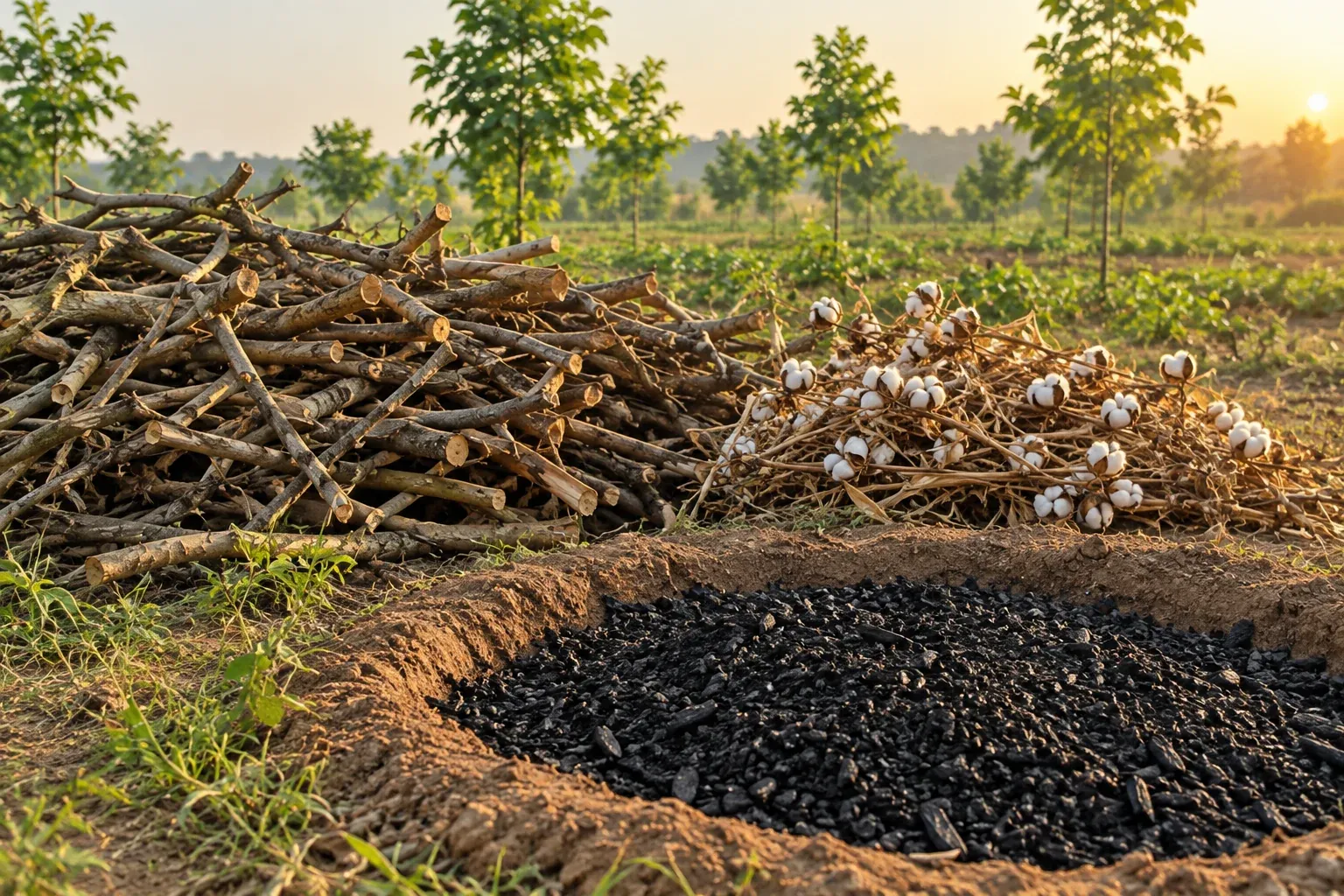
Biochar adds another link. We make biochar by burning organic waste such as crop residue and dead plants in a controlled, no-oxygen environment, and use it as a nature-based way to improve soil fertility, sequester carbon and enhance water retention.
Our programme work centres on cotton stalks; see our guide on biochar and soil carbon in Indian cotton for how that works in the field. Woody residue from tree management is a similar material, though farmers should check what suits their kiln and local rules.
Reducing tillage around trees
With our intervention, we anticipate a 30% reduction in tillage on our farms within the first two years. Less tillage helps trees as well as soil: roots are not cut by repeated passes, and the ground under young trees holds moisture longer.
What we are still learning
Our key learning from the past year is that adoption follows visible benefit, and that consistency in practice needs continued handholding. Variation in agronomic practices across farms means tree planting results will vary too. We do not yet have tree-specific yield figures to publish, and survival rates, species performance and income from trees are things we are still tracking.
You can read more about where these programmes run on our projects page.
A step-by-step way to choose a system for your farm
Use this sequence before you buy a single sapling. Each step has a pass mark and a fallback if the check fails.
- Draw the plot. Mark crop rows, bunds, water points, paths, the boundary and wind direction. Pass: you can see at least one strip where trees would not touch a crop row. If not: the plot is too tight for trees inside it; consider shared common land or a neighbour agreement.
- Check tenure. Confirm you can keep and harvest the trees. Pass: ownership of the land and trees is clear. If not: stick to short-lived or fodder species, or get an agreement in writing first.
- Check water. Ask whether young trees can survive their first two summers. Pass: a reliable source or a plan to water them. If not: plant at monsoon onset, choose hardy local species, and plant fewer.
- Pick the system from the land. Boundary or windbreak for open crop land; alley cropping only where rows can be wide; silvopasture if you have livestock and a grazing patch; a riparian buffer if the field meets water. If two fit: start with the lower-risk boundary option.
- Choose species with local advice. Ask the local agriculture or forestry office, or a trusted farmer group, which species do well nearby. Mix fast-yielding fodder or fuel species with slower fruit or timber. Walk away from: any species that is known locally to compete hard with cotton or host its pests.
- Test on one section first. Plant one boundary and compare edge-row yield with an untreated edge. Pass: the edge rows lose little compared to the control. If not: increase the gap, prune harder, or change species.
- Keep records. Note species, number, date, plot and survival each season. This is what a buyer or programme can check, and it is what turns a planting day into evidence.
If you are part of a farmer group, ask the programme team what support exists for saplings, training and records before you start. Farmers in the same village often share lessons faster than any manual.
Frequently asked questions
Can agroforestry improve long-term soil carbon?
Yes, in many cases. Trees add carbon through roots, leaf litter and woody biomass, and they reduce erosion. The size of the gain depends on species, spacing, soil and how long the trees stay in place. Measured results need soil sampling over several years, so treat any single-season claim with caution.
The carbon science is covered in more depth in our earlier agroforestry guide, and carbon revenue is a separate question from field fit. Joining a carbon project does not automatically earn money; revenue depends on project design, verified outcomes, credit issuance, market value, costs and the agreed benefit-sharing mechanism.
How long before trees start paying income?
Time to income varies by species: fodder and pruned leaf material can help within a season or two, fruit trees usually need several years before a useful harvest, and timber takes the longest. Plan the first years around the main crop's income, and treat tree income as a later layer.
Do trees reduce cotton yield?
They can if planted wrongly. Trees too close to cotton compete for light, water and nutrients, which lowers yield on the shaded edge. Trees on the boundary, pruned regularly and kept clear of the crop rows, should cost little yield, though it varies by species. Test on one boundary first and compare against an untreated side.
Can brands count farm trees in sourcing claims?
Only with records. A brand can credit tree planting on sourcing farms when species, number of trees, plot location and survival are recorded and checked. Without plot-level records, a tree count is a statement of intent, not evidence a buyer can use in reporting.
Where to go from here
Agroforestry systems work best when they are chosen for the plot, not copied from a brochure. For most Indian cotton and field-crop farms, that means starting with trees on the boundary, keeping crop rows clear, and keeping records from day one. Larger designs like alley cropping can follow once the first trees have proved themselves.
If you are a farmer group, mill or brand looking at how trees, HDPS, biochar and traceable records fit into one programme, contact the Beetle Regen team to talk through your region, your crop and what a first tree-planting plan could look like.