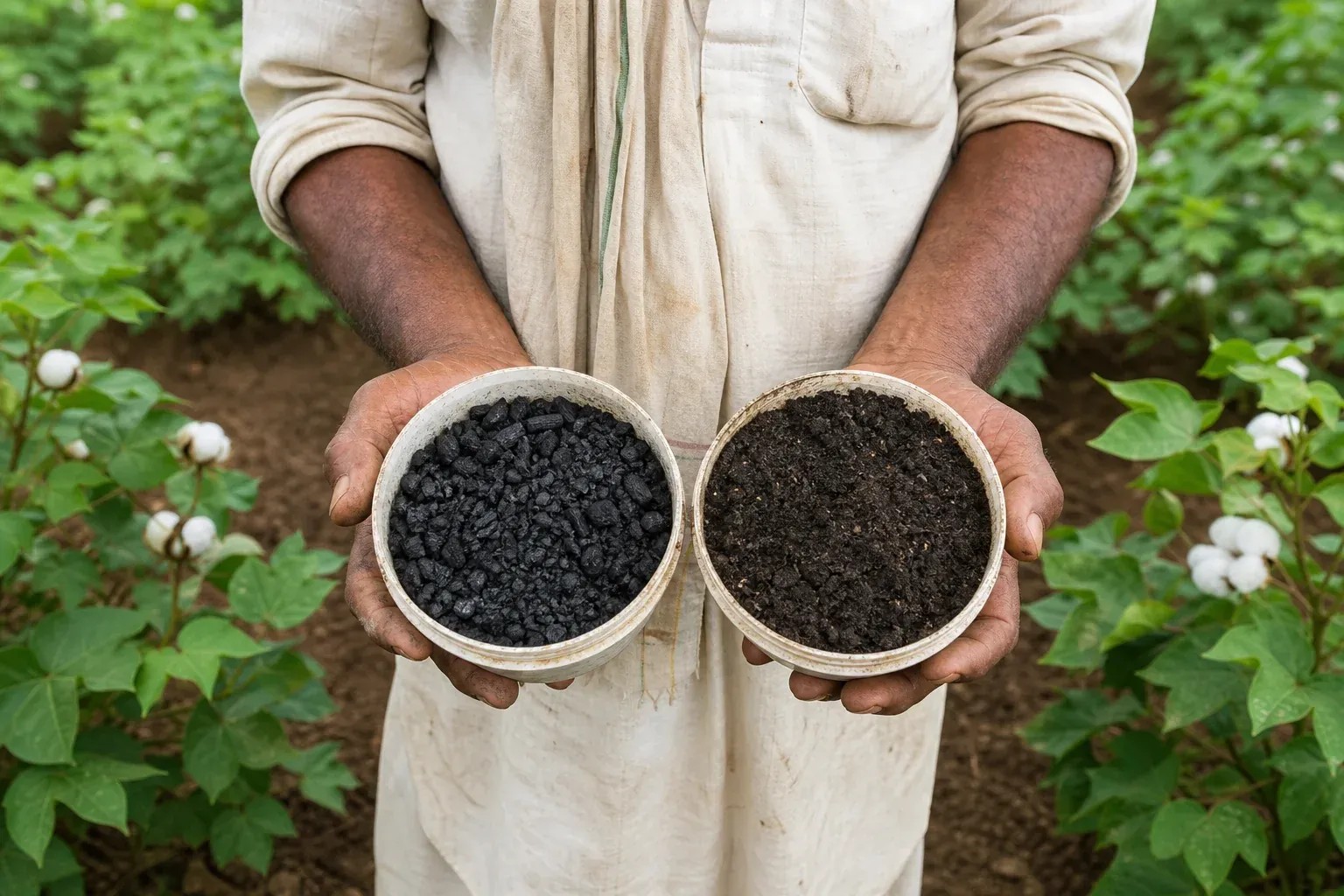
Biochar vs Compost: Which Builds Soil Carbon Faster?
Biochar builds more durable soil carbon than compost, locking carbon into a stable form that can last centuries, while compost builds soil carbon faster in the short term but releases most of it back into the atmosphere within years. For biochar vs compost for soil carbon, the right pick depends on whether you need permanence for carbon credits or a quick fertility fix for depleted fields.
Key Takeaways
- Permanence gap: Biochar carbon can remain stable in soil for 100+ years, while compost carbon typically cycles back to CO2 within 3 to 10 years as microbes consume it.
- Speed of results: Compost often lifts crop response within one season by feeding soil microbes and adding nutrients quickly; biochar's yield benefits build over two to three seasons.
- Cost and labor: Compost needs regular turning and moisture management; biochar needs a kiln, dried feedstock, and trained operators, but produces a material that lasts far longer once applied.
- Carbon insetting fit: Brands seeking verifiable, measurable carbon insetting for Scope 3 reporting lean on biochar because its durability suits MRV (measurement, reporting, verification) protocols.
- Best results come from both: Co-composting biochar with farm residue before application combines fast nutrient cycling with long-term carbon storage in a single input.
At a Glance: Biochar vs Compost
| Factor | Biochar | Compost |
|---|---|---|
| Carbon permanence | Decades to centuries | 3-10 years |
| Time to visible yield effect | 2-3 seasons | 1 season |
| Production method | Pyrolysis (low-oxygen burning) of crop residue | Aerobic decomposition of organic matter |
| Farm-level equipment | Kiln or retort, drying area | Compost pit, turning tools |
| Labor intensity | Moderate, concentrated during production | Ongoing, requires regular turning and watering |
| Best fit for | Carbon insetting, water retention, long-term soil structure | Fast nutrient boost, microbial activity, degraded soil recovery |
| Fit for brand carbon claims | Strong (verifiable, durable) | Weak on its own (short-lived) |
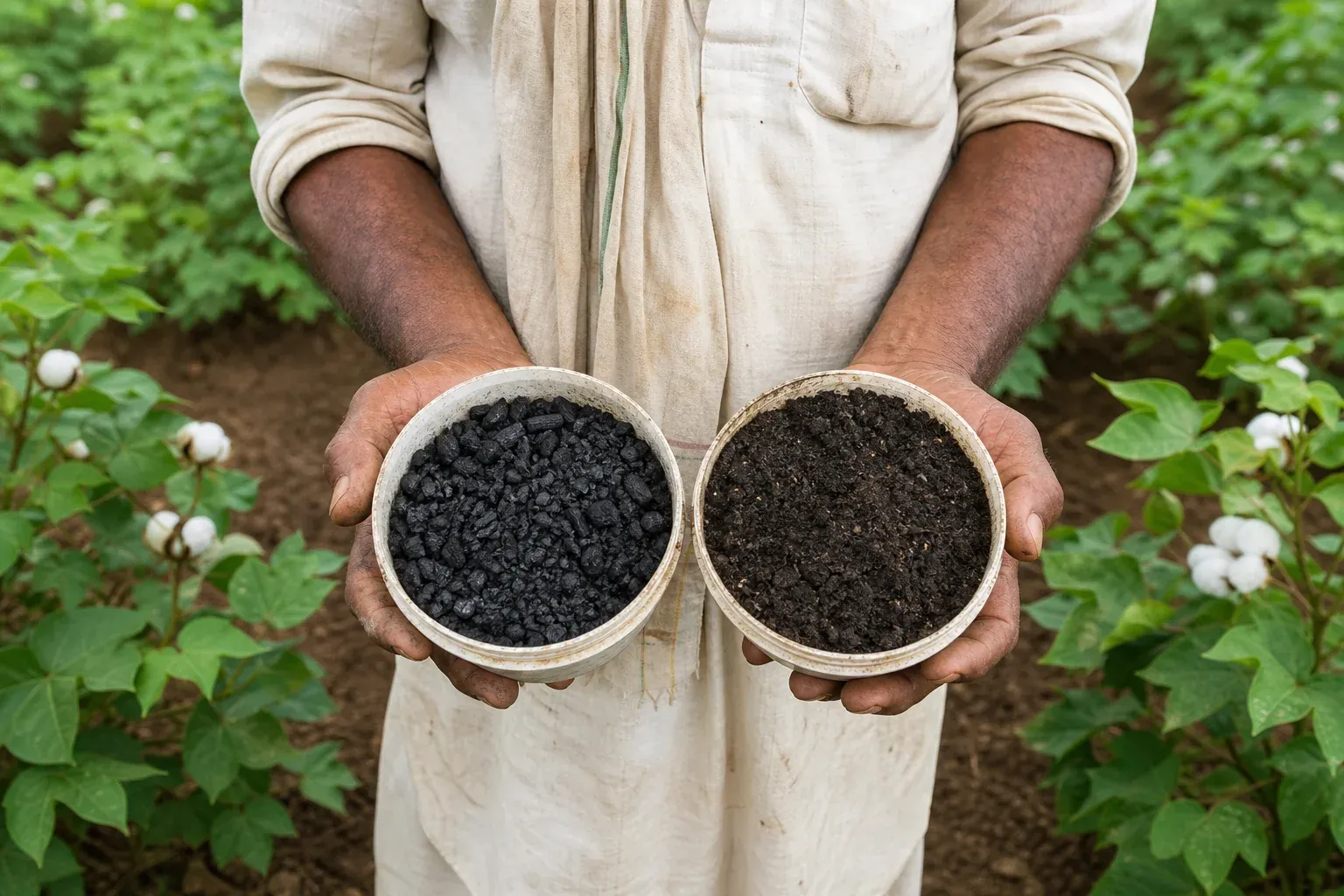
What Makes Biochar Different From Compost?
Compost forms when microbes break down organic waste, like crop residue, manure, or kitchen scraps, in the presence of oxygen. The process feeds soil biology and releases nutrients gradually. Biochar takes a different route entirely.
Producers heat crop residue, such as cotton stalks or rice husks, in a low-oxygen chamber through a process called pyrolysis. That heat converts the biomass into a stable, carbon-rich material instead of letting it decompose or burn away as smoke. We cover the production side in detail in what biochar is and how farmers use it, but the core distinction matters here: compost feeds soil life, biochar changes soil structure.
That structural difference is why the two methods behave so differently once they're in the ground.
How Long Does Soil Carbon From Each Method Actually Last?
Biochar carbon resists microbial breakdown for decades to centuries because pyrolysis rearranges the carbon into a stable, aromatic structure microbes struggle to digest. Compost carbon, by contrast, gets consumed by soil organisms within a few years and returns to the atmosphere as CO2.
This gap is the single biggest reason carbon insetting programs favor biochar over compost. When a textile brand needs to report a tonne of sequestered carbon under CSRD or a similar disclosure framework, that tonne has to still be in the ground when auditors check years later. Compost cannot make that promise on its own.
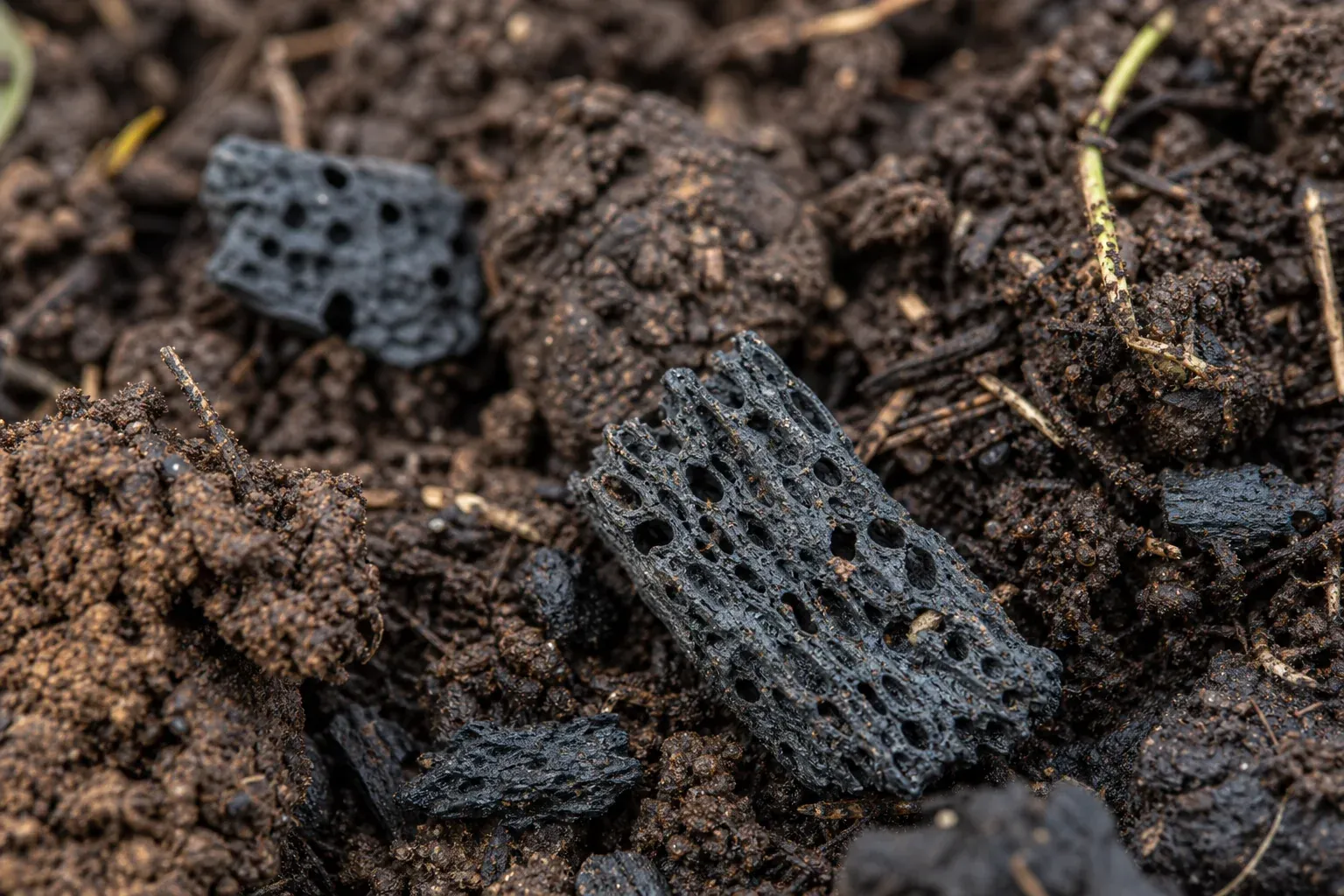
Soil scientists measure this using accelerated decomposition studies and radiocarbon dating on aged biochar samples. Field data from biochar trials globally, including work referenced by the UN Food and Agriculture Organization's soils portal, consistently shows biochar's recalcitrant carbon fraction surviving well beyond a single cropping cycle. Compost's contribution to soil organic carbon, while real, needs to be reapplied year after year to hold steady.
That does not make compost carbon worthless. It builds the active, biologically available carbon pool that feeds soil life season to season. Biochar builds the passive pool that stays put. Different jobs, both needed.
Cost and Labor: Comparing Farm-Level Investment
Compost is cheaper to start. Most smallholder farms in Madhya Pradesh and Maharashtra already generate crop residue, manure, and green waste that can go straight into a compost pit with minimal upfront spend. The catch is labor: turning the pile every few weeks, managing moisture, and waiting several months for it to mature.
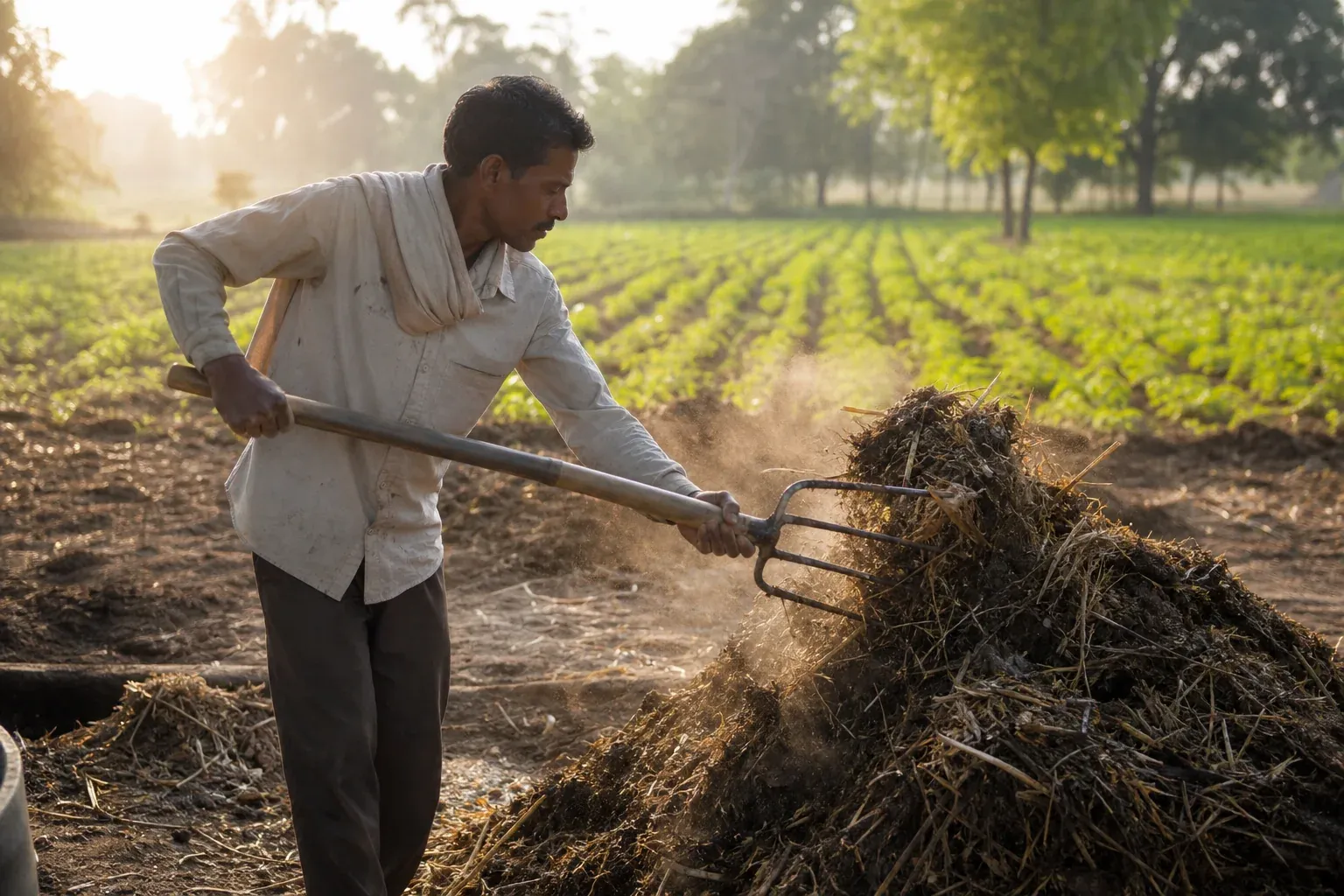
Biochar demands more upfront investment. Farmers need a kiln or retort, dried and sized feedstock, and someone trained to run a safe burn. We walk through that training process in safe biochar kiln operation if you're weighing whether your cooperative has the capacity to start production.
Once produced, though, biochar keeps working for years without reapplication at the same rate compost requires. That changes the cost math over a five-year horizon: compost costs less per application but needs repeating annually, while biochar costs more upfront but holds its structural benefits far longer.
For farmer cooperatives weighing this trade-off, the honest answer is that neither wins on cost alone. It comes down to whether your farm has spare labor for ongoing compost turning or spare capital and training time for a kiln.
Yield Impact: What Farmers See in the Field
Compost tends to show up first. Because it releases nitrogen, phosphorus, and potassium as microbes break it down, farmers often see a visible bump in plant vigor within one growing season. This makes compost attractive for fields that have been chemically farmed for years and need an immediate nutrient correction.
Biochar plays a slower, structural game. Its porous particles hold water and nutrients that would otherwise leach away, and that benefit compounds over two to three seasons as the soil's water-holding capacity improves. Farmers in Beetle Regen's cotton programs typically report the clearest yield gains from biochar in the second and third season after application, not the first.
The two methods answer different questions: compost answers "how do I feed this soil now," and biochar answers "how do I make this soil hold onto what I feed it."
Which One Fits Your Farm or Brand Goal?
Pick compost if your field is depleted and needs a fast nutrient correction before the next planting window. Pick biochar if you're building toward verifiable carbon insetting credits or long-term water retention in drought-prone plots. Most regenerative cotton programs we run end up using both, staged across a multi-season rotation.
Can You Use Biochar and Compost Together?
Yes, and co-composting biochar is standard practice in several of Beetle Regen's cotton pilot sites. Mixing raw biochar into a compost pile before it matures lets the biochar's porous surface absorb nutrients and microbes during decomposition, a process sometimes called nutrient loading.
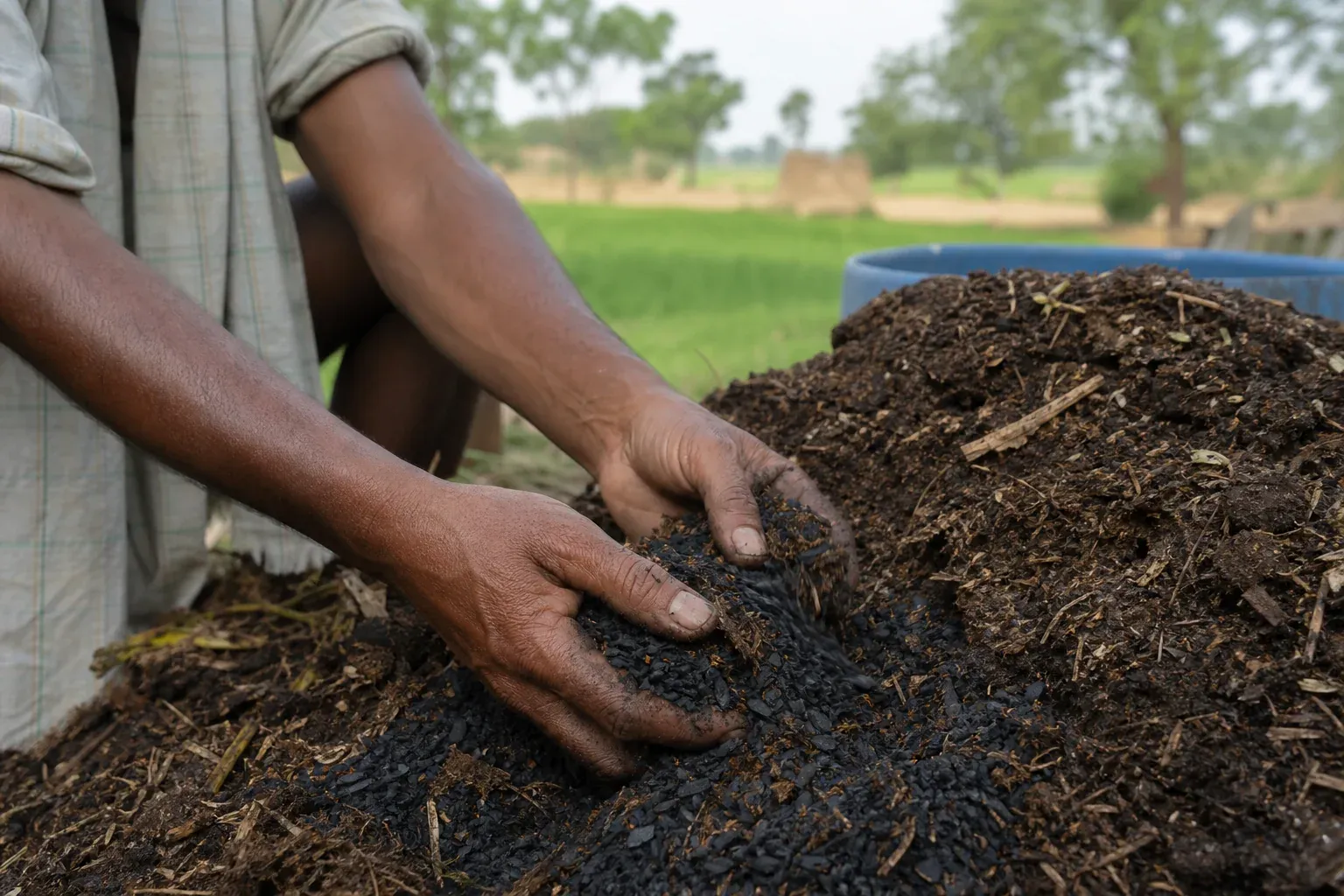
The result is a single input that carries compost's fast nutrient release alongside biochar's long-term carbon stability. Farmers apply it once, and the field gets both the short-term biological boost and the durable carbon structure. It also solves a practical problem: raw biochar applied alone can temporarily tie up nitrogen in soil until it equilibrates, and pre-charging it with compost avoids that lag.
Our work with cotton cooperatives across the biochar projects in India shows this combined approach performs better on both soil test metrics and farmer-reported yield than either input used in isolation.
How Does This Compare to Cover Crops?
Cover crops build soil carbon through root biomass and continuous living cover, a slower and cheaper method than either biochar or compost but one that also depends on consistent seasonal planting to keep working. If you're weighing all three carbon-building methods against each other, our detailed breakdown in Biochar vs Cover Crops: Which Sequesters More Carbon? covers that comparison directly.
Broadly, cover crops sit between compost and biochar on permanence, and many regenerative programs layer all three depending on field condition and season.
Frequently Asked Questions
Does compost sequester carbon permanently?
No. Compost adds organic carbon to soil, but most of it gets metabolized by microbes and released as CO2 within three to ten years, depending on soil type and climate. Reapplying compost regularly maintains soil carbon levels but does not create a permanent carbon sink on its own.
How much biochar per acre works for cotton fields?
Application rates in Beetle Regen's cotton programs typically range from 1 to 2 tonnes per acre for the first application, adjusted based on baseline soil carbon and field-specific soil tests. Rates vary by soil texture and prior degradation, so a soil assessment should guide the exact figure for any given plot.
Can smallholder farmers afford biochar production?
Smallholders can produce biochar affordably when they use existing crop residue as feedstock and access shared kiln infrastructure through a cooperative rather than buying individual equipment. Training and initial kiln setup are the main costs; our regenerative cotton program KPI guide outlines how cooperatives track return on that investment over multiple seasons.
Which method do textile brands prefer for carbon insetting claims?
Textile brands generally favor biochar for carbon insetting because its durability holds up under MRV verification and audit cycles that stretch across multiple years. Compost supports the soil health story but rarely stands alone as a quantifiable insetting claim in Scope 3 disclosures.
Choosing between biochar and compost is not really an either-or decision once you look at what each one is actually built to do. Compost repairs soil biology fast. Biochar locks carbon in place for the long haul. Regenerative cotton programs that pair the two, timed to field condition and season, tend to outperform either input used alone, on both soil test data and farmer-reported yield.
If you're a farmer cooperative deciding where to start, or a brand evaluating which carbon-building method backs up your net zero claims, we can walk through soil data from active regenerative cotton sites in India and Bangladesh. Contact us to talk through which combination of biochar and compost fits your fields, your timeline, and your carbon reporting needs. You can also explore how our approach to regenerative soil work ties these methods into a full farm-to-fashion carbon insetting program.