Carbon Insetting Protocol Comparison: Verra, Gold Standard & Soil Carbon
Ask three sustainability consultants which carbon insetting protocol to use for an Indian cotton program, and you will likely get three different answers.
That disagreement is not a sign of confusion — it reflects a genuine complexity that brands and program designers face every time they try to translate farm-level climate action into verified, market-recognized carbon credits. The carbon insetting protocol comparison that follows is designed to cut through that complexity with a structured, practical framework.
This post compares the three most relevant frameworks for Indian agriculture: Verra's Verified Carbon Standard (VCS), the Gold Standard for the Global Goals, and a set of emerging soil carbon frameworks that are gaining traction in smallholder contexts.
For each, we examine MRV requirements, farmer eligibility criteria, credit issuance timelines, and fit with specific crops and geographies. The goal is a decision-ready matrix that sustainability teams, sourcing directors, and regenerative agriculture consultants can use immediately.
Why Protocol Selection Defines Your Insetting Program's Credibility
Choosing a carbon insetting protocol is not a back-office administrative decision. It determines whether the credits your program generates will be accepted by corporate buyers, recognized in scope 3 emissions disclosures, and trusted by third-party auditors reviewing your sustainability reporting. A poorly matched protocol can invalidate years of on-farm work. It can also expose brands to greenwashing risk.
For textile and fashion brands working toward net zero commitments, the protocol choice also shapes the narrative. A Gold Standard certification carries a different story than a Verra VCS credit, even if the underlying carbon sequestration is identical. Brands like those in the H&M, Primark, or PVH supply chain ecosystems increasingly specify which standards they will accept for insetting claims. This makes protocol literacy a commercial necessity.
Indian agriculture adds a further layer of complexity. The country's cotton and rice sectors are dominated by smallholder farmers, many holding less than two hectares. Land tenure documentation is inconsistent. Baseline data is sparse.
And the diversity of agro-climatic zones — from the black cotton soils of Maharashtra to the alluvial plains of West Bengal — means that no single methodology fits all contexts. A rigorous carbon insetting protocol comparison must account for these realities, not just the headline requirements of each standard.
This comparison is designed for three audiences: sustainability consultants advising brands on insetting strategy, textile and fashion brands building supply chain climate programs, and farmer program designers who need to know which standard their MRV infrastructure can realistically support.
Understanding Carbon Insetting Protocols: What They Govern and Why It Matters
Before comparing specific standards, it helps to clarify what a carbon insetting protocol actually governs. Unlike a carbon offset standard — which certifies credits generated outside a company's value chain, an insetting protocol certifies climate action within the supply chain. The credits generated stay inside the brand's scope 3 accounting rather than being sold on the open market to unrelated buyers.
Every credible protocol governs four core elements. First, additionality: the carbon sequestration or emission reduction must be beyond what would have happened without the project. Second, permanence: the carbon stored must remain stored for a defined period, typically 20 to 100 years, with buffer pools to account for reversal risk.
Third, MRV (Measurement, Reporting, and Verification): the methodology for measuring carbon outcomes must be scientifically defensible and independently verified. Fourth, leakage: the project must not simply displace emissions to another location.
For Indian smallholder agriculture, MRV is often the most challenging element. Soil organic carbon (SOC) measurement requires physical sampling, laboratory analysis, and statistical modeling across heterogeneous plots. The cost of rigorous MRV can easily exceed the value of credits generated on small farms, which is why protocol selection must weigh scientific rigor against economic viability.
Later in this article we give indicative MRV cost bands for each standard (see the comparison table); treat those as planning ranges to confirm with a VVB quote for your specific project area, not as fixed prices. To understand how this fits into a broader carbon accounting framework, see our guide on Carbon Sequestration in Agriculture: A Complete Framework.
Verra VCS: Strengths and Limitations for Indian Farmers
Verra's Verified Carbon Standard is the world's most widely used voluntary carbon standard. The registry describes cumulative issuance in the order of one billion credits since its founding — for the current, audited figure, check Verra's own registry dashboard directly rather than relying on any secondary source, since issuance totals update continuously.
For Indian agriculture, the most relevant category is Agriculture, Forestry and Other Land Use (AFOLU), which covers soil carbon, reduced tillage, improved cropland management, and agroforestry.
Relevant Methodologies
Three Verra methodologies are most applicable to Indian cotton and rice contexts. VM0042 (Improved Agricultural Land Management) covers practices like reduced tillage, cover cropping, and nutrient management that increase soil organic carbon. VM0017 addresses avoided deforestation and is less directly applicable to cropland.
VM0021 covers soil carbon quantification using the RothC or Century models, which require multi-year baseline data. For rice paddy methane reduction through Alternative Wetting and Drying (AWD), the relevant methodology is AMS-III.AU under the CDM framework, which Verra has adapted for voluntary markets.
MRV Requirements Under Verra VCS
Verra's MRV requirements are rigorous. Projects must establish a baseline scenario using at least three years of historical land use data. Soil sampling must follow stratified random sampling protocols, with a minimum of one composite sample per 10 hectares. Laboratory analysis must be conducted by accredited facilities. Annual monitoring reports are required.
Full verification by an accredited Validation and Verification Body (VVB) must occur at least every five years, though most projects verify every two to three years to maintain buyer confidence. For the current, binding version of these rules, consult the specific methodology document (for example VM0042) on Verra's own methodology registry rather than a summary, since methodologies are periodically revised.
For Indian smallholder programs, this creates a practical challenge. Aggregating dozens or hundreds of small farms into a single project boundary is possible under Verra's grouped project approach, but it requires a robust farmer registration system, GPS-mapped plot boundaries, and consistent data collection across all participants.
This is where ERP integration and digital MRV platforms become essential infrastructure rather than optional add-ons. See how data systems support this in our post on How to Integrate Regenerative Agriculture Data Across Supply Chains.
Farmer Eligibility and Credit Issuance Timeline
Verra does not set a minimum farm size, but the economics of project development typically require a minimum aggregated area of 500 to 1,000 hectares to justify the upfront cost of project design documents (PDDs), baseline studies, and VVB fees. Farmers must be able to demonstrate land tenure or long-term use rights, which can be challenging in India's complex land ownership landscape.
The credit issuance timeline under Verra VCS typically runs 18 to 36 months from project registration to first credit issuance. This includes a 6-to-12-month validation period, a 12-to-18-month monitoring period, and a 3-to-6-month verification and issuance process.
Adding those stages together (6-12 + 12-18 + 3-6 months) is what produces the 18-to-36-month range: the low end assumes every stage runs at its fastest, the high end assumes each stage runs at its slowest. For brands with near-term sustainability reporting deadlines, this timeline requires early program initiation.
Strengths and Limitations
Verra's primary strength is global market recognition. Credits issued under VCS are accepted by the largest corporate buyers, trade on established platforms like carbon exchanges, and are recognized in frameworks like the Science Based Targets initiative (SBTi). The standard's depth of methodology also means that complex interventions, including biochar applications and AWD rice, have defined pathways.
The limitations are equally significant. High upfront development costs, often USD 50,000 to 150,000 for a new project, create a barrier for smaller programs. Documentation requirements are primarily in English. This creates a burden for farmer-facing implementation in Hindi, Marathi, or Telugu-speaking regions.
And the standard's conservatism around soil carbon permanence means that buffer pool deductions can reduce net credit issuance by 10 to 30 percent. As with all figures in this section, confirm current cost and deduction bands against Verra's own published fee schedule and buffer pool rules before budgeting a specific project, since these are subject to revision.
Gold Standard for the Global Goals: A Rigorous but Narrower Path
The Gold Standard was established by WWF and other NGOs to ensure that carbon projects deliver not just climate benefits but measurable contributions to the UN Sustainable Development Goals (SDGs). For brands that want their insetting program to tell a richer story, one that connects climate action to farmer income, gender equity, and community resilience, Gold Standard offers a compelling framework.
Relevant Activity Types and MRV Requirements
Gold Standard's Land Use & Forests framework covers soil carbon, sustainable agriculture, and agroforestry. The standard requires projects to quantify and report on at least three SDG indicators beyond climate, which typically include income improvements for farmers, water quality or availability, and biodiversity metrics. This co-benefit measurement layer adds both value and complexity to the MRV process.
Verification under Gold Standard requires a community validation process in which local stakeholders formally endorse the project design. This is a meaningful safeguard against top-down programs that fail to serve farmers. It adds 3 to 6 months to the project development timeline. Annual progress reports must document both carbon outcomes and SDG indicator progress, requiring a more sophisticated data collection system than carbon-only programs.
Farmer Eligibility and Credit Issuance Timeline
Gold Standard is particularly well-suited to community-based project structures, such as farmer cooperatives or self-help groups, which are common in Indian agriculture. The standard has explicit requirements for gender inclusion, requiring projects to assess and address gender-differentiated impacts. For programs working with women farmers or mixed-gender cooperatives in cotton-growing regions, this requirement aligns naturally with existing program design.
The credit issuance timeline under Gold Standard is typically 24 to 42 months from project initiation to first issuance, reflecting the additional co-benefit verification layer described above (the 3-to-6-month community validation step layered onto a Verra-like validation-monitoring-verification sequence). This is longer than Verra VCS and should be factored into program planning for brands with specific reporting year targets.
Strengths and Limitations
Gold Standard credits typically command a price premium of 20 to 50 percent over comparable Verra VCS credits in voluntary markets, driven by the SDG co-benefit narrative.
For fashion brands communicating sustainability to consumers and investors, the ability to say that their insetting program improved farmer incomes and water access, with verified data, is a significant differentiator. Because premiums move with market conditions, check Gold Standard's own marketplace listings for current pricing before quoting a figure to a buyer.
The limitations center on scope and cost. Gold Standard has fewer published soil carbon methodologies than Verra, and its approval process for new methodologies is slower. The additional co-benefit measurement requirements increase MRV costs. And the longer timeline means that brands cannot rely on Gold Standard credits for near-term compliance reporting without early program initiation.
Emerging Soil Carbon Frameworks: BCarbon, Regen Network, and India-Specific Standards
Neither Verra VCS nor Gold Standard was designed with Indian smallholder soil carbon as a primary use case. Both standards have adapted over time, but gaps remain, particularly around the cost of MRV at small scale, the use of remote sensing as a primary measurement tool, and the integration of biochar applications as a sequestration method. A new generation of frameworks is addressing these gaps directly.
BCarbon: A Soil-First Methodology
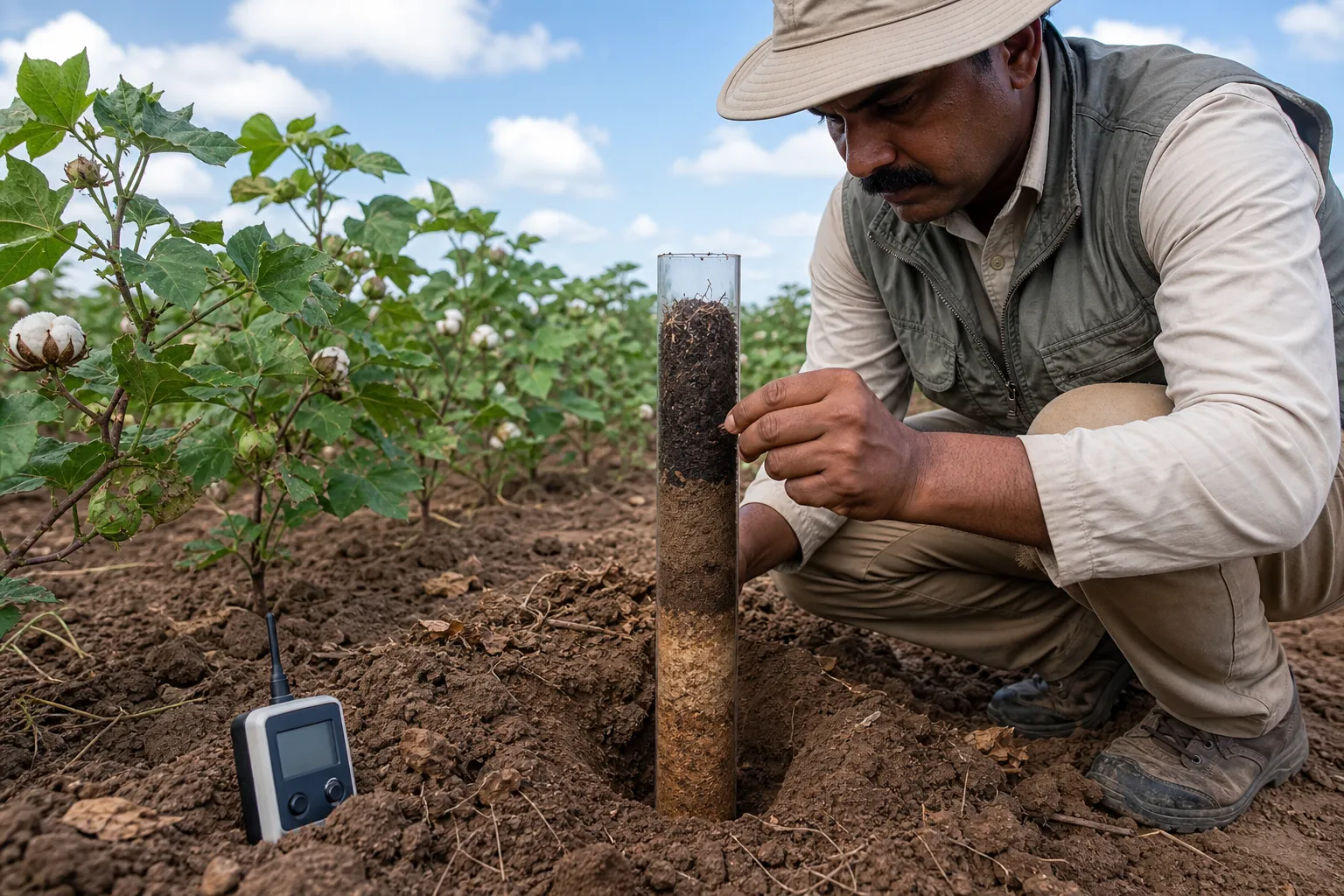
BCarbon, developed by the Baker Institute at Rice University, is a soil carbon-specific standard that uses a rigorous sampling protocol designed to reduce measurement uncertainty without requiring the full project development infrastructure of Verra or Gold Standard.
BCarbon's methodology requires soil sampling to 1-meter depth, which captures a more complete picture of carbon storage than the 30-centimeter sampling common in other standards. The standard is currently being piloted in several Asian agricultural contexts and represents a promising pathway for Indian cotton programs where deep-rooted crops create significant subsoil carbon dynamics.
Regen Network: Open-Source and Blockchain-Verified
Regen Network operates an open-source methodology library and a blockchain-based credit registry that allows project developers to create and verify credits using community-developed methodologies. Several methodologies in the Regen library are directly applicable to Indian agriculture, including protocols for soil organic carbon improvement and agroforestry.
The blockchain verification layer provides an immutable audit trail that supports blockchain traceability requirements increasingly demanded by fashion brands. However, Regen credits currently have lower market liquidity than Verra or Gold Standard credits, and corporate buyers may require additional due diligence before accepting them for scope 3 accounting.
India-Specific Developments
India is developing its own carbon credit infrastructure. NABARD (National Bank for Agriculture and Rural Development) has published frameworks for agricultural carbon credit programs targeting smallholder farmers. The Indian Council of Agricultural Research (ICAR) is conducting multi-site soil organic carbon research that will underpin future domestic methodologies.
The Bureau of Indian Standards (BIS) is in the process of developing national carbon credit standards that could eventually provide a domestic alternative to international frameworks. Because these programs are actively evolving, program designers should check NABARD's and BIS's own published notices for the current state of each framework rather than treating any summary, including this one, as final.
These developments are significant for programs that want to align with India's domestic carbon market, which is expected to formalize under the Carbon Credit Trading Scheme (CCTS) announced by the Ministry of Environment, Forest and Climate Change. For a deeper look at how these policy developments connect to on-farm practice, see our analysis in How Regenerative Agriculture Aligns with Climate Policy.
MRV Innovations Enabling Emerging Frameworks
What makes emerging frameworks viable is a new generation of MRV technology. Satellite-based soil organic carbon estimation using hyperspectral imaging can now provide plot-level SOC estimates at a fraction of the cost of physical sampling. IoT soil sensors provide continuous moisture and temperature data that improves carbon model accuracy.
And machine learning models trained on Indian soil datasets are reducing the uncertainty margins that previously required large buffer pool deductions. These technologies are making it economically feasible to run protocol-compliant insetting programs on farms as small as one hectare.
Carbon Insetting Protocol Comparison: Side-by-Side Matrix
The table below summarizes the key dimensions of each framework for Indian agricultural contexts. Every figure in it is the same planning-range figure already discussed above in the body text; the table simply reorganizes those numbers for quick reference.
This carbon insetting protocol comparison matrix is designed as a starting point for program design decisions, not a definitive ranking — verify current costs and timelines with the standard body or a VVB before finalizing a budget, since fees and rules are periodically revised.
| Dimension | Verra VCS | Gold Standard | Emerging Soil Carbon Frameworks |
|---|---|---|---|
| MRV Cost (per project) | High (USD 50K, 150K+) | High, Very High (USD 70K, 200K+) | Low, Medium (USD 10K, 50K) |
| Credit Issuance Timeline | 18, 36 months | 24, 42 months | 12, 24 months |
| Smallholder Suitability | Moderate (grouped projects) | Good (community-based) | Excellent (designed for small scale) |
| Cotton Program Fit | Strong (VM0042) | Moderate | Emerging (BCarbon, Regen) |
| Rice/AWD Methane Fit | Strong (AMS-III.AU adapted) | Moderate | Limited (developing) |
| Biochar Acceptance | Yes (VM0044) | Limited (case-by-case) | Regen Network: Yes |
| Brand Recognition | Very High | High | Low, Moderate |
| SDG Co-Benefits | Optional | Required (3+ SDGs) | Optional (framework-dependent) |
| Scope 3 Acceptance | Widely accepted | Widely accepted | Buyer-dependent |
| Domestic India Market Fit | Moderate | Moderate | High (NABARD-aligned) |
This carbon insetting protocol comparison matrix reveals a clear pattern: established standards offer credibility and market access at higher cost and longer timelines. Emerging frameworks offer speed and smallholder fit at the cost of market recognition.
The optimal choice for most Indian programs is not a single standard but a phased approach, beginning with an emerging framework to generate early credits and farmer data, then transitioning to Verra VCS or Gold Standard as the program scales. For more on how carbon credits function within regenerative agriculture programs, see How Carbon Credits Transform Regenerative Agriculture.
Matching Protocol to Crop, Geography, and Corporate Climate Goals

The right protocol for a cotton program in Maharashtra is not necessarily the right protocol for a rice program in West Bengal. Crop type, agro-climatic zone, and the specific corporate climate goal being served all influence the optimal choice.
Cotton Farming: Maharashtra, Gujarat, and Telangana
India's major cotton-growing states sit on Vertisol (black cotton soil) and Alfisol soil types that have significant carbon sequestration potential when managed regeneratively. For cotton programs in these regions, Verra VM0042 is the most established pathway, covering reduced tillage, cover cropping, and improved nutrient management. The methodology's baseline requirements are manageable for programs that have been collecting farm data for two or more seasons.
For programs incorporating biochar applications, which Beetle Regen's programs do at scale, Verra's VM0044 (Biochar Utilization in Soil) provides a dedicated pathway. This methodology quantifies the carbon sequestered in biochar applied to agricultural soils and has been validated for tropical and subtropical contexts. The combination of VM0042 and VM0044 in a single project can significantly increase credit yield per hectare.
Rice and Paddy Farming: West Bengal, Odisha, and Bangladesh
Rice paddy farming is a significant source of methane emissions, contributing approximately 10 percent of global agricultural greenhouse gas emissions, a figure worth cross-checking against a current inventory report such as the IPCC's or FAO's agricultural emissions data if it will be cited to a buyer or auditor.
Alternative Wetting and Drying (AWD), a water management practice that involves controlled drying cycles during the growing season, can reduce methane emissions by 30 to 70 percent while maintaining yields; this range reflects variation across soil type, water availability, and drying schedule, so a specific project's expected reduction should be confirmed through its own monitoring data rather than assumed at either end of the range.
For AWD programs, Verra's adapted AMS-III.AU methodology provides the most credible pathway to verified emission reduction credits.
Gold Standard is also applicable to AWD programs and may be preferable for brands that want to document co-benefits such as water savings and farmer income improvements alongside methane reduction. The SDG narrative around water stewardship is particularly strong for AWD programs in water-stressed regions.
Aligning Protocol Choice with Corporate Net Zero Targets
Brands operating under Science Based Targets initiative (SBTi) commitments need to ensure that their insetting credits are recognized within SBTi's accounting framework. SBTi currently accepts Verra VCS and Gold Standard credits for beyond-value-chain mitigation claims, but has specific requirements for within-value-chain insetting that are still evolving. Brands should verify current SBTi guidance before committing to a protocol, particularly for scope 3 category 1 (purchased goods and services) claims.
For brands pursuing carbon neutral certification under PAS 2060 or ISO 14064, both Verra VCS and Gold Standard credits are recognized. Emerging framework credits may require additional documentation to satisfy auditors under these standards.
The intersection of protocol selection, ERP integration, and blockchain traceability is where Beetle Regen's Sustainability as a Service (SaaS) model adds particular value.
Rather than requiring brands to build internal expertise across all three domains, Beetle Regen provides an integrated program design service that matches protocol to context, builds the MRV data infrastructure, and connects farm-level data to brand-level sustainability reporting. For brands navigating this complexity, Supply Chain Transformation Through Regenerative Agriculture Consulting provides a useful overview of how this works in practice.
Practical Steps to Launch a Protocol-Compliant Insetting Program in India

Understanding the protocols is necessary but not sufficient. The checklist below translates protocol knowledge into program action, step by step.
- Define the corporate climate goal and credit use case. Are the credits for internal scope 3 accounting, a carbon neutral product claim, a net zero target contribution, or sale on the voluntary market? Each use case has different protocol requirements and buyer expectations, and this clarity determines whether insetting or offsetting is the appropriate mechanism.
- Conduct baseline soil testing and farmer eligibility assessment. All three frameworks require baseline soil testing before project registration, using a stratified sampling design across the project area. Simultaneously assess farmer eligibility: land tenure documentation, willingness to participate, existing practice data, and capacity to maintain monitoring records.
- Select methodology and engage a Validation and Verification Body (VVB). With baseline data in hand, select the specific methodology within the chosen standard. Engage an accredited VVB early — VVBs with South Asian agricultural experience include SCS Global Services, Bureau Veritas, and DNV.
- Design the MRV system. Build farmer registration systems, GPS plot mapping, soil sampling protocols, practice change documentation, and data aggregation platforms before the monitoring period begins. Validate any remote sensing or IoT sensor technology against physical sampling during the first season.
- Register the project and begin the monitoring period. Submit the Project Design Document (PDD) to the registry. For Verra and Gold Standard, this triggers the public comment period and validation process. Maintain rigorous records throughout — gaps in monitoring data are the most common cause of credit issuance delays.
- First verification and credit issuance. Submit monitoring reports to the VVB at the end of the first monitoring period. The VVB conducts a site visit, reviews documentation, and issues a verification report; upon registry approval, credits are issued to the project account.
For guidance on soil testing methodology referenced in step 2, see Soil Degradation: How Regenerative Farming Reverses Damage.
Common pitfall: Additionality challenges are the most frequent cause of project rejection. Ensure that the practices being credited are genuinely additional: not already required by law, not already common practice in the region, and not already incentivized by other programs. A thorough additionality assessment during project design is far less costly than a failed validation.
Frequently Asked Questions on Carbon Insetting Protocol Comparison
Can a single project be dual-certified under Verra VCS and Gold Standard?
Yes. Verra VCS and Gold Standard have a formal co-certification pathway that allows projects to be registered under both standards simultaneously. This is common for projects that want the market liquidity of Verra credits and the premium pricing of Gold Standard co-benefits.
The additional cost is approximately 20 to 30 percent above a single-standard project, a range worth reconfirming with your VVB since it depends on project size and complexity. The combined credit value often justifies the investment for programs with strong SDG co-benefit stories.
What is the minimum farm size for Verra VCS AFOLU projects in India?
Verra does not specify a minimum individual farm size. However, the grouped project approach, which allows multiple small farms to be aggregated under a single project boundary, requires a minimum total project area that makes the economics viable. In practice, most Indian programs require at least 500 aggregated hectares to cover project development costs. Emerging frameworks like BCarbon and Regen Network have lower minimum area requirements.
How does AWD rice methodology fit into existing protocol frameworks?
AWD is best served by Verra's adapted AMS-III.AU methodology, which quantifies methane emission reductions from water management changes in rice cultivation. The methodology requires water level monitoring data (typically using simple perforated tubes installed in fields) and yield data to confirm that production is maintained.
Gold Standard also accepts AWD projects but requires additional co-benefit documentation. For a detailed field guide to AWD implementation, the principles covered in Beetle Regen's Alternative Wetting and Drying programs provide a practical foundation.
Are biochar credits accepted under Verra VCS or Gold Standard?
Verra VCS accepts biochar credits under methodology VM0044, which was finalized in 2023 and covers biochar produced from biomass feedstocks and applied to agricultural soils. Gold Standard accepts biochar on a case-by-case basis pending a dedicated methodology, which is currently under development.
Regen Network has community-developed biochar methodologies that are applicable for programs where market recognition requirements are flexible. For a comprehensive look at biochar's role in supply chain insetting, see Carbon Sequestration in Agriculture: A Complete Framework.
How long does it take to receive first carbon credits under each protocol?
Under Verra VCS, the typical timeline from project initiation to first credit issuance is 18 to 36 months. Gold Standard typically takes 24 to 42 months due to the additional co-benefit verification layer.
Emerging frameworks like BCarbon and Regen Network can issue credits in 12 to 24 months. These timelines assume that baseline data collection begins before formal project registration; programs that start baseline data collection after registration will add 6 to 12 months to these estimates.
What role does blockchain traceability play in MRV for insetting programs?
Blockchain traceability does not replace the physical and laboratory components of MRV, but it provides an immutable audit trail for the data that feeds into carbon calculations. For insetting programs where brands need to demonstrate to auditors that farm-level data has not been altered between collection and reporting, blockchain-anchored data records provide a significant credibility advantage.
Regen Network's registry is built on blockchain infrastructure, and several Verra-registered projects are using blockchain data anchoring as a supplementary verification layer. For more on how digital infrastructure supports these programs, see API Integration for Carbon Credit Platforms: A Complete Guide.
Making the Right Protocol Choice for Your Program
The carbon insetting protocol comparison presented here points to a clear conclusion: there is no universally optimal standard for Indian agriculture. Verra VCS offers the deepest methodology library and the strongest market recognition, making it the right choice for programs that need to satisfy sophisticated corporate buyers and scope 3 auditors.
Gold Standard offers a premium narrative and SDG co-benefit documentation that resonates with fashion brands communicating to consumers and investors. Emerging soil carbon frameworks offer speed, cost efficiency, and smallholder fit that established standards cannot yet match.
The most effective programs in India are increasingly using a portfolio approach: piloting with emerging frameworks to generate early data and farmer trust, then transitioning to Verra or Gold Standard as the program scales and the economics improve. This approach also allows programs to capture the domestic carbon market opportunity under India's evolving CCTS framework while maintaining access to international voluntary markets.
For brands and consultants ready to move from protocol analysis to program design, the complexity of this landscape is exactly why specialist implementation support matters. Beetle Regen's team works directly with cotton and rice farming communities across India and Bangladesh, combining on-the-ground MRV expertise with the protocol knowledge needed to generate credits that brands can use with confidence.
If you are designing an insetting program and want to match the right standard to your crop, geography, and corporate climate goals, connect with the Beetle Regen team to discuss a protocol assessment for your supply chain.