
Carbon Insetting Solutions: Decarbonize Your Textile Supply Chain
Here is a question worth sitting with: if your brand's carbon footprint were a pie chart, how much of it would you actually control? For most textile and fashion brands, the honest answer is uncomfortable. Scope 1 and Scope 2 emissions — your factories, offices, and direct energy use — typically account for less than 10% of total emissions. The remaining 90% or more lives in Scope 3: the farms, the spinning mills, the dyehouses, and the logistics networks that make up your supply chain.
That is precisely why carbon insetting solutions have moved from a niche sustainability concept to a strategic imperative for brands serious about decarbonization. Unlike purchasing offsets from a rainforest project on the other side of the world, insetting embeds emissions reductions directly inside your own supply chain — at the farms where your cotton grows, in the soil your suppliers depend on, and among the farming communities your sourcing decisions affect every season.
This guide walks textile and fashion brands through a practical, step-by-step framework for designing and implementing carbon insetting solutions, from mapping your Scope 3 hotspots to verifying outcomes and scaling what works.

What Makes Carbon Insetting Solutions Different from Offsetting
The distinction matters more than most sustainability teams realize. Carbon offsetting involves purchasing credits generated by emissions reductions or removals that happen entirely outside your value chain, a wind farm in Kenya, a methane capture project in Brazil. The carbon math may balance on paper, but the climate benefit has no structural connection to your business operations.
Carbon insetting, by contrast, generates verified emissions reductions or removals within your own supply chain. A textile brand that funds regenerative cotton farming practices in Gujarat, or biochar application on farms in Madhya Pradesh that supply its cotton, is not buying its way out of a problem. It is investing in the transformation of the system it depends on.
This distinction is becoming commercially significant. The Science Based Targets initiative (SBTi) and the GHG Protocol both emphasize that Scope 3 reductions must come from actual supply chain interventions, not offset purchases, for brands to credibly claim progress against science-aligned targets. Investors and regulators are reading the same guidance. The result is growing pressure on brands to show that their decarbonization strategy reaches into the supply chain, not just the balance sheet.
Carbon insetting solutions also create co-benefits that offsetting cannot: improved soil health, better farmer incomes, stronger supply chain resilience, and traceable sustainability claims that hold up to third-party scrutiny. For brands building long-term sourcing relationships in India and Bangladesh, these co-benefits are not peripheral, they are the foundation of a supply chain that will still be productive in 2035.
"Insetting is not a climate accounting trick. It is a supply chain investment strategy that happens to generate verified carbon outcomes."
To understand the full landscape of emissions reduction options available to your brand, the Modern ESG Dictionary provides a clear breakdown of the terminology that underpins these decisions.
1. Map Your Scope 3 Hotspots Before You Design Anything
Effective carbon insetting solutions begin with a clear picture of where emissions actually occur in your supply chain. Without this baseline, brands risk investing in interventions that address a small fraction of their footprint while the largest sources remain untouched.
Why Scope 3 Category 1 Is the Priority
For textile brands, Scope 3 Category 1 (purchased goods and services) is almost always the dominant emissions source. This category covers the upstream production of raw materials, cotton farming, synthetic fiber production, and the energy used in spinning and weaving. Agricultural production alone can account for 15, 30% of a garment's total lifecycle emissions, depending on the fiber type and farming system.
Cotton farming, in particular, carries a significant emissions burden from synthetic fertilizer use (which generates nitrous oxide, a potent greenhouse gas), tillage practices that release stored soil carbon, and water management decisions. These are precisely the farm-level activities that regenerative agriculture practices can address, and that carbon insetting solutions can turn into verified reductions.
Building Your Supply Chain Carbon Baseline
A credible insetting program starts with a supply chain carbon footprint assessment. This involves:
- Tier 1 and Tier 2 supplier mapping: Identifying which farms, ginning facilities, and spinning mills supply your raw materials, and in which geographies.
- Activity data collection: Gathering data on fertilizer application rates, tillage practices, irrigation methods, and energy sources at the farm level.
- Emissions factor application: Using recognized emissions factors (IPCC, national inventory data) to convert activity data into CO₂-equivalent figures.
- Hotspot identification: Ranking supply chain nodes by emissions intensity to prioritize where insetting interventions will deliver the greatest impact per rupee invested.
For brands sourcing cotton from India or Bangladesh, this baseline work often reveals that a relatively small number of farming districts account for a disproportionate share of supply chain emissions. That concentration is actually an advantage: it means targeted insetting programs can move the needle on your overall Scope 3 footprint without requiring simultaneous intervention across hundreds of suppliers.
For a deeper look at how to connect this data across your supply chain systems, the guide on integrating regenerative agriculture data across supply chains covers the technical architecture in detail.
2. Select Verified Insetting Methodologies That Match Your Supply Chain
Not all carbon insetting methodologies are created equal, and not all of them are appropriate for every supply chain context. Selecting the right methodology is one of the most consequential decisions in designing a credible insetting program.
The Main Methodology Categories for Textile Supply Chains
Soil organic carbon (SOC) sequestration is the most widely applicable methodology for cotton-growing regions. Regenerative practices, cover cropping, reduced tillage, compost application, and crop rotation, increase the amount of carbon stored in agricultural soils. This approach is well-suited to cotton farming in India's major growing states (Gujarat, Maharashtra, Telangana, Madhya Pradesh) and can be measured through periodic soil sampling and laboratory analysis.
To understand the science and measurement frameworks behind this approach, the carbon sequestration in agriculture framework provides a comprehensive reference.
Biochar production and application offers a complementary and increasingly important insetting pathway. Biochar, a stable form of carbon produced by heating agricultural waste (crop residues, husks) in low-oxygen conditions, can be incorporated into farm soils where it sequesters carbon for hundreds to thousands of years. Its durability makes it particularly attractive for brands seeking high-permanence carbon removals. Biochar also improves soil water retention and nutrient availability, which supports yield stability, a critical co-benefit for farmer adoption.
Alternative Wetting and Drying (AWD) is the primary insetting methodology for rice-growing supply chains, particularly relevant for brands sourcing from Bangladesh or eastern India. Conventional paddy farming keeps fields continuously flooded, producing significant methane emissions. AWD involves controlled drainage cycles that reduce methane output by 30, 70% without reducing yields. For brands with rice or blended fiber supply chains, AWD represents a high-impact, low-cost insetting opportunity.
Agroforestry integration, planting trees within or around agricultural fields, can generate additional carbon sequestration while providing shade, biodiversity benefits, and supplementary income for farmers. This methodology is particularly relevant for smallholder cotton farming systems in India where field boundaries and degraded land offer integration opportunities.
Matching Methodology to Protocol Requirements
Each methodology must be implemented under a recognized verification standard to generate credible insetting outcomes. The main options for textile supply chain programs include:
- Verra's Verified Carbon Standard (VCS): The most widely recognized standard globally, with approved methodologies for soil carbon, biochar, and AWD. VCS credits (Verified Carbon Units) are accepted by most corporate buyers and registries.
- Gold Standard for the Global Goals: Particularly strong on co-benefit documentation (SDG alignment), making it well-suited for brands that need to demonstrate social and environmental outcomes alongside carbon reductions.
- Soil Carbon Initiative methodologies: Emerging frameworks specifically designed for agricultural soil carbon, with streamlined MRV requirements for smallholder contexts.
The choice of protocol affects everything from measurement frequency to verification costs to the market value of resulting credits. Brands should align protocol selection with their reporting requirements, timeline, and the specific farming systems in their supply chain.
3. Partner with On-Ground Programs Built for Textile Supply Chains
Designing a methodology is one thing. Implementing it across hundreds or thousands of smallholder farms in rural India or Bangladesh is another challenge entirely. This is where the quality of your on-ground program partner becomes the decisive factor in whether your insetting program delivers real outcomes or remains a well-intentioned pilot that never scales.

What to Look for in an Insetting Program Partner
The most effective insetting program partners share several characteristics that distinguish them from generic carbon project developers:
- Existing farmer relationships and trust: Adoption of new farming practices depends on trust built over seasons, not a single training workshop. Partners with established farmer networks in your sourcing regions can achieve adoption rates that new entrants cannot.
- Textile supply chain fluency: An insetting partner that understands the commercial realities of textile sourcing, lead times, quality specifications, traceability requirements, can design programs that align with your procurement calendar, not just the carbon project timeline.
- Integrated MRV capability: Measurement, Reporting, and Verification (MRV) is the backbone of any credible insetting program. Partners should have established protocols for soil sampling, yield monitoring, and digital data collection at the farm level.
- Farmer-first program design: Programs that impose practices on farmers without building genuine understanding and economic incentive consistently underperform. Look for partners whose training methodology builds farmer agency and knowledge, not just compliance.
Regenerative Cotton Programs: How They Work in Practice
A well-designed regenerative cotton insetting program typically operates across three interconnected tracks:
Agronomic transformation: Farmers receive structured training in regenerative practices, cover cropping, composting, reduced synthetic input use, and soil health monitoring. This is not a one-time workshop; effective programs involve seasonal field demonstrations, peer learning groups, and ongoing technical support. The result is measurable improvement in soil organic matter, reduced input costs, and in many cases, improved yields. For evidence on the yield dimension, the analysis of how regenerative agriculture increases crop yield is directly relevant.
Carbon measurement and verification: Baseline soil samples are taken before the program begins. Subsequent sampling at defined intervals (typically annually) measures changes in soil organic carbon. This data feeds into the chosen verification protocol, generating verified carbon outcomes that can be attributed to the brand's supply chain.
Supply chain linkage: The regenerative cotton produced by program farmers is traced from farm to brand through a traceability system, ensuring that the brand's sourcing claims are backed by verifiable data. This linkage is what transforms a carbon project into a genuine insetting program, the emissions reductions are tied to the specific cotton the brand is purchasing.
Biochar as a Complementary Insetting Tool
Biochar production programs add a high-permanence carbon removal layer to regenerative cotton insetting. Agricultural residues from cotton farming, stalks, husks, and other biomass, are converted into biochar through pyrolysis and applied back to the same fields. This creates a closed-loop system where farm waste becomes a soil amendment and a verified carbon removal, simultaneously improving soil health and generating durable insetting credits.
Beetle Regen's biochar-based carbon insetting programs are designed specifically for this integration, connecting biochar production infrastructure with existing regenerative cotton programs to maximize both agronomic and carbon outcomes for partnering brands.
4. Integrate Insetting Data into Your Carbon Accounting Framework
Generating verified insetting outcomes is only half the work. Those outcomes need to flow into your brand's carbon accounting framework in a way that is auditable, GHG Protocol-aligned, and defensible to external scrutiny. This integration step is where many early-stage insetting programs stumble.
Connecting Field-Level MRV to Brand-Level Reporting
The data journey from a soil sample in a Gujarat cotton field to a line item in your Scope 3 emissions report involves several translation steps:
- Field data collection: Soil samples, yield records, input use logs, and practice adoption data are collected at the farm level, typically through a combination of field officer visits and digital data entry tools.
- Aggregation and quality control: Farm-level data is aggregated to the program level, with quality checks to identify outliers, missing data, and inconsistencies before verification.
- Third-party verification: An accredited verification body reviews the aggregated data against the chosen methodology's requirements, issuing a verification statement that confirms the quantity of emissions reductions or removals achieved.
- Credit issuance and registry recording: Verified carbon units are issued and recorded on a recognized registry (Verra, Gold Standard), creating a permanent, publicly auditable record.
- Brand-level accounting: The verified reductions are attributed to the brand's Scope 3 inventory, with documentation of the insetting methodology, verification body, and registry record number.
For brands that have already invested in supply chain traceability infrastructure, this data integration is significantly more straightforward. The supply chain traceability guide for regenerative cotton explains how traceability systems can be designed to support both sourcing claims and carbon accounting simultaneously.
Avoiding Double-Counting and Ensuring Additionality
Two technical requirements deserve particular attention in the accounting integration step. Additionality requires that the emissions reductions achieved would not have occurred without the insetting program's intervention, in other words, the program must be driving genuine change, not simply documenting business-as-usual practices. Double-counting prevention ensures that the same tonne of CO₂ reduction is not claimed by both the brand and the farmer (or another buyer) simultaneously.
Both requirements are addressed through proper registry management and clear contractual agreements with program partners that specify who holds the rights to claim the verified reductions. Brands should ensure these terms are explicit in any insetting program partnership agreement before the program begins.
5. Verify, Monetize, and Communicate Your Insetting Outcomes
Once your insetting program has generated verified outcomes, you face a strategic decision: retire the credits against your own net zero targets, sell them on the voluntary carbon market, or do both. The right answer depends on your decarbonization timeline, your reporting commitments, and your commercial priorities.
Third-Party Verification: What to Expect
Verification is not a one-time event. Most insetting programs operate on annual or biennial verification cycles, with each cycle producing a verification report that confirms the emissions reductions achieved in that period. The verification process typically involves:
- Document review of MRV data, methodology compliance records, and farmer participation data
- Field visits to a sample of participating farms to validate data accuracy
- Issuance of a verification statement and credit issuance on the relevant registry
First-time verification for a new program typically takes 6, 12 months from program launch, depending on the methodology and verification body. Brands should factor this timeline into their reporting commitments and avoid making public claims about insetting outcomes before verification is complete.
Communicating Insetting Outcomes Without Greenwashing Risk
Verified insetting outcomes give brands a strong foundation for credible climate communication, but the language used matters enormously. The key principles for defensible communication are:
- Always reference the verification standard and body (e.g., "verified under Verra's VCS standard by [verification body]")
- Distinguish clearly between emissions reductions (avoided emissions) and carbon removals (sequestration)
- Avoid claiming "carbon neutral" status based solely on insetting unless residual emissions have also been addressed
- Link insetting outcomes to specific supply chain improvements, not just aggregate carbon numbers
For brands navigating the intersection of insetting, ESG reporting, and investor communication, the fashion brand net zero roadmap provides a structured framework for connecting insetting outcomes to verified climate targets.
6. Build a Long-Term Insetting Program That Scales
A pilot program covering 500 farmers in one district is a proof of concept. A program covering 10,000 farmers across multiple states, integrated into your core sourcing strategy, is a climate asset. The gap between the two is not just a question of budget, it is a question of program design, stakeholder alignment, and institutional commitment.
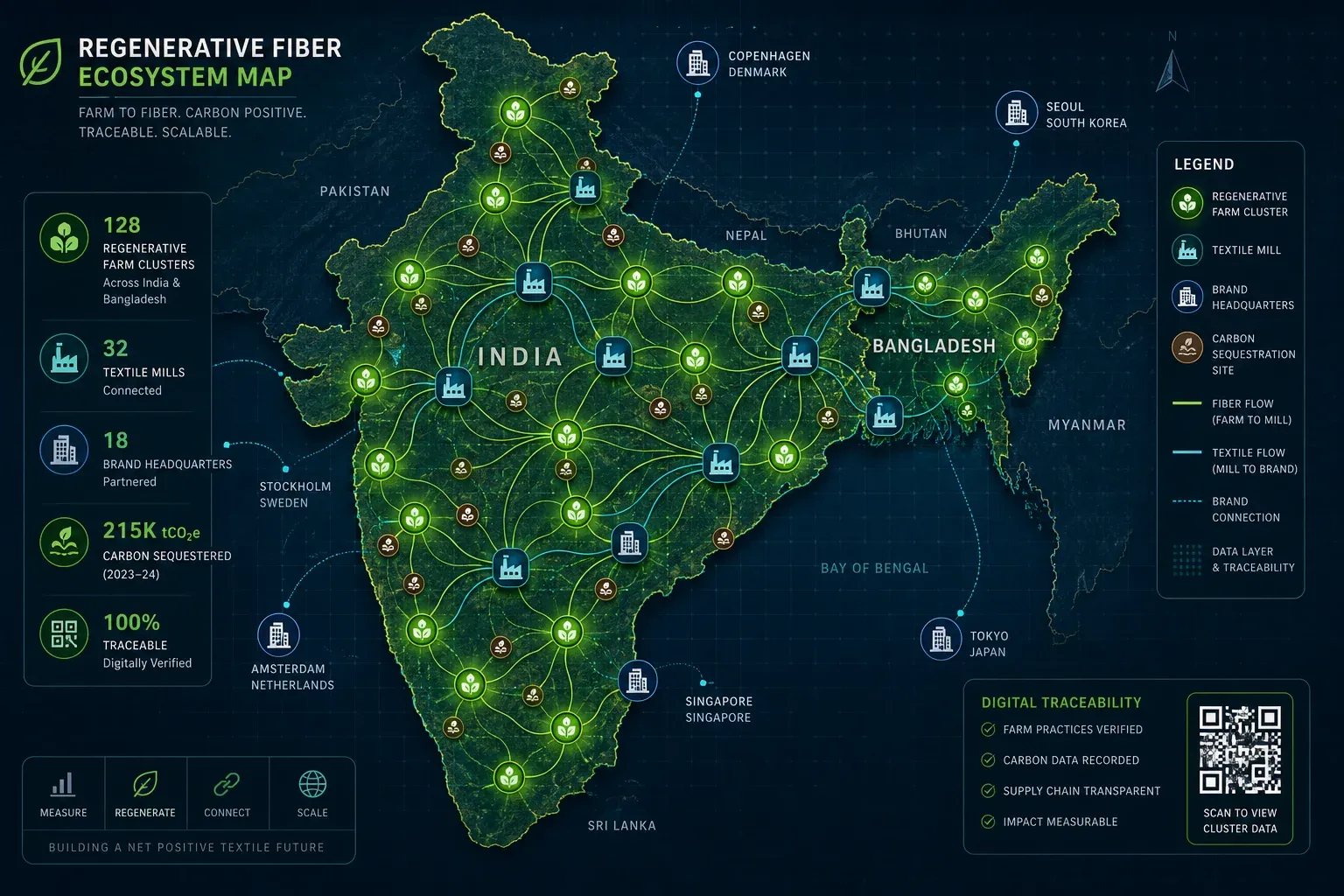
From Pilot to Program: The Scaling Pathway
Successful scaling of carbon insetting solutions follows a recognizable pattern. Pilot programs establish the agronomic model, the MRV protocol, and the farmer engagement approach in a defined geography. Lessons from the pilot, what practices farmers adopt most readily, which data collection methods work in low-connectivity environments, how long it takes to see measurable soil carbon changes, inform the design of the scaled program.
Scaling then proceeds through geographic expansion (adding new districts or states), farmer network deepening (increasing adoption rates within existing geographies), and methodology diversification (adding biochar or AWD to a soil carbon program). Each expansion phase should be supported by a verification cycle that confirms the program is delivering outcomes at scale, not just on paper.
Stakeholder Engagement as a Scaling Enabler
Scaling insetting programs requires active engagement with multiple stakeholder groups simultaneously. Farmers and cooperatives need ongoing technical support and clear economic incentives. State agricultural departments and NGOs can provide complementary resources and legitimacy. Brands need regular progress reporting and clear linkage between insetting outcomes and their sourcing volumes. Financial institutions and carbon buyers may provide additional revenue streams that improve program economics.
Managing this stakeholder ecosystem is a significant program management challenge, one that is substantially easier when your insetting program partner has existing relationships across these groups. For a deeper look at how stakeholder engagement drives regenerative agriculture outcomes, the complete guide to regenerative agriculture covers the collaborative dimensions of program design.
Sustainability as a Service: Embedding Insetting into Your Operating Model
For brands that want to move beyond project-by-project insetting and build a systematic decarbonization capability, a Sustainability as a Service (SaaS) model offers a more integrated approach. Rather than managing insetting programs as standalone projects, brands access a continuous service that combines carbon footprinting, insetting program management, MRV data integration, verification support, and ESG reporting, all calibrated to the brand's specific supply chain and reporting requirements.
This model is particularly valuable for mid-size brands that lack the internal sustainability team capacity to manage complex insetting programs independently, but whose supply chain footprint is large enough to justify a structured, ongoing decarbonization program. Beetle Regen's Sustainability as a Service offering is designed precisely for this context, providing brands with the technical depth and on-ground presence needed to run credible insetting programs without building that capability from scratch internally.
Soil health is the foundation of every insetting program's long-term performance. Understanding how regenerative farming reverses soil degradation, and what that means for carbon permanence, is essential context for any brand designing a multi-year insetting strategy. The analysis of how regenerative farming reverses soil degradation provides that scientific grounding.
Frequently Asked Questions About Carbon Insetting Solutions
How long does it take to generate verified carbon credits through insetting?
The timeline from program launch to first verified credit issuance is typically 12, 24 months. This includes the baseline assessment period (3, 6 months), the first practice implementation season (6, 12 months), and the verification process (3, 6 months). Biochar programs can sometimes move faster because the carbon removal is more immediately measurable than soil organic carbon changes, which require multiple seasons to detect reliably.
Can small and mid-size textile brands implement insetting programs?
Yes, though the approach differs from large-brand programs. Smaller brands often benefit from joining aggregated insetting programs where multiple brands share the cost of MRV infrastructure and verification, while each brand receives a proportional allocation of verified outcomes linked to their sourcing volumes. This model makes insetting economically viable at sourcing scales that would not justify a standalone program.
What is the difference between insetting and inset credits?
Insetting refers to the broader strategy of generating emissions reductions within your own supply chain. Inset credits are the verified carbon units generated by that strategy, recorded on a registry and attributable to specific supply chain activities. Not all insetting programs generate tradeable credits, some brands choose to use the verified reductions solely for internal accounting purposes without issuing registry credits.
How does insetting support Net Zero commitments under SBTi?
The Science Based Targets initiative requires brands to demonstrate absolute Scope 3 emissions reductions of at least 90% by their target year, with residual emissions addressed through high-quality carbon removals. Insetting directly supports the 90% reduction requirement by generating verified Scope 3 reductions within the supply chain. It is important to note that SBTi does not currently allow insetting credits to substitute for the required absolute reductions, they must represent genuine supply chain transformation, not accounting adjustments. This is precisely why program design quality matters so much.
How does soil testing fit into an insetting program?
Soil testing is the empirical backbone of any soil carbon insetting program. Baseline soil samples establish the starting point for carbon measurement, and subsequent samples track changes over time. The frequency, depth, and laboratory analysis methods used in soil testing directly affect the accuracy and credibility of carbon quantification. Brands should ensure their insetting program partner uses standardized soil testing protocols aligned with their chosen verification methodology.
Turn Your Supply Chain into a Verified Climate Asset
Carbon insetting solutions represent one of the most strategically sound investments a textile brand can make in 2026. They address the largest share of your emissions footprint, generate co-benefits that strengthen your supply chain, and produce verified outcomes that hold up to the scrutiny of investors, regulators, and consumers. The brands that move now, building insetting programs into their core sourcing strategy rather than treating them as peripheral sustainability projects, will be the ones with credible, auditable decarbonization stories to tell when reporting requirements tighten further in the years ahead.
Beetle Regen works with textile brands, retailers, and supply chain manufacturers to design and implement carbon insetting solutions that are grounded in real farm-level change, verified by recognized standards, and integrated into your existing sourcing and reporting workflows. If you are ready to move from Scope 3 ambition to verified supply chain action, connect with the Beetle Regen team to explore what an insetting program built around your specific supply chain could look like.