
Climate Action Carbon Credits: India Market Trends 2026
Carbon credit prices in India's voluntary market have swung by more than 40% within a single quarter in recent years — and yet demand from both buyers and project developers has never been stronger. That contradiction tells you something important about where this market actually stands.
India is not a passive participant in global carbon markets. It is one of the largest potential suppliers of nature-based and agriculture-linked carbon credits on the planet. With over 140 million farming households, a national carbon trading framework now taking shape, and textile brands under mounting Scope 3 pressure, the conditions for a significant market expansion are in place. What is missing, in many cases, is the infrastructure to connect supply with demand in a credible, verifiable way.
This post maps the key trends shaping climate action carbon credits in India in 2026 — from regulatory developments and agriculture credit opportunities to the specific challenges that still need solving. Whether you are a brand sustainability lead, a policy professional, or an agricultural cooperative exploring carbon income, this is the landscape you are operating in.

India's Carbon Credit Market at a Glance
India's carbon market has two distinct layers in 2026. The first is the voluntary carbon market (VCM), where project developers generate credits under international standards like Verra's Verified Carbon Standard (VCS) or Gold Standard, and sell them to corporate buyers seeking to offset or inset emissions. The second is the emerging compliance market, anchored by the Carbon Credit Trading Scheme (CCTS) introduced under the Energy Conservation (Amendment) Act 2022.
The voluntary market has been active for over a decade. India has historically been one of the top three countries globally for registered CDM (Clean Development Mechanism) projects, and that project development expertise has carried over into the VCM era. As of 2026, India hosts hundreds of active VCM projects spanning renewable energy, cookstoves, forestry, and increasingly, agriculture and soil carbon.
The compliance market is newer and still being operationalized. The Bureau of Energy Efficiency (BEE) is the designated administrator, and the framework targets energy-intensive industries first — cement, steel, aluminium, and textiles among them. For agriculture-linked credits, the pathway into the compliance market is less direct, but the policy signal is clear: India intends to build a functioning domestic carbon price.
What makes 2026 a pivotal year is the convergence of three forces: the CCTS framework moving from design to early implementation, India's updated Nationally Determined Contributions (NDCs) requiring measurable sectoral action, and a wave of international textile brands publicly committing to supply-chain decarbonization with verifiable credit purchases. The market is no longer theoretical. It is operational, and the gaps are becoming visible.
5 Carbon Credit Market Trends Shaping India in 2026
Trend 1: Domestic Carbon Market Regulation Is Moving from Paper to Practice
The CCTS framework has been in development since 2022, but 2026 marks the year where early compliance obligations begin to crystallize for designated sectors. The Ministry of Power and BEE have been working through the technical architecture, setting baselines, defining eligible project types, and establishing the registry infrastructure. For project developers and brands watching this space, the key implication is that domestic carbon credit prices will increasingly be influenced by compliance demand, not just voluntary buyer preferences.
This matters for agriculture-linked credits because the CCTS, in its current design, focuses primarily on industrial emitters. Agricultural projects will likely remain in the voluntary market for the near term. But the existence of a domestic compliance floor creates upward price pressure across the broader market, which benefits all credit types.
Trend 2: Agriculture and Land-Use Credits Are Gaining Institutional Credibility
Soil carbon and agriculture-linked credits have historically faced skepticism from institutional buyers due to concerns about permanence, additionality, and measurement accuracy. That skepticism is softening in 2026, driven by three developments: improved MRV technology (including remote sensing and soil sampling protocols), the emergence of credible aggregation platforms that can pool smallholder credits at scale, and growing buyer sophistication about the difference between high-quality and low-quality credits.
India's agricultural sector, particularly cotton, rice, and pulses, is well-positioned to supply these credits. Practices like regenerative agriculture, cover cropping, reduced tillage, and biochar application all generate measurable carbon benefits that can be verified under established methodologies.
Trend 3: Textile and Fashion Brands Are Driving Demand for Supply-Chain-Linked Credits
The fashion industry's Scope 3 problem is well-documented. For most apparel brands, between 70% and 90% of total emissions sit in the supply chain, in raw material production, fiber processing, and manufacturing. Regulatory pressure from the EU's Corporate Sustainability Reporting Directive (CSRD) and India's own BRSR (Business Responsibility and Sustainability Reporting) framework is forcing brands to quantify and address these emissions with specificity.
The result is a surge in demand for supply-chain-linked carbon credits, credits generated within a brand's own value chain rather than purchased from unrelated projects. This is the logic behind carbon insetting, and it is reshaping how brands think about climate action carbon credits. A credit generated on the cotton farm that supplies your yarn carries far more ESG credibility than an equivalent credit from a wind farm in a different country.
Trend 4: Biochar Credits Are Entering Mainstream Verification Pipelines
Biochar-based carbon removal has moved from niche to mainstream in 2026. Verra's methodology for biochar carbon removal (BCR) is now widely used, and Gold Standard has also developed pathways for biochar project registration. In India, where agricultural residue burning is both a significant emission source and a wasted resource, biochar production offers a dual benefit: it converts crop waste into a stable carbon sink while improving soil fertility.
For textile supply chains specifically, biochar produced from cotton gin trash or rice husk, both abundant in India's major agricultural belts, can generate high-durability carbon credits with co-benefits for soil health and crop yield. This makes biochar one of the most strategically valuable credit types for brands seeking both climate action and supply chain resilience. You can explore the mechanics in detail in our guide to carbon insetting solutions for textile supply chains.
Trend 5: Smallholder Aggregation Models Are Unlocking Rural Credit Supply
India's agricultural landscape is dominated by smallholder farmers, the average farm size is under 1.5 hectares. Individual smallholders cannot access carbon markets on their own; the transaction costs of MRV, registration, and credit issuance far exceed the revenue a single farm would generate. Aggregation models, where cooperatives, NGOs, or program developers pool credits from hundreds or thousands of farmers, are the solution.
These models are maturing rapidly. Platforms and consultancies that can manage farmer onboarding, data collection, MRV compliance, and credit sale on behalf of aggregated farmer groups are seeing significant interest from both domestic and international buyers. The key challenge is ensuring that farmers receive a fair share of credit revenue, a design question that has significant implications for long-term program viability.
Agriculture Carbon Credits: The Opportunity for Indian Farmers

For India's farming communities, carbon credits represent something genuinely new: a revenue stream that rewards environmental stewardship rather than just yield volume. A farmer who adopts regenerative practices, reducing synthetic inputs, planting cover crops, applying biochar, or implementing water-efficient irrigation, is actively sequestering carbon and reducing emissions. Carbon markets, in theory, allow that farmer to be paid for that service.
In practice, the pathway from farm practice to credit revenue involves several steps, each with its own complexity.
How Agricultural Carbon Credits Are Generated
The process begins with baseline establishment, measuring the current carbon stock in the soil and the current emission profile of the farm. This requires soil sampling, farm-level data collection, and often remote sensing data to establish a credible starting point. From there, the farmer (or the aggregating program) implements a defined set of practices over a multi-year period. Annual or biennial soil sampling and activity data collection track the change in carbon stock. The net change, after accounting for any reversals or uncertainties, becomes the basis for credit issuance.
Verification by an accredited third-party auditor is required before credits can be issued under any major standard. This is where MRV infrastructure becomes critical. Programs that invest in robust MRV and traceability systems from the outset produce credits that command higher prices and face fewer buyer objections.
Income Potential and Realistic Expectations
Carbon credit prices in India's voluntary market vary significantly by credit type, vintage, and co-benefit profile. Agriculture and soil carbon credits with strong co-benefits, improved farmer livelihoods, biodiversity gains, water conservation, typically command a premium over commodity-grade credits. For smallholder farmers participating in well-designed aggregation programs, carbon income can meaningfully supplement farm revenue, though it is rarely transformative on its own without being paired with yield improvements and input cost reductions.
The more durable income story for farmers combines carbon credit revenue with the productivity gains that regenerative practices deliver. A farmer who reduces synthetic fertilizer costs, improves soil water retention, and increases yield through practices like regenerative agriculture methods is building a more resilient livelihood, with carbon income as an additional layer, not the sole justification.
Key Challenges: Additionality, Permanence, and Baseline Measurement
Three technical challenges remain significant for Indian agricultural carbon credits. Additionality requires demonstrating that the carbon sequestration would not have happened without the carbon credit incentive, a complex argument in regions where some regenerative practices are already being adopted for agronomic reasons. Permanence requires ensuring that sequestered carbon stays in the soil over the long term, which is complicated by drought, flooding, and land-use change risks. Baseline measurement in India is hampered by limited historical soil carbon data, making it difficult to establish credible starting points for many projects.
These are solvable problems, but they require investment in data infrastructure, farmer training, and program design expertise. Programs that cut corners on these elements produce credits that face buyer scrutiny and potential devaluation.
How Textile Brands Are Using Carbon Credits for Climate Action
The textile and fashion industry's relationship with carbon markets has evolved considerably. A few years ago, most brand carbon credit purchases were straightforward offsets, buying credits from renewable energy or forestry projects to balance reported emissions. That approach is increasingly seen as insufficient, both by regulators and by sophisticated investors.
The shift is toward supply-chain-integrated climate action. Brands are now expected to demonstrate that they are reducing emissions within their value chain, not just compensating for them elsewhere. This is where carbon insetting, generating credits within your own supply chain, becomes strategically important. For a cotton-sourcing brand, that means working with the farms that grow your fiber to implement regenerative practices, measure the carbon benefit, and generate credits that are directly linked to your supply chain.
Scope 3 Pressure Is the Primary Driver
Under the GHG Protocol's Scope 3 framework, agricultural raw material production falls under Category 1 (purchased goods and services). For most textile brands, this is the single largest emissions category. Addressing it requires either switching to lower-emission raw materials, working with suppliers to reduce emissions at source, or a combination of both.
Carbon credits generated within the supply chain, from regenerative cotton farms, biochar application, or water management improvements, directly address Scope 3 Category 1 emissions. This is a fundamentally different claim than purchasing offset credits from an unrelated project, and it is one that holds up better under CSRD and BRSR disclosure requirements. Our fashion brand net zero roadmap walks through how verified climate targets connect to supply-chain credit strategies.
Traceability Is the Foundation of Credible Carbon Claims
A carbon credit claim is only as strong as the data behind it. For brands making public commitments about supply-chain decarbonization, the ability to trace a credit back to a specific farm, a specific practice, and a specific verification event is essential. Without that traceability, carbon claims are vulnerable to greenwashing accusations, a risk that has real reputational and regulatory consequences.
This is why supply chain traceability and carbon credit programs need to be designed together, not bolted on separately. Brands that invest in supply chain traceability for regenerative cotton from the outset are building the data infrastructure that makes carbon claims defensible.
Policy Landscape: What India's Regulatory Push Means for Carbon Markets
India's policy environment for carbon markets has become significantly more active since 2022. Understanding the key regulatory developments helps both brands and project developers anticipate where the market is heading.
The Carbon Credit Trading Scheme (CCTS)
The CCTS, established under the Energy Conservation (Amendment) Act 2022, creates the legal framework for a domestic carbon market in India. The scheme designates certain energy-intensive sectors as obligated entities, sets emission intensity targets, and allows entities that outperform their targets to generate and sell carbon credit certificates. Entities that underperform must purchase credits to meet their obligations.
The BEE is developing the technical standards and registry infrastructure. The scheme is expected to cover sectors including aluminium, cement, chlor-alkali, fertilizers, iron and steel, oil refineries, petrochemicals, pulp and paper, and textiles. The inclusion of textiles is significant, it means that Indian textile manufacturers will face domestic carbon compliance obligations, creating additional demand for credits and additional incentive to reduce supply-chain emissions.
India's NDCs and Sectoral Carbon Targets
India's updated NDCs commit to reducing the emissions intensity of GDP by 45% by 2030 compared to 2005 levels, and to achieving about 50% of cumulative electric power installed capacity from non-fossil fuel sources by 2030. These targets create the macro-level demand signal for carbon markets. Sectors that cannot decarbonize fast enough through technology will need to purchase credits to meet their obligations, and agriculture-linked credits, with their co-benefits for rural livelihoods and food security, are well-positioned to attract policy support.
Article 6 and India's Bilateral Carbon Trade Potential
Article 6 of the Paris Agreement creates a framework for countries to trade carbon credits internationally, with appropriate adjustments to avoid double-counting. India has significant potential as a credit-exporting country under Article 6.2 bilateral agreements. Several countries, including Japan, Switzerland, and Singapore, have been actively pursuing bilateral carbon trading arrangements with developing nations. India's large project pipeline and established project development expertise make it an attractive partner.
For agriculture-linked credits specifically, Article 6 trade could open significant new revenue streams for Indian farming communities, provided the domestic regulatory framework develops the necessary infrastructure for credit registration, transfer, and corresponding adjustment.
Challenges Holding Back India's Carbon Credit Ecosystem
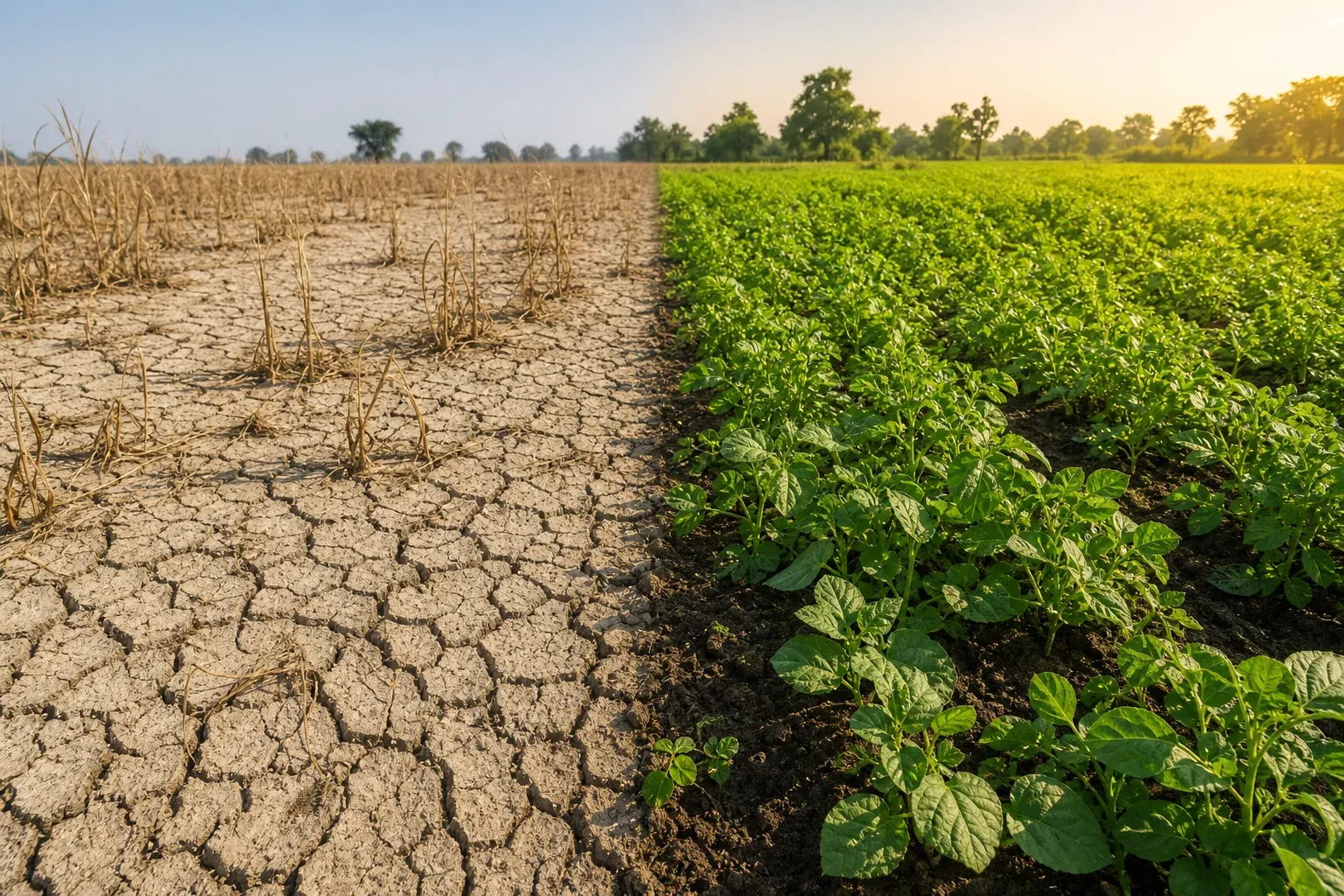
Despite the significant opportunity, India's carbon credit market faces real structural challenges. Acknowledging them honestly is important, both for setting realistic expectations and for identifying where investment and innovation are most needed.
Fragmented Land Ownership
With average farm sizes under 1.5 hectares and hundreds of millions of smallholder farmers, aggregating sufficient land area to make carbon project economics work is genuinely difficult. The transaction costs of farmer onboarding, data collection, and MRV compliance are largely fixed, they do not scale down proportionally with farm size. This means that programs serving smallholder farmers require either significant grant or concessional finance to cover upfront costs, or a sufficiently large aggregated pool to spread costs across.
MRV Infrastructure Gaps
Credible carbon credits require credible measurement. India's agricultural MRV infrastructure, soil testing laboratories, remote sensing data pipelines, farmer data collection systems, is improving but remains uneven. In many regions, the baseline soil carbon data needed to establish credible project starting points simply does not exist. Building this infrastructure takes time and investment, and it is not something individual project developers can do alone.
Greenwashing Risk and Verification Quality
As demand for carbon credits grows, so does the risk of low-quality credits entering the market. Credits that are not properly verified, that rely on inflated baselines, or that claim benefits that are not additional or permanent undermine buyer confidence in the entire market. India has seen some high-profile scrutiny of credit quality in recent years, and the reputational damage from a greenwashing scandal affects all market participants, not just the offending project.
Third-party verification by accredited auditors is non-negotiable for credits that will be used in brand ESG reporting. Programs that invest in rigorous verification from the outset are building a durable asset; programs that cut corners are building a liability.
Price Volatility and Farmer Income Predictability
Voluntary carbon market prices are volatile. A farmer or cooperative that enters a carbon program based on a projected credit price faces real income uncertainty if prices fall. This is a significant barrier to farmer participation, particularly for smallholders who cannot absorb income shocks. Program designs that offer price floors, advance payments, or long-term offtake agreements with corporate buyers help mitigate this risk, but they require buyers willing to make multi-year commitments, which is not always the case.
How Beetle Regen Bridges the Gap Between Farmers and Carbon Markets

The challenges described above are real, but they are not insurmountable. What they require is program design expertise, farmer relationships, and the ability to connect supply-side credit generation with demand-side brand commitments in a credible, traceable way. This is precisely where Beetle Regen's work sits.
End-to-End Carbon Program Design
Beetle Regen works with agricultural communities and textile brands to design carbon programs that are credible from the ground up. That means establishing robust baselines, selecting appropriate MRV methodologies, building farmer data collection systems, and connecting the resulting credits to brand supply chains in a way that satisfies ESG disclosure requirements. The program is not designed around credit volume maximization, it is designed around farmer benefit and credit quality, which are the foundations of long-term market credibility.
Biochar-Based Carbon Insetting
One of Beetle Regen's core offerings is biochar production and carbon insetting for textile supply chains. Biochar, produced from agricultural residues like cotton gin trash or rice husk, offers high-durability carbon removal with measurable soil health co-benefits. Unlike soil organic carbon, which can be lost through drought or tillage, biochar carbon is stable over centuries. This permanence makes biochar credits among the most credible available, and it makes them particularly valuable for brands making long-term net zero commitments.
The soil health benefits of biochar, improved water retention, enhanced microbial activity, reduced fertilizer requirements, also directly support the carbon sequestration goals that underpin the credit program, creating a virtuous cycle between farmer productivity and climate impact.
Farmer Capacity Building and Cooperative Aggregation
Beetle Regen's approach to farmer engagement is built on capacity building, not just compliance. Farmers who understand why they are adopting new practices, and who see tangible agronomic and income benefits, are far more likely to maintain those practices over the multi-year periods that carbon programs require. This is the difference between a program that generates credits for two years and then collapses, and one that builds durable change in farming communities.
The cooperative aggregation model allows individual smallholders to participate in carbon markets that would otherwise be inaccessible to them. By pooling credits across hundreds of farmers, the program achieves the scale needed to make MRV and verification economics work, while ensuring that individual farmers receive a meaningful share of credit revenue. This model is explored in depth in our analysis of how regenerative agriculture aligns with climate policy in India.
Connecting Brands to Verified Supply-Chain Credits
For textile and fashion brands, Beetle Regen provides the link between supply-chain carbon programs and ESG reporting requirements. Credits generated through Beetle Regen's programs are traceable to specific farms, specific practices, and specific verification events, giving brands the documentation they need to make credible climate action claims. This is not a commodity credit purchase; it is a supply-chain partnership that delivers both carbon impact and sourcing resilience.
Brands working with Beetle Regen can integrate carbon credit data with their broader sustainability reporting through the data integration frameworks that connect farm-level data to brand-level ESG disclosures.
Frequently Asked Questions: Carbon Credits and Climate Action in India
What is the current price of carbon credits in India?
Carbon credit prices in India's voluntary market vary significantly by credit type and quality. Renewable energy credits have historically traded at lower prices, while high-quality nature-based credits with strong co-benefits, including agriculture and soil carbon credits, command premiums. Compliance market prices under the CCTS framework are still being established. For current pricing relevant to your specific program or procurement needs, direct engagement with program developers or market intermediaries is recommended.
Can smallholder farmers in India sell carbon credits?
Yes, but not independently. Individual smallholder farmers in India typically cannot access carbon markets on their own due to the transaction costs of MRV, registration, and credit issuance. Aggregation through cooperatives, NGOs, or program developers like Beetle Regen is the standard pathway. In a well-designed aggregation program, farmers contribute their land and practice data, and receive a share of credit revenue after program costs are deducted. The design of revenue-sharing arrangements is critical to ensuring that farmers receive fair compensation.
What is the difference between compliance and voluntary carbon markets in India?
India's compliance carbon market (the CCTS) is a regulatory framework where designated energy-intensive industries are required to meet emission intensity targets and can trade carbon credit certificates to meet those obligations. Participation is mandatory for covered entities. The voluntary carbon market (VCM) operates independently of regulatory mandates, project developers generate credits under international standards like Verra or Gold Standard, and corporate buyers purchase them voluntarily to meet sustainability commitments. Agriculture-linked credits currently operate primarily in the voluntary market, though the CCTS framework may create pathways for agricultural credits in the future.
How do textile brands use carbon credits to meet net zero goals?
Textile brands use carbon credits as part of a broader decarbonization strategy. The most credible approach combines direct emission reductions (switching to renewable energy, improving manufacturing efficiency, sourcing lower-emission materials) with supply-chain-linked carbon credits that address residual Scope 3 emissions. Carbon insetting, generating credits within the brand's own supply chain, is increasingly preferred over purchasing unrelated offset credits, because it directly addresses the source of emissions and provides traceable evidence of climate action. Brands that integrate carbon credit programs with their sourcing strategy, rather than treating them as a separate purchase, build more defensible ESG claims.
"The most credible climate action carbon credits are not purchased, they are built into the supply chain from the ground up. That is the difference between a compliance exercise and a genuine climate contribution."
Taking the Next Step in India's Carbon Credit Market
India's carbon credit market in 2026 is at an inflection point. The regulatory framework is taking shape, institutional buyer demand is growing, and the agricultural sector, with its vast land area and millions of smallholder farmers, holds enormous potential as a credit supply source. But realizing that potential requires more than market access. It requires program design expertise, farmer relationships, MRV infrastructure, and the ability to connect supply-chain carbon action to brand ESG commitments in a credible, traceable way.
Whether you are a textile brand looking to address Scope 3 emissions through supply-chain-linked climate action carbon credits, a cooperative exploring carbon income for your farmer members, or a policy professional mapping India's carbon market trajectory, the decisions made in the next two to three years will shape the market for a decade.
Beetle Regen works at the intersection of regenerative agriculture, carbon markets, and textile supply chains, designing programs that deliver verified climate impact for brands and meaningful income for farmers. If you are ready to move from carbon market analysis to carbon market action, connect with the Beetle Regen team to explore what a supply-chain carbon program could look like for your organization.