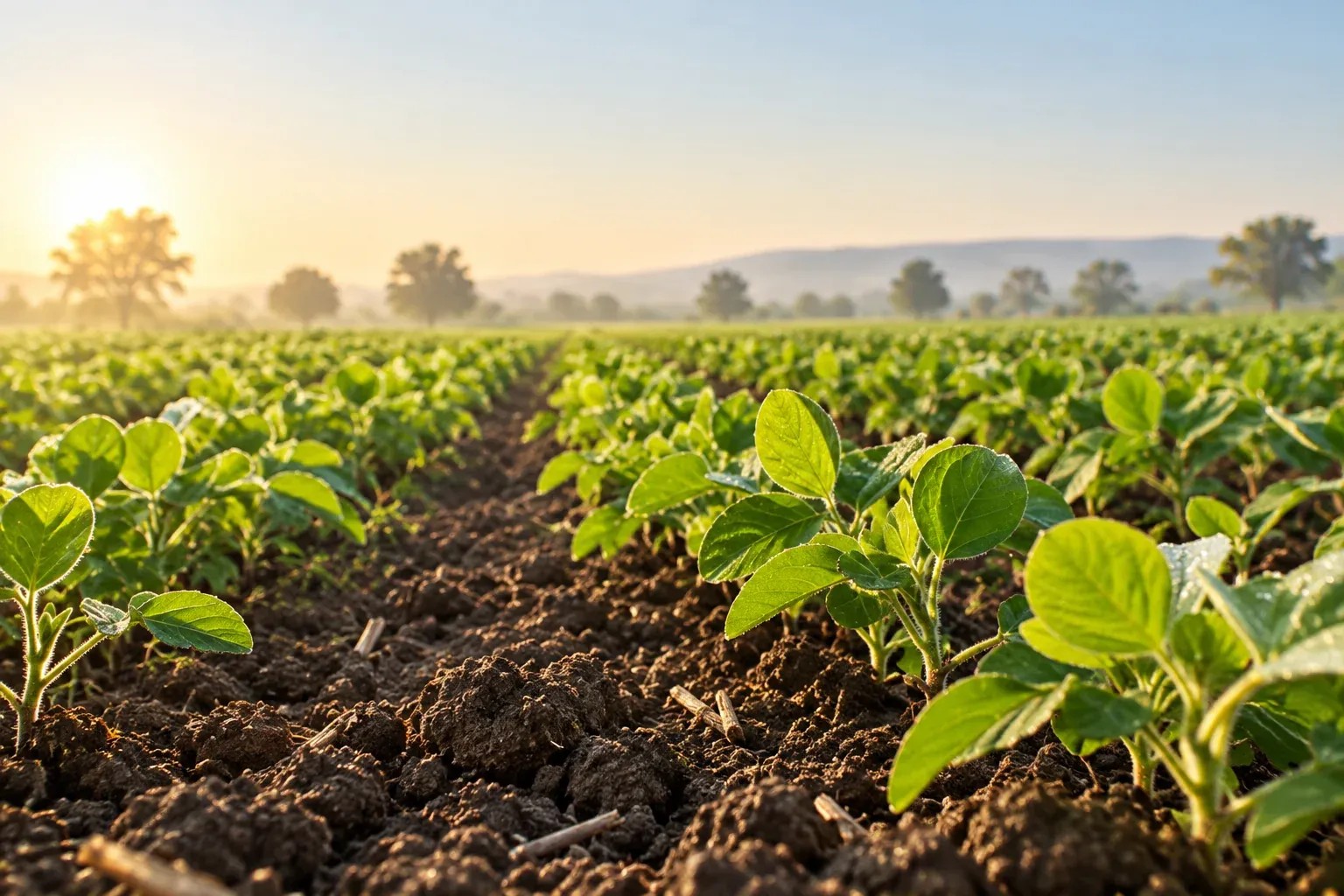
Crop Rotation in India: A Regenerative Farming Perspective
Crop rotation in India means growing different crops in a planned order on the same plot, season after season, so the soil, pests and nutrients do not get stuck in one pattern. It is one of the oldest soil-health practices available to smallholders, and it costs far less than most inputs.
This guide explains how it works, where it sits in a regenerative farming system, and what farmers, cooperatives and sourcing teams should check before relying on it.
At Beetle Regen Solutions, we train smallholder cotton and rice farmers in Madhya Pradesh, Maharashtra and Andhra Pradesh in regenerative practices, alongside HDPS, AWD and farmer-led biochar. Rotation is one tool in that wider set. We do not publish a fixed crop sequence, because the right order depends on your soil, water, market and local advice.
What Is Crop Rotation, and Why Does It Help Soil in India?
Crop rotation is the practice of growing different plant species in a set order on the same field over successive seasons. It helps soil because each crop uses nutrients, roots and pests differently, so no single problem builds up year after year. Including a legume can also add nitrogen back to the soil.
The UNCCD describes crop rotation as a sequence that can be designed to limit bare soil exposure to wind erosion, with varied root structures helping to hold soil together. That matters on rainfed farms in central India, where heavy monsoon rain and dry spells both strip topsoil.
Three things rotation does in the field
It breaks pest and disease cycles. Growing one crop continuously in the same soil lets disease-causing organisms build up. Switching to a plant from a different family removes their host, so the cycle is interrupted, as training material from MANAGE, the Government of India's agricultural extension institute, explains.
It alternates rooting depths. A deep-rooted crop followed by a shallow-rooted one draws water and nutrients from different layers of soil. Roots also open channels that help water soak in, which supports water retention.
It can rebuild nitrogen. When a legume is part of the order, it can fix nitrogen from the air, so the next crop may need less purchased fertilizer. How much less depends on the legume, the soil and the management. A soil test is the safer guide than a general rule.
Why monoculture wears soil down
Growing a single crop on the same plot every year invites pests and depletes specific nutrients. Farmers then spend more on fertilizer and pesticide to cover the gap, and the soil biology that does that work for free gets weaker. This is the cycle regenerative farming tries to reverse. For wider background, see our overview of soil degradation and how regenerative farming reverses it.
How Does Crop Rotation Support Farmer Income?
Crop rotation supports farmer income mainly by lowering input costs and reducing the risk of a bad season. Healthier soil can need less fertilizer, pest losses can fall, and a second crop type spreads market risk. Rotation alone is rarely the whole story, so incomes are best judged across the full practice package.
Research hosted by ICAR on maize-based rotations in India found that conservation agriculture practices, which combine reduced tillage with residue retention in rotations, delivered higher net returns than conventional tillage in the study plots. Rotation worked together with other soil practices there, not alone.
Our own 2025-26 programme figures follow the same logic. Across cotton-growing landscapes, participating farmers reported about 18% higher yield and about 38% higher net annual income than control group farmers. They also cut chemical fertilizer use by about 23%. Those results come from a package of regenerative practices, with each farmer adopting four to five of them. They should not be credited to rotation alone.
The honest trade-off
Rotation asks a farmer to depart from a familiar crop. That can mean learning new agronomy, finding a buyer for a different crop, or accepting some short-term risk while soil health improves. We saw in the past year that uptake is strongest where farmers see visible, early benefits, and that consistency of practice needs continued handholding.
Crop Rotation, Intercropping and Cover Crops: What Is the Difference?
Rotation changes the crop over time on the same plot, while intercropping grows two or more crops together in the same season. Cover crops are grown mainly to protect and feed the soil rather than for sale. Boundary tree planting adds trees around the field. Each solves a different problem.
Farmers often mix these terms up, so the table below separates them. It describes the practices in general terms and does not recommend any particular crop pairing.
| Practice | What changes | Main soil or farm benefit |
|---|---|---|
| Crop rotation | Different crops follow one another on the same plot across seasons | Breaks pest and disease cycles; varies rooting depth; legumes can add nitrogen |
| Intercropping | Two or more crops grow together in one season | Better use of space and light; extra income sources; more diversity in the field |
| Cover cropping | A crop is grown to cover soil between main crops | Less bare soil; organic matter input; erosion protection |
| Boundary planting / agroforestry | Trees are planted along field edges or within cropland | Biodiversity, windbreak, longer-term income |
In our 2025-26 results, 29% of farmers adopted boundary plantation, with parallel efforts on crop diversification. Our soil carbon projects in Maharashtra also include intercropping among the improved cropland management practices. For a deeper look at the rotation practice itself, read our complete guide to crop rotation in regenerative agriculture.
Where Crop Rotation Sits Beside HDPS, AWD and Biochar
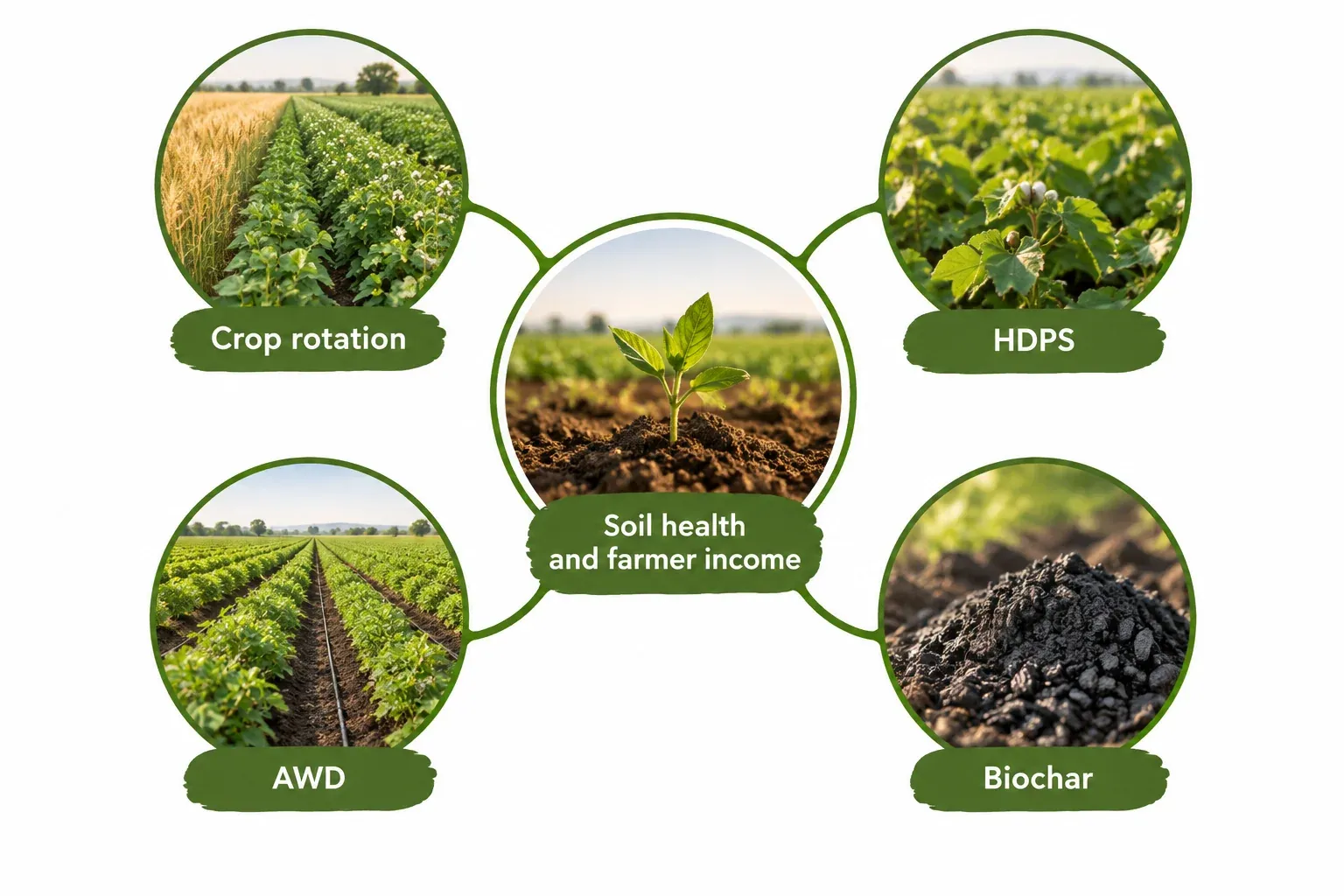
Regenerative farming is a package, not a single fix. Rotation works on the biology and nutrient balance of the soil across seasons. HDPS works on plant density and productivity within a crop. AWD works on water in rice fields. Biochar works on soil carbon and water retention.
| Practice | What it addresses | Where we run it |
|---|---|---|
| Crop rotation | Pest cycles, nutrient balance, rooting depth over seasons | Part of the general regenerative toolkit; sequences set locally |
| HDPS (High-Density Planting System) | Land use and yield through closer, strategic planting of cotton | Results across more than 2,000 hectares so far; 260 farmers engaged in Khargone |
| AWD (Alternate Wetting and Drying) | Water management and methane in paddy | Rice fields in Andhra Pradesh |
| Biochar | Soil fertility, water retention and carbon storage | Farmer-led production from crop residue such as cotton stalks |
Our AWD work aims to reduce the water footprint of paddy farming by up to 30% and can lower methane emissions by 48%. Biochar is made by burning organic waste such as crop residue in a controlled, no-oxygen environment. Our teams explain the method in what biochar is and how farmers use it.
These practices support each other. Residue that would otherwise be burned can become biochar. Better soil from rotation and biochar can help dense plantings use water and nutrients well. And a rice plot under AWD still benefits from planned crop change when the local setting allows it.
How Does Rotation Fit Into Beetle's Farmer Training in Madhya Pradesh and Maharashtra?
Rotation is taught as one practice within our wider regenerative training, which experts and local partners deliver together. We focus on demonstrations, handholding and records so farmers can judge results themselves. We do not prescribe a crop sequence. Local agronomists and farmers decide what suits each plot.
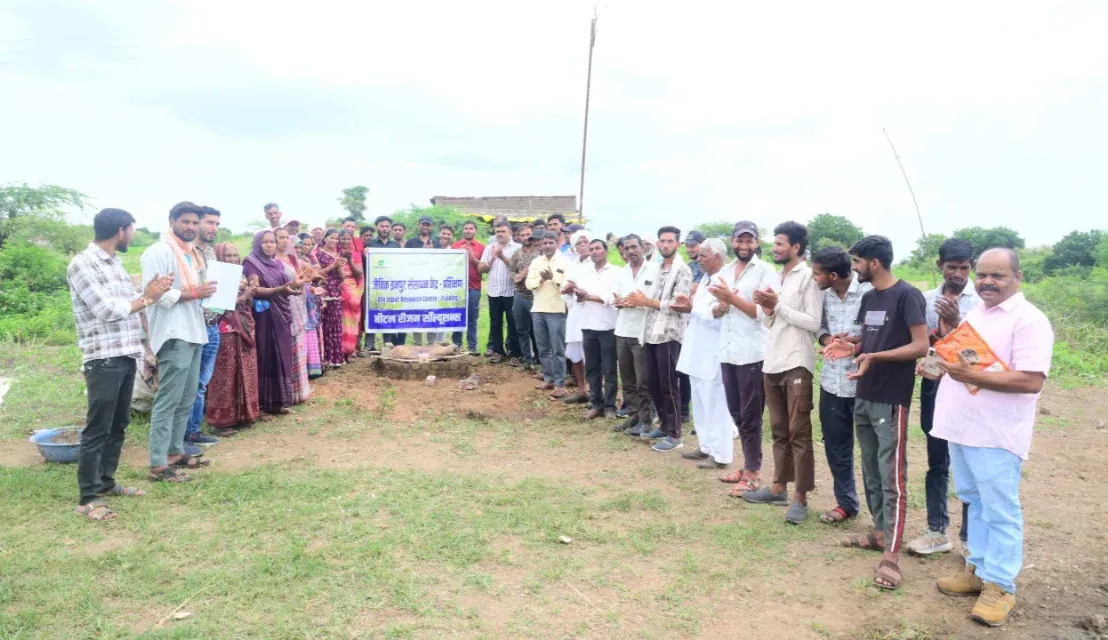
Training works through partners with deep local roots. The Niranjanlal Agrawal Foundation leads on-ground operations across our intervention states, including farmer mobilisation, capacity building, demonstration plots and field monitoring. Under the IDH Regenerative Production Landscape Collaborative, we support 10 partner organisations in Madhya Pradesh with manuals and Training of Trainers.
The framework we co-developed there rests on three pillars: regenerative agriculture practices, biochar systems and Bio-Resource Centres. Practices such as rotation sit under the first pillar. You can read how this works on the ground in our projects.
What we learned about adoption
The main lesson from 2025-26 is that farmers adopt a practice when they see it work. Pilots and demonstrations from the year before convinced them far more than rules or standards did. The second lesson is that consistency matters. Practices drift from plot to plot, which is why handholding and simple field records remain part of the programme.
A Practical Starting Checklist for Farmers and Cooperatives
A good first season of rotation is small, recorded and advised locally. These steps apply to any smallholder plot, and none of them require us to name a crop order.
- Write down plot history. Note which crops grew in the last two or three seasons, plus any pest or disease problems and fertilizer used.
- Test the soil. A soil test shows nutrient status and helps you decide what the next crop should do for the field. Use it instead of rules of thumb.
- Ask a local agronomist. Contact your state agriculture department, a Krishi Vigyan Kendra or an extension officer. They know rainfall, soil type and approved varieties for your block.
- Check the market first. A rotation only pays if you can sell the next crop. Confirm buyers, prices and storage before sowing.
- Start on one plot. Keep a comparison plot under your usual practice so you can see the difference with your own eyes.
- Keep records. Note sowing dates, inputs, pests and yield per plot. These records help with training, with buyers and with any carbon or sustainability programme later.
- Combine with other practices. Residue management, reduced tillage and organic inputs make rotation work better, as the Tamil Nadu Agricultural University notes when it says rotating crop varieties and cultural practices gives more assured benefits than rotation of crops alone.
What Should Brands and Sourcing Teams Ask About Rotation?
Brands should ask whether rotation is recorded at plot level, who verified it, and how it links to measured outcomes such as soil organic carbon, yield and input use. A claim without farm-level records is a story, not evidence. Ask for practice data by season, not only a programme description.
Specific questions to put to any supplier or programme partner:
- Is the crop history logged for each plot and each season, with the farmer's consent?
- Are results compared with a control group, as ours are?
- Which other practices were adopted at the same time, so rotation is not credited with their effects?
- How are soil carbon outcomes measured and verified, and under which registry or standard?
Our soil carbon projects in Khargone, Nagpur and Chhatrapati Sambhaji Nagar use digital monitoring, soil modelling and Verra's VM0042 methodology, because credible claims need measurement behind them. Brands exploring this can start with our regenerative cotton sourcing guide for India and Bangladesh.
Common Questions About Crop Rotation in India
Does crop rotation earn carbon credits by itself?
No. Rotation does not automatically earn money from carbon credits. Carbon revenue depends on project design, verified outcomes, credit issuance, market value, project costs and the agreed benefit-sharing mechanism. Farmers should ask for these terms in writing before enrolling in any carbon project.
The most common mistake we see is joining a carbon project without understanding what participation requires. Revenue may be shared between farmers, project developers and implementation partners after development, monitoring, verification and registry costs. The right question is not only what percentage goes to farmers, but how deductions and the farmer's share are set.
Do I need to rotate crops every season?
Not always. Rotation means changing the crop in a planned order over several seasons, and the right cycle depends on your crops, water, soil and market. A local agronomist can suggest a cycle that fits your plot. Start small and keep records.
Can rotation help with crop yield enhancement?
It can, as part of a wider system. Healthier soil, fewer pest build-ups and balanced nutrients support yield over time. In our programmes, the yield gain of about 18% came from a package of practices. For more on that link, see how regenerative practice connects to productivity.
Next Steps
Rotation is simple to understand and hard to do consistently, which is why records, training and local advice matter more than any fixed recipe. If you run a farmer cooperative or source cotton from smallholders and want to see how rotation, HDPS, AWD and biochar can fit a programme, contact our team to discuss a farmer training programme.