How Biochar Carbon Insetting Works for Textile Brands
Biochar carbon insetting for textile supply chains works by converting crop residue from a brand's own cotton-growing regions into a stable form of carbon, burying it in the same fields that grow the fiber, and verifying that removal so the brand can count it directly against its Scope 3 emissions. Unlike buying an offset from an unrelated project on the other side of the world, insetting keeps the carbon benefit, the farmer income, and the supply chain data inside one traceable loop.
Key Takeaways
- Insetting stays inside your supply chain: Biochar is made from crop waste grown by your own cotton or fiber suppliers, so the removal happens on farms already tied to your sourcing map, not a disconnected project.
- Cost runs well below most external offsets: Depending on scale, feedstock logistics, and MRV intensity, biochar insetting typically lands in a range that brands can compare directly against offset market prices before committing budget.
- Permanence is measured in centuries, not years: Biochar's carbon stays locked in soil far longer than cover crops or compost, which is why registries like Puro.earth and Verra treat it as a durable removal category.
- Farmers get paid twice: Once for the residue they used to burn, and again through carbon credit revenue share, on top of the yield and soil health gains from application.
- MRV is the real bottleneck: Sampling protocols, registry approval, and data integration into a brand's Scope 3 inventory determine how fast tonnes convert into reportable claims.
At a Glance: Biochar Insetting Snapshot
| Factor | Typical Range or Detail |
|---|---|
| Feedstock source | Cotton stalks, gin waste, husk from the brand's own supplier farms |
| Carbon permanence | 100+ years in soil, often modeled at 300-1,000 years depending on pyrolysis conditions |
| Typical application rate | 2 to 5 tonnes of biochar per acre for cotton fields, adjusted by soil type |
| Verification standards used | Puro.earth Biochar Methodology, Verra VM0044, Gold Standard soil carbon protocols |
| Time to first verified tonnes | Typically one full growing season plus a verification cycle, roughly 12-18 months |
| Farmer payment structure | Residue collection fee plus a share of carbon credit revenue upon verification |
| Reporting fit | Feeds directly into Scope 3 land-use and purchased goods categories, supports CSRD value-chain disclosure |
| Comparison to external offsets | Generally lower cost per tonne with added traceability and supplier-linked co-benefits |
1. Start With the Feedstock Already Sitting in Your Supply Chain
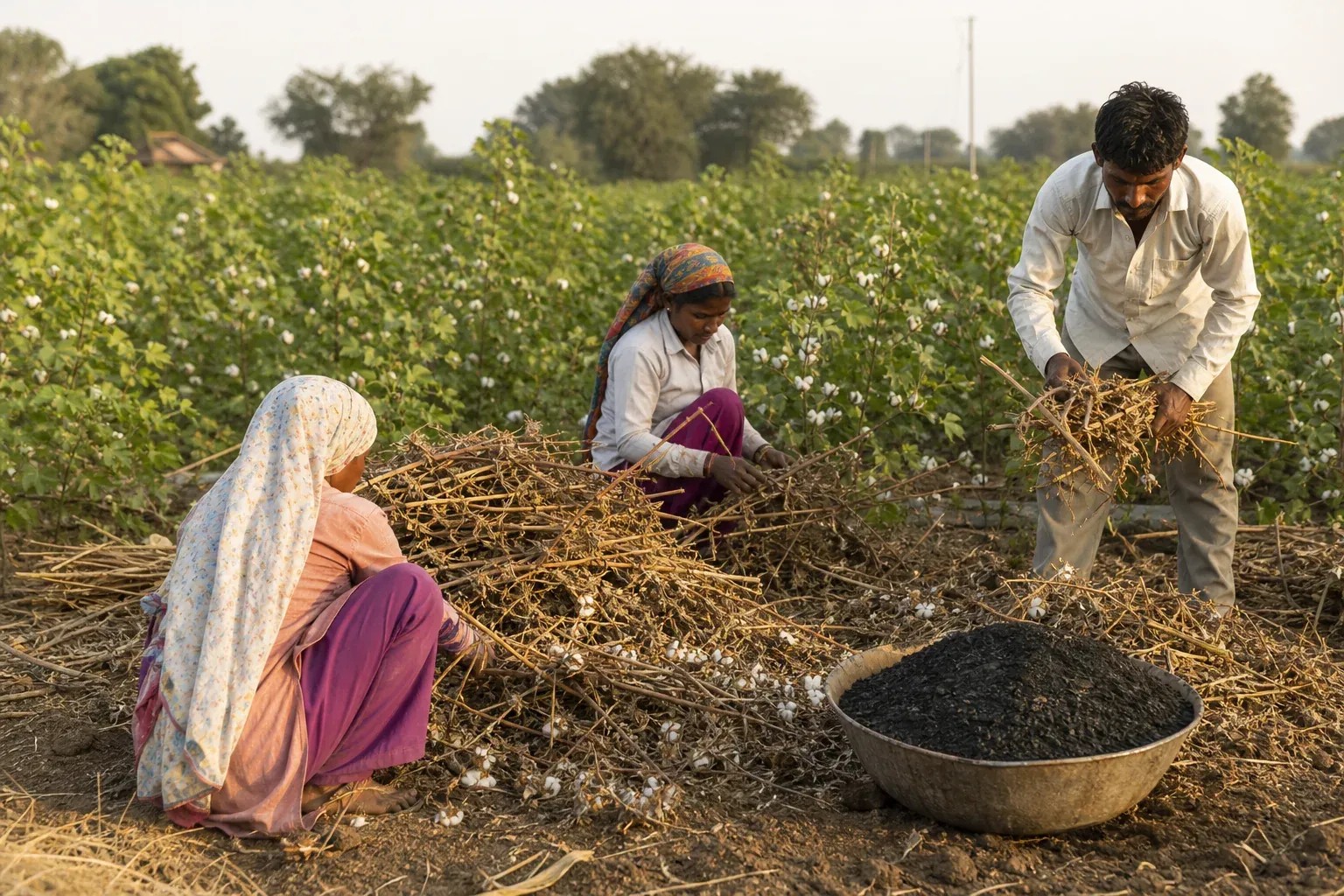
Every cotton season, farmers in Khargone and dozens of other districts across Madhya Pradesh and Maharashtra clear their fields of stalks, husks, and gin waste. Most of that residue gets burned right there in the open, sending smoke and particulate matter into the air and wasting organic material that could have gone back into the soil. This is the starting point for biochar carbon insetting for textile supply chains: the raw material is not imported or purchased from a separate market, it is already growing in the fields tied to a brand's cotton contracts.
We work with cooperatives to collect this residue instead of letting it go up in smoke. A collection route typically covers a cluster of farms within a 15 to 20 kilometer radius, since transporting bulky, low-density crop waste over longer distances erodes the economics fast. Farmers get paid for material they used to burn or discard, which turns a pollution problem into a small but real revenue line before the carbon program even starts generating credits.
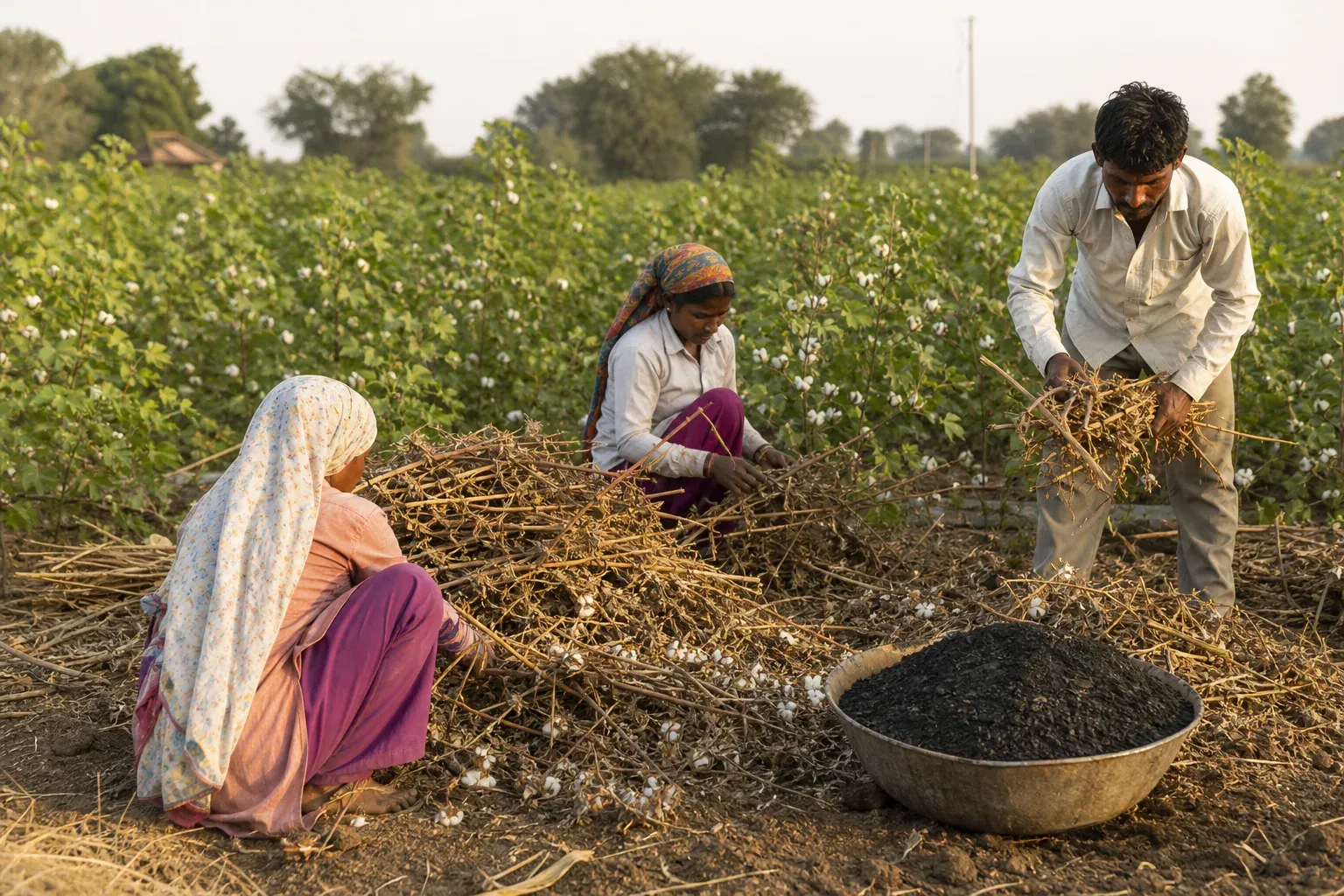
This step also solves a traceability problem that plagues many brand sustainability claims. Because the feedstock comes from named farms already mapped for regenerative cotton programs, the carbon story connects to the same GPS coordinates, farmer IDs, and field records used for supply chain traceability for regenerative cotton. A brand's sourcing team and its sustainability team end up working from the same dataset instead of two disconnected systems.
2. Convert Crop Residue Into Biochar at the Farm Cluster Level
Once collected, the residue goes through pyrolysis: heating organic matter with very little oxygen so it chars instead of burning completely. Think of it as the same chemistry behind charcoal, but controlled carefully to lock carbon into a stable structure rather than releasing it all as smoke. The output is a lightweight, porous black material that looks a bit like charcoal but behaves very differently once it goes into soil.
We run this conversion at the farm cluster level using kilns sized for the volume of residue a cooperative can realistically supply. Smaller, decentralized units cut transport costs and keep processing close to the source, while larger centralized units offer more consistent quality control but need a bigger feedstock catchment. Both models get tested for two things before any biochar goes to a field: fixed carbon content, which tells us how much of the material is stable carbon versus ash or volatile compounds, and the H:Corg ratio, a simple lab measure that indicates how "cooked" the material is and how long it will likely persist in soil.
This step is where biochar production separates itself from other soil amendments. Compost and green manure add organic matter that decomposes over months or a few years. Biochar's carbon structure resists microbial breakdown, which is exactly why it earns durable removal credit rather than short-term soil carbon credit. If you want the deeper mechanics of how sequestration methods compare, our carbon sequestration in agriculture framework breaks down the full spectrum of approaches side by side.
3. Apply Biochar to Soil and Start the Sequestration Clock
Application rates for cotton fields typically run between 2 and 5 tonnes of biochar per acre, adjusted based on existing soil organic matter and texture. Sandy soils with low organic content often respond well to higher rates, while heavier clay soils need less. Farmers usually mix biochar into the topsoil layer during land preparation, sometimes blended with compost or manure to help it integrate faster and boost early microbial colonization.
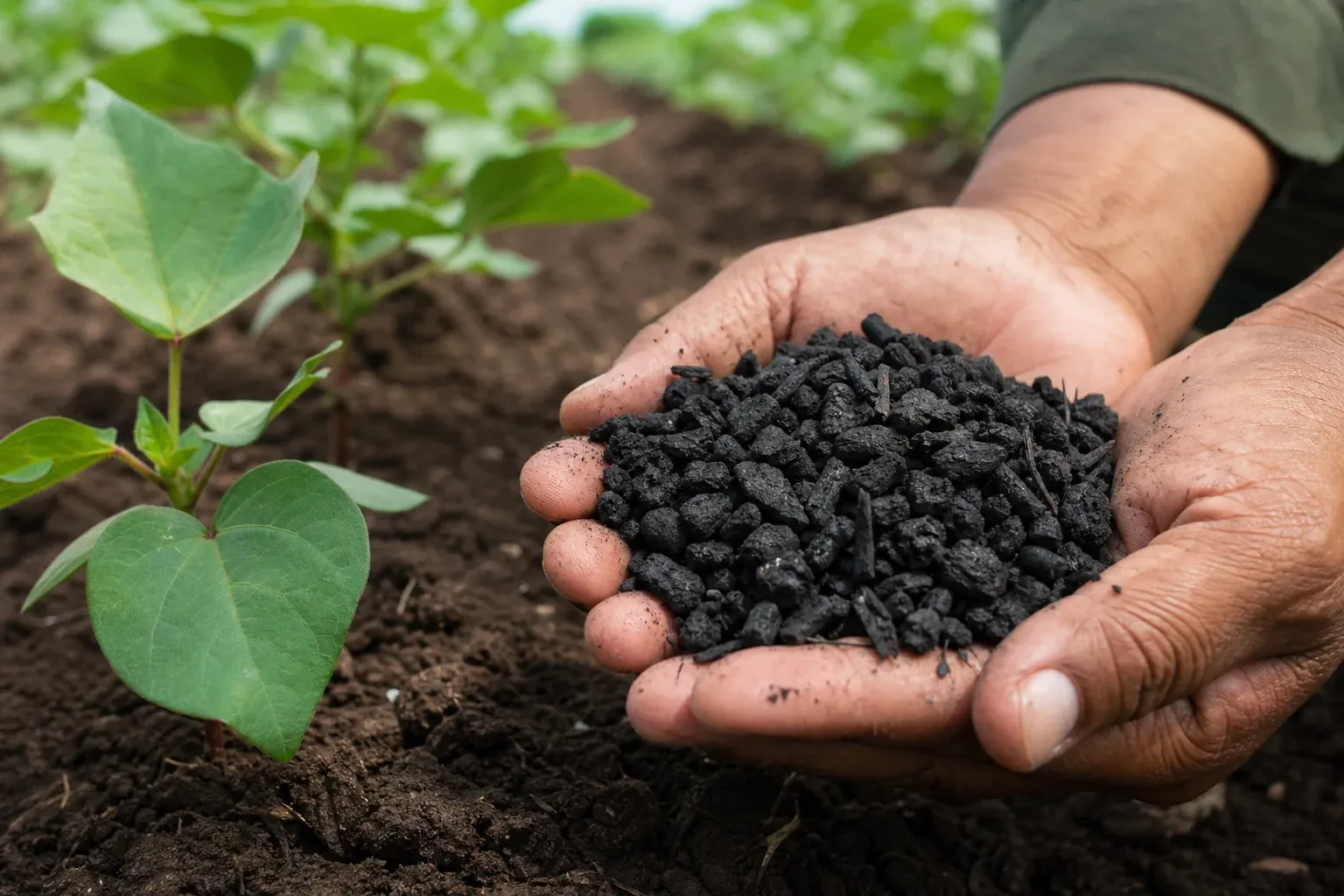
The moment biochar goes into the ground, the sequestration clock starts. Unlike biomass that eventually decomposes and releases carbon back to the atmosphere, biochar's charred carbon structure can remain stable in soil for centuries. Farmers see the soil health side of this within a season or two: better water retention during dry spells, improved microbial activity, and often a measurable yield bump on marginal plots. These co-benefits sit alongside the carbon story, not instead of it, and they matter to farmers who are being asked to change practices for reasons beyond a distant brand's climate target.
For brands comparing methods, it helps to understand how biochar stacks up against other regenerative interventions like cover crops in terms of permanence and measurable impact. Cover crops build soil organic matter and support biodiversity, but that carbon is more vulnerable to loss through tillage or drought. Biochar's stability is the reason it qualifies as a removal credit under stricter methodologies rather than a temporary avoidance credit.
4. Measure, Report, and Verify the Carbon Removal (MRV)
This is the step that determines whether a tonne of carbon claimed on paper becomes a tonne a brand can actually report. Measurement, Reporting, and Verification, usually shortened to MRV, involves three layers working together. Field teams take soil and biochar samples at defined intervals, testing for fixed carbon content and confirming application rates match what was recorded at the farm level. Digital records log every batch of biochar back to its production kiln and originating farm cluster, creating an auditable chain from stalk to soil. Third-party verifiers then review this data against an approved methodology before any credit gets issued.
Several standards now specifically address biochar. Puro.earth runs a dedicated Biochar Methodology built around the fixed carbon and H:Corg measurements described earlier. Verra's VM0044 methodology covers biochar within a broader soil carbon framework, and Gold Standard has its own soil carbon protocols that some programs use in parallel. Choosing the right standard affects both cost and the credibility of the claim, which is why we've written separately about how these MRV and traceability systems for cotton actually get built in practice.
According to the UN Food and Agriculture Organization, roughly a third of the world's soils are already degraded, which is part of why regulators and registries are pushing for rigorous, field-verified soil carbon data rather than modeled estimates. Brands facing scrutiny under the EU's Corporate Sustainability Reporting Directive can't afford to submit numbers that won't hold up under audit, so the MRV layer isn't a formality, it's the foundation the whole claim rests on.
5. Convert Verified Tonnes Into Insetting Credits Tied to Your Scope 3 Inventory
Once a batch of biochar is verified, it generates a specific number of tonnes of CO2-equivalent removal. This is where insetting diverges from traditional offsetting. Instead of purchasing credits from a forestry project in another country with no link to the brand's own operations, insetting credits get mapped directly to the farms, cooperatives, and cotton bales inside that brand's supplier network. A denim brand sourcing cotton from Yavatmal can point to the exact cluster of farms where its biochar program removed carbon, and tie that removal to the bales that eventually became its own product line.

This distinction matters for Scope 3 reporting. Scope 3 emissions, the indirect emissions across a brand's supply chain, are notoriously hard to reduce because they happen at suppliers a brand doesn't directly control. Insetting gives sustainability teams a way to show a reduction that occurred inside their own value chain rather than a generic purchase that offsets emissions without changing anything upstream. If your team is still mapping out how carbon insetting fits into a broader climate strategy, our fashion brand net zero roadmap walks through where insetting sits relative to direct emissions cuts and residual offsetting.
For brands managing CSRD disclosure requirements, this traceability isn't optional anymore. Auditors increasingly want to see value-chain-grounded evidence, not just a certificate from a registry. A biochar program with named farms, GPS-tagged fields, and batch-level records gives sustainability teams something they can actually defend in an audit conversation, rather than a line item that says "offsets purchased" with no further detail.
6. Understand the Real Cost Structure Per Tonne
Cost per tonne for biochar carbon insetting depends on four main drivers: feedstock collection logistics, pyrolysis unit type and scale, MRV intensity, and farmer payment structure. Collection costs rise with distance and with how scattered the smallholder farms are across a region. Centralized pyrolysis units bring economies of scale but add transport cost; decentralized kilns cut transport but need more oversight to keep quality consistent across sites. MRV costs scale with sampling frequency and the strictness of the chosen registry methodology.
Here's how biochar insetting typically compares against other carbon strategies a brand might consider:
| Approach | Traceability to Brand's Own Supply Chain | Typical Permanence | Farmer Co-Benefit | Reporting Fit |
|---|---|---|---|---|
| Biochar carbon insetting | Direct, farm-level GPS and batch tracking | Centuries | Residue payment plus credit revenue share, plus soil health and yield gains | Maps cleanly to Scope 3 and CSRD value-chain disclosure |
| External nature-based offsets (e.g. forestry) | None, unrelated project and geography | Variable, often reversible (fire, logging risk) | None tied to the brand's own suppliers | Counts toward carbon neutral claims, weaker for Scope 3 narrative |
| Cover crop or compost-based insetting | Direct, same supply chain | Years to a couple decades, vulnerable to tillage | Soil health, moderate income support | Good for soil health story, less durable removal claim |
| Renewable energy offset credits | None, typically unrelated sector | N/A (avoidance, not removal) | None | Useful for energy Scope 2, weak fit for agricultural Scope 3 |
Brands often ask for a specific number before committing budget, and that's a fair question, but the honest answer is that cost per tonne varies by region, scale, and how much verification rigor a program layers in. We recommend requesting a program-specific cost breakdown rather than relying on a generic industry average, since a small pilot cluster in one district will price differently than a multi-district program spanning several cooperatives. You can contact us to walk through cost structures for your specific sourcing regions and volume targets.
7. What a Real Program Looks Like End to End
A typical program starts with a pilot cluster, often 200 to 500 acres across a handful of villages in a district like Khargone or Wardha. In season one, the focus is farmer onboarding: explaining why residue collection matters, setting up collection logistics, and running the first pyrolysis batches. Soil baseline testing happens before any biochar goes into the ground, establishing the starting point every later measurement gets compared against.
By season two, application rates are calibrated per plot, and the first round of MRV sampling begins. This is usually when a brand sees its first set of provisional data, not yet fully verified but directional enough to start planning how the tonnes will map to its Scope 3 inventory. Season three is typically when verified tonnes are issued through the chosen registry and the brand can formally count the removal in its disclosures.
Farmer training runs throughout this timeline, not just at the start. Cooperatives that stick with the program tend to be the ones where training continues season over season, covering everything from correct application timing to how carbon payments actually get calculated and distributed. Our guide on integrating regenerative agriculture data across supply chains covers how this farmer-level data eventually flows up into a brand's enterprise reporting systems, and our piece on how regenerative agriculture increases crop yield digs into the productivity side that keeps farmers engaged season after season, not just the carbon side.
Brands that treat this as a multi-year relationship, rather than a one-off credit purchase, tend to get better data quality and stronger farmer retention. The ISO 14064 framework for greenhouse gas quantification is often referenced by verifiers as a baseline for the kind of rigor these programs need to sustain over multiple reporting cycles.
Frequently Asked Questions
Is biochar carbon insetting the same as carbon offsetting?
No. Offsetting means buying credits from a project unconnected to your supply chain, often in a different country or sector. Insetting means the carbon removal happens inside your own supply chain, on the same farms that grow your cotton or fiber, which gives the claim direct traceability to your sourcing map.
How long does biochar carbon actually stay in the soil?
Well-produced biochar with high fixed carbon content can remain stable in soil for centuries, and some modeling extends that further depending on pyrolysis conditions and soil environment. This is why registries classify it as a durable removal rather than a temporary avoidance credit.
What certifications or standards apply to biochar carbon insetting?
The most commonly used are the Puro.earth Biochar Methodology, Verra's VM0044 soil carbon framework, and Gold Standard soil carbon protocols. The right choice depends on your reporting needs, your registry preferences, and how your auditors expect the claim to be structured.
How fast can a textile brand see verified tonnes from a new program?
Most programs need a full growing season to establish baselines and apply biochar, followed by a verification cycle. Realistically, that's 12 to 18 months from program start to first verified tonnes, with volumes typically scaling in seasons two and three as farmer participation grows.
Does biochar insetting help with EU CSRD compliance?
Yes, because CSRD increasingly expects value-chain-grounded evidence rather than generic offset certificates. A biochar program with farm-level GPS data, batch records, and third-party verification gives sustainability teams documentation that holds up under audit scrutiny far better than a purchased offset with no connection to the brand's own operations.
If your team is trying to move from a carbon neutral claim built on purchased offsets to a Scope 3 reduction strategy grounded in your own cotton supply chain, biochar carbon insetting is one of the most concrete places to start. It pays farmers for residue they used to burn, builds soil health in the same fields you already source from, and generates verified removal data your compliance team can actually defend. Contact us to discuss what a pilot cluster could look like in your sourcing regions, and how it fits alongside the regenerative cotton and traceability programs already running across our partner farms in India and Bangladesh.