How Long Does It Take for Biochar to Improve Soil?
Biochar starts changing soil biology within three to six weeks of application, but the soil organic carbon gains that farmers actually feel, better water holding, looser structure, higher yield, take a full growing season to show up and two to three seasons to compound into something measurable. That gap between "it's working" and "I can see it" is where most biochar programs lose farmers. Understanding the real timeline is what keeps them in the field long enough to benefit.
Key Takeaways
- Microbial activity moves first: Soil microbial biomass and enzyme activity shift within 3 to 6 weeks of biochar incorporation, well before any visible plant response.
- Soil organic carbon builds over months, not days: Beetle Regen field sampling across Madhya Pradesh and Maharashtra cotton plots shows detectable soil organic carbon increases starting around month 3 to 4, ahead of any yield change.
- Yield can lag or dip in season one: On heavily degraded soil, first-season yield often stays flat while nutrient and microbial cycles reset. Season 2 and season 3 are where uplift becomes repeatable.
- The carbon itself is stable for centuries: Biochar's carbon fraction is chemically resistant to breakdown almost immediately, even though the soil health benefits it triggers take longer to appear.
- Feedstock and application rate change the clock: Pyrolysis quality, dosing, and local soil texture can shorten or stretch every stage of this timeline by a season or more.
Biochar Soil Improvement Timeline At a Glance
| Time Period | What Changes | What Farmers Can Expect to See |
|---|---|---|
| Week 1 to 6 | Microbial colonization, enzyme activity rises | No visible change in the field; only lab sampling detects it |
| Month 2 to 4 | Soil organic carbon starts rising in topsoil | Slightly darker soil, marginally easier tillage |
| Month 4 to 6 | Water infiltration and moisture retention improve | Soil holds moisture longer between irrigation or rain cycles |
| Season 1 (first crop cycle) | Structure and porosity improve; nutrient cycling resets | Yield often flat or slightly below baseline on degraded soil |
| Season 2 | Soil organic carbon and microbial gains compound | Measurable yield uplift begins in most cotton plots |
| Season 3 and beyond | Gains stabilize into a repeatable pattern | Consistent yield gains; carbon becomes verifiable for MRV reporting |
What Actually Happens Underground When Biochar Goes Into Soil
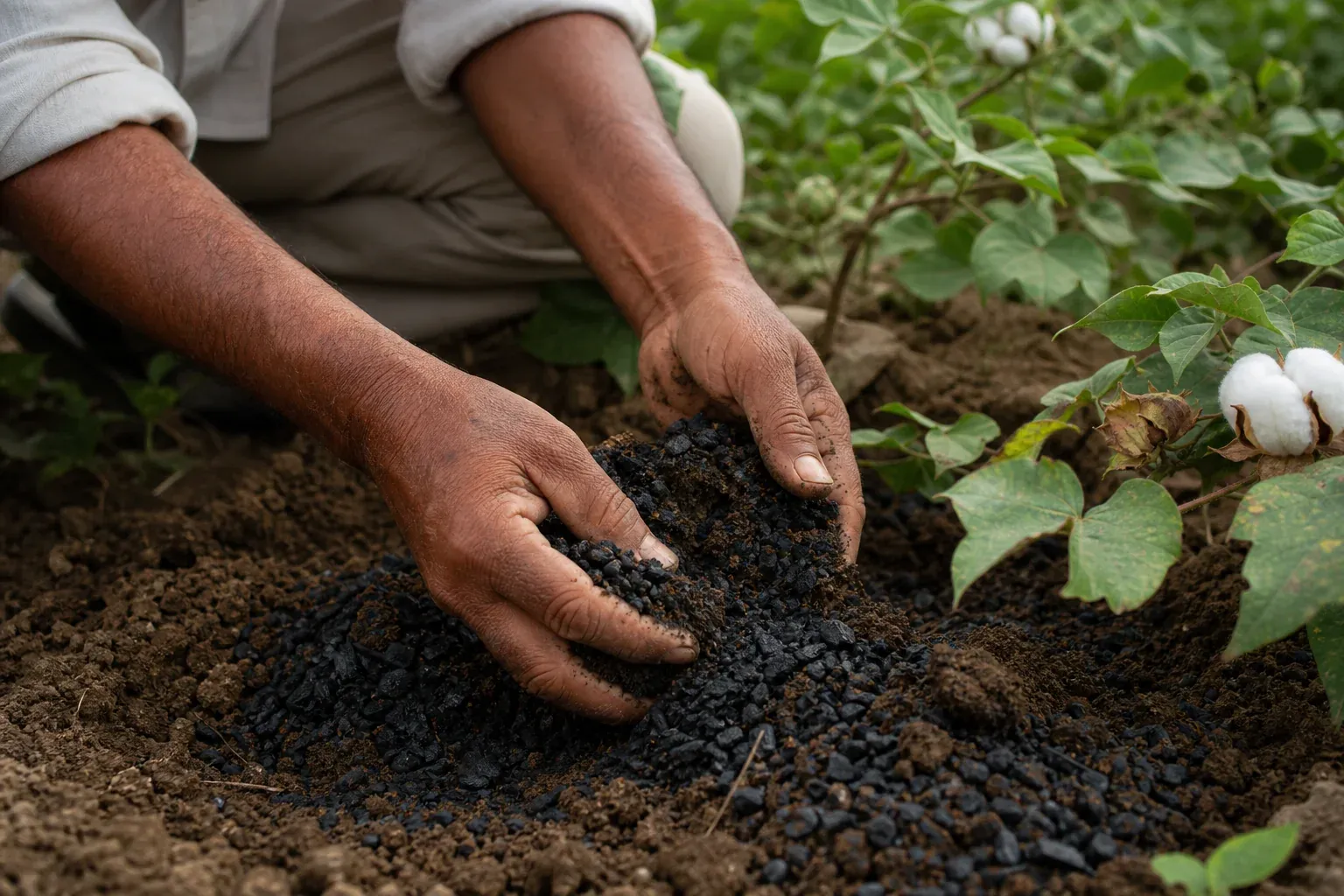
Biochar is not fertilizer. It doesn't feed a plant the way nitrogen or potash does. It's a carbon scaffold, a porous, charcoal-like structure made by heating crop residue in low oxygen. Once it's mixed into soil, it changes how soil organic carbon behaves rather than adding a quick nutrient hit. That distinction matters because it explains why the timeline for biochar looks so different from the timeline for compost or synthetic fertilizer.
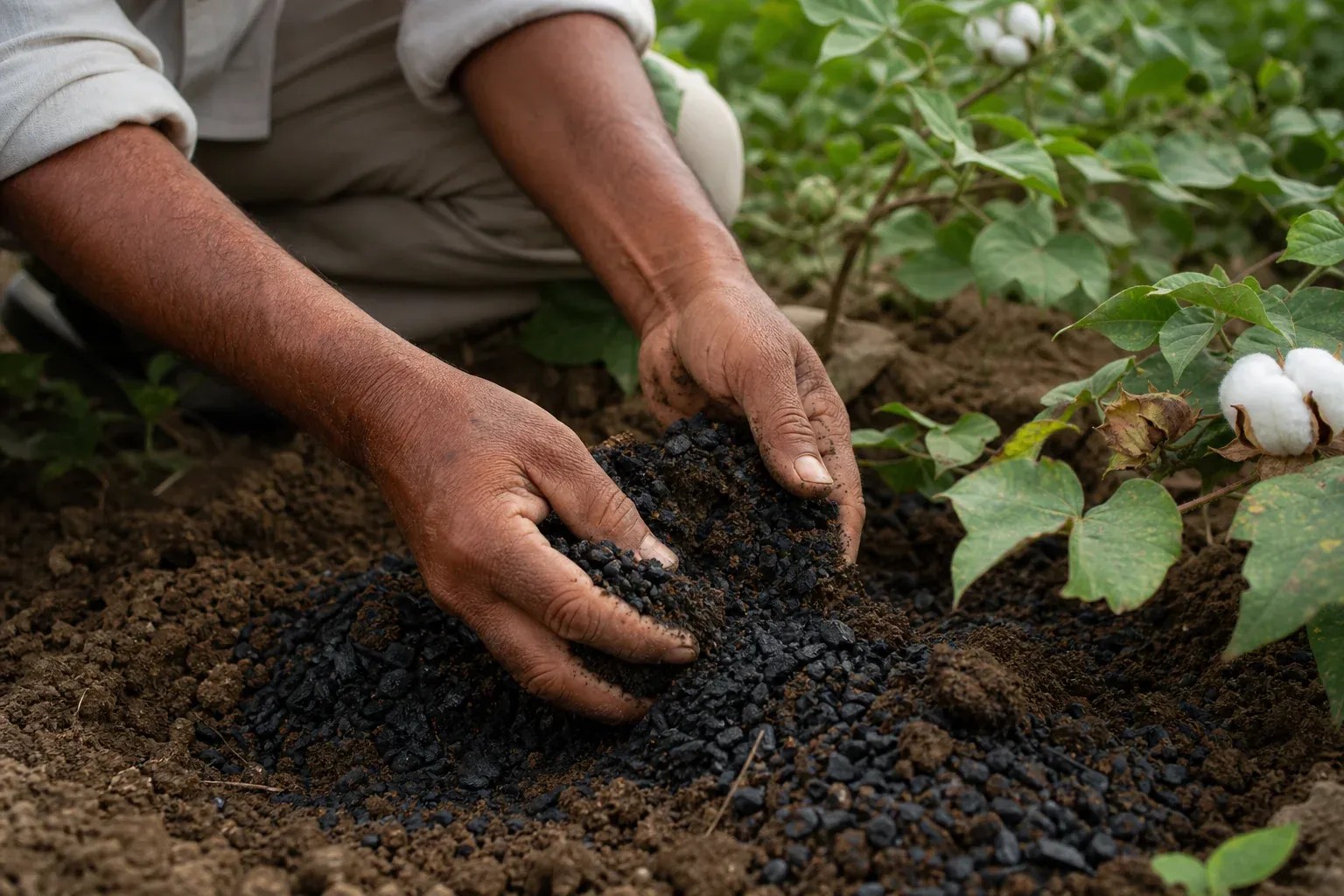
Picture a handful of biochar under a microscope. It looks like a sponge, riddled with microscopic tunnels left behind when the original plant cell walls burned away. Those tunnels give soil microbes and fungi somewhere to live almost the moment biochar goes into the ground. In field plots we've worked across Khargone and Yavatmal, this colonization is the very first thing that changes, long before anyone can see a difference standing at the edge of the field.
It helps to separate two kinds of carbon inputs. Compost, crop residue, and green manure are labile carbon, they break down fast, feed microbes for a season, and largely cycle back into the atmosphere within months. Biochar's carbon is different. Most of it is recalcitrant carbon, chemically resistant to microbial breakdown, which is why it persists in soil for centuries rather than months. That stability is exactly what makes biochar useful for carbon insetting programs that need durable, verifiable sequestration. But durability of the carbon itself and visible improvement of the soil around it are two separate clocks, and conflating them is the single biggest reason farmers and brands misjudge how fast biochar "works."
Weeks 1 to 6: Microbial Activity Shifts First
If you sample soil three weeks after biochar application, you won't see a yield change. You won't even see a change in bulk soil organic carbon percentage yet. What you will see, if you're testing for it, is a jump in microbial biomass and enzyme activity, particularly enzymes tied to nitrogen and phosphorus cycling.
This happens because biochar's pore structure offers immediate real estate. Bacteria and fungi move in fast, the same way life colonizes a new reef structure dropped into open water. Soil that was compacted and biologically thin suddenly has more surface area for microbial life to establish itself.
This is also where expectations need calibrating. A farmer standing in the field six weeks after application, looking for taller plants or greener leaves, won't find them yet. That's not a failure of the biochar. It's simply too early in the process. Programs that run short trials, a single season with no microbial sampling, routinely under-report biochar's effect, because they're measuring the wrong variable at the wrong time. This is one reason MRV systems built for biochar carbon insetting need to track microbial and soil indicators separately from yield data from day one.
Months 2 to 6: Soil Organic Carbon Starts Building
Soil organic carbon, often shortened to SOC, is simply the carbon-based fraction of organic matter in soil: decomposed roots, microbial residue, and, once it's added, biochar itself. Think of it as the soil's savings account. Higher SOC generally means better structure, better water holding, and steadier nutrient supply to roots.
Because biochar's carbon is so chemically stable, it counts toward measurable soil organic carbon almost as soon as it's incorporated, unlike compost, which mineralizes quickly and loses much of its carbon back to the atmosphere within a growing season. But "counts toward SOC" on paper and "shows up in a lab test as a meaningful shift" are different things. In practice, across Beetle Regen field sampling in Madhya Pradesh and Maharashtra cotton plots, we typically see a detectable rise in topsoil organic carbon starting around month 3 to 4 after application, ahead of any change in yield.
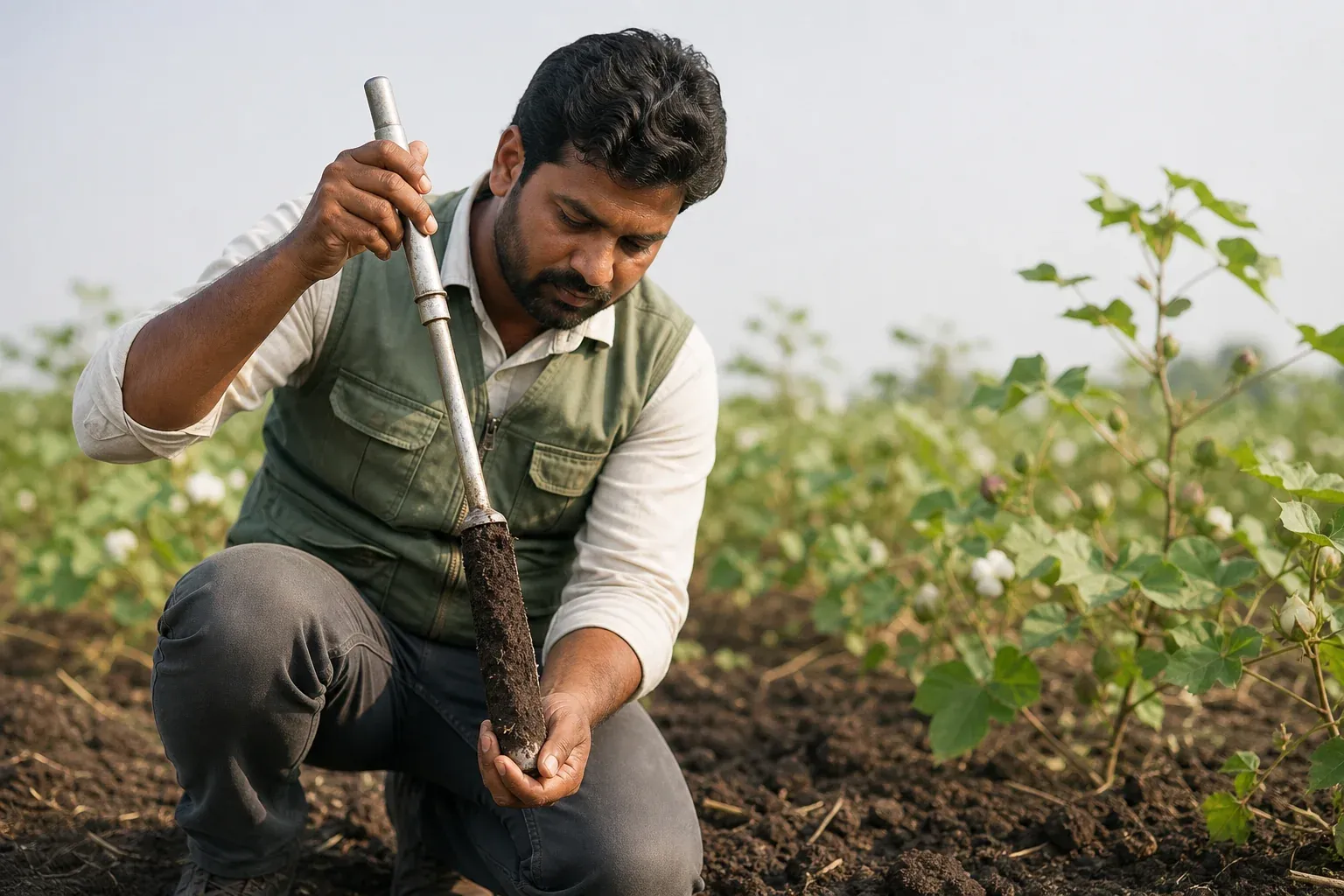
Why the delay? Soil organic carbon needs a full wet-dry cycle, sometimes more than one, to properly bind with clay particles and soil minerals. This binding is what locks carbon into stable aggregates instead of leaving it loose in the topsoil where it can wash away or oxidize. Fields that go through a monsoon and a dry spell after biochar application tend to show this binding faster than fields under constant irrigation with no natural wetting-drying rhythm. That is also why water retention and reduced compaction typically show up slightly after the SOC shift itself, generally in the month 4 to 6 window, once enough stable aggregates have formed to change how the soil physically holds moisture.
None of this shows up as a number a farmer can see without testing. This is exactly the kind of gap our regenerative agriculture training programs are built to close, walking farmers through what's happening below the surface so they don't mistake a quiet season for a failed one.
Season 1: Structure and Water Holding Improve, Yield May Lag
The first full cropping season after biochar application is where soil structure and water infiltration become noticeable in the field itself, not just in a lab report. Farmers in our cotton programs commonly describe soil that "breaks apart easier" or holds moisture a day or two longer between waterings.
Here's the part that catches people off guard: yield in season one can be flat, and on very degraded soil, it can even dip slightly below the farmer's normal baseline. This isn't biochar failing. It's the soil's microbial and nutrient cycles resetting around a new structure. Nitrogen can be temporarily tied up as microbial populations expand to take advantage of the new habitat biochar provides, competing briefly with the crop for available nutrients before the system stabilizes.
This is the season where farmers most often lose confidence and where programs without season-long support see the highest dropout. Setting the expectation upfront, "season one is about the soil resetting, not about your yield number", changes how a farmer reads a flat harvest. It's also why yield gains from regenerative practices need to be framed as a multi-season pattern rather than a single-year promise.
Application rate and feedstock source shift this timeline too. Cotton stalk biochar applied at a moderate, tested rate tends to move through season one more smoothly than under-dosed or poorly pyrolyzed material, which simply takes longer to deliver a structural change.
Seasons 2 and 3: Yield Gains Become Measurable
By season two, most of the cotton plots we track show a measurable yield uplift. This is where the compounding effect of rising soil organic carbon, an established microbial population, and improved water retention starts working together instead of separately. Farmers who paired biochar with reduced tillage, keeping that new soil structure intact instead of breaking it apart with deep plowing, saw the compounding happen faster than farmers who applied biochar but changed nothing else about their field practices.

Season three is typically where the pattern stabilizes. Instead of a one-off bump that could be attributed to rainfall or a good season, yield gains start repeating year over year in a way that's harder to explain away as luck. This is also the point where biochar's carbon sequestration becomes fully verifiable for carbon credit and MRV reporting, since soil sampling by season three shows a stable, defensible increase in soil organic carbon rather than a first-year fluctuation that verifiers are right to be skeptical of.
For brands and supply chain partners tracking regenerative cotton traceability, this three-season pattern is the honest benchmark to plan around, not a single harvest report.
What Changes This Timeline: Feedstock, Application Rate, and Local Soil
No two fields move through this timeline at exactly the same pace. A few variables consistently speed it up or slow it down:
- Feedstock and pyrolysis quality: Biochar made at the right temperature from clean cotton stalk residue has more consistent porosity than poorly processed material, which means faster microbial colonization from week one.
- Application rate: Under-dosing stretches out every stage of this timeline because there simply isn't enough surface area to shift microbial and carbon dynamics quickly. Over-dosing can temporarily tie up nitrogen, which can look like a step backward before it becomes a step forward.
- Local soil texture: Sandy soils common in parts of Maharashtra respond differently than the heavier clay-loam soils found in Madhya Pradesh's cotton belt. Sandy soils often show water retention gains faster, while clay-heavy soils take longer to show structural change but tend to hold carbon gains more permanently once they arrive.
- Complementary practices: Pairing biochar with compost, cover crops, or reduced tillage speeds up the soil organic carbon response because these practices feed the same microbial populations biochar's structure supports.
This is part of why we treat biochar as one piece of a broader regenerative agriculture system rather than a standalone fix. The timeline compresses when practices work together instead of biochar carrying the whole load alone.
Why This Timeline Matters for Textile Brands and Carbon Programs
Brands buying into biochar-based carbon insetting need to hold two timelines in their heads at once. The carbon itself is stable and countable close to the point of application, that's the basis of the sequestration claim. The soil health story, the one that supports farmer income gains, yield resilience, and long-term supply security, plays out over two to three seasons.
MRV systems built around this reality sample soil organic carbon at defined intervals rather than expecting season-one proof of dramatic soil transformation. Brands working toward verified net zero targets get a more defensible number when their supplier reports a three-season SOC trend line instead of a single measurement taken too early to mean much.
This timeline also shapes how we design farmer training. Season one is where dropout risk is highest, precisely because it's the season with the least visible payoff. Season-long field support, not a one-time workshop, is what keeps farmers in the program through the lag period so they're still there to capture the season 2 and season 3 gains. According to the UN Food and Agriculture Organization, roughly a third of the world's soils are already degraded, which raises the stakes on getting this transition right the first time rather than losing farmers mid-program. Research summarized by the U.S. Environmental Protection Agency similarly notes that biochar's soil benefits accumulate over multiple growing seasons rather than appearing instantly, which lines up with what we see on the ground in Indian cotton fields.
Frequently Asked Questions
Does biochar work immediately after it's applied to soil?
Not in a way you can see. Microbial activity shifts within three to six weeks, but visible changes in soil structure, water holding, or yield take a full season or longer to appear.
How long before I see yield increases from biochar?
Most cotton fields in our programs show measurable yield uplift by season two, with gains stabilizing into a repeatable pattern by season three. Season one yield is often flat while the soil's nutrient and microbial cycles reset.
Does biochar improve soil organic carbon permanently?
The carbon fraction in biochar is highly resistant to breakdown and can persist in soil for centuries. The broader soil health benefits it triggers, like improved structure and microbial activity, are durable as long as the biochar remains in the soil and isn't disrupted by heavy tillage.
Can I speed up biochar's soil benefits?
Pairing biochar with compost, cover crops, or reduced tillage speeds up the soil organic carbon response because these practices support the same microbial populations biochar's porous structure encourages. Correct application rate and quality feedstock also shorten the timeline considerably compared to under-dosed or poorly processed biochar.
If you're a farmer weighing whether biochar is worth the wait, or a brand trying to build a defensible carbon insetting timeline into your Scope 3 reporting, the honest answer is that both payoffs are real, they just arrive on different clocks. Beetle Regen's field teams have tracked this exact timeline across cotton-growing regions in India and Bangladesh, and we build our training and MRV programs around it rather than around a single-season promise. Contact us to talk through what a realistic biochar soil improvement timeline looks like for your farms or your supply chain.