How Regenerative Cotton Farming Cuts Water Use
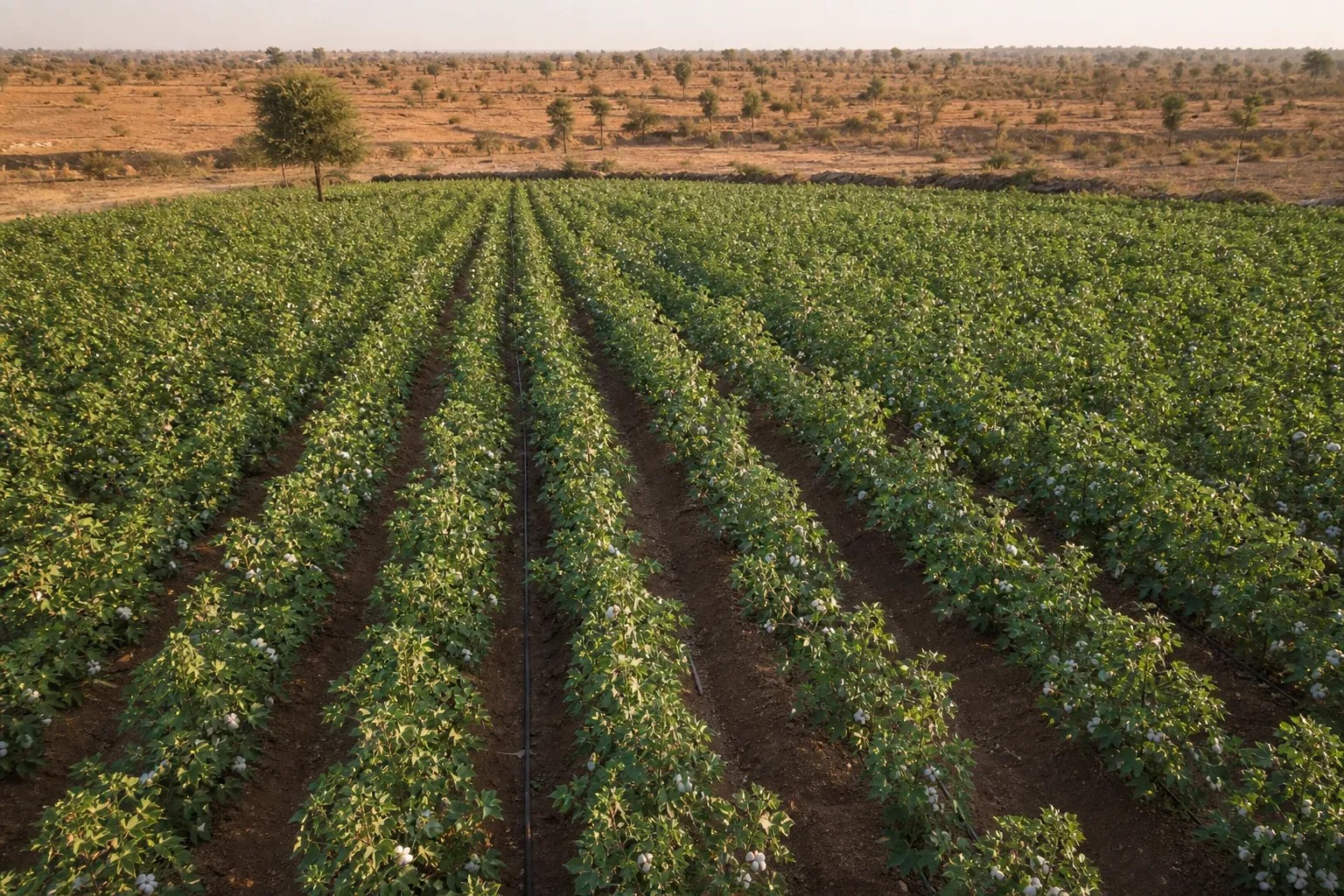
Conventional cotton farming uses roughly 10,000 litres of water to produce a single kilogram of lint — enough to fill a small swimming pool for one T-shirt and a pair of jeans. That number has defined cotton's environmental reputation for decades. But it is not inevitable. Farmers across Maharashtra, Telangana, and Gujarat are already producing cotton with a fraction of that water footprint, using a combination of soil restoration, precision irrigation, and biological inputs that work together to make every litre count.
Water scarcity is no longer a future risk for cotton-growing regions in India. Groundwater tables in key cotton belts have dropped measurably over the past two decades. Erratic monsoons are compressing the reliable growing window. And textile brands sourcing from these regions are beginning to face hard questions from regulators, investors, and consumers about the water embedded in their products. Water use reduction in regenerative cotton farming is not just an environmental goal — it is a practical, measurable outcome that benefits farmers, brands, and the communities that depend on these watersheds.
This guide breaks down six specific practices that drive water efficiency in regenerative cotton systems, explains the mechanisms behind each one, and ends with the questions textile brands should be asking their suppliers right now.
Why Water Use in Cotton Farming Demands a Different Approach
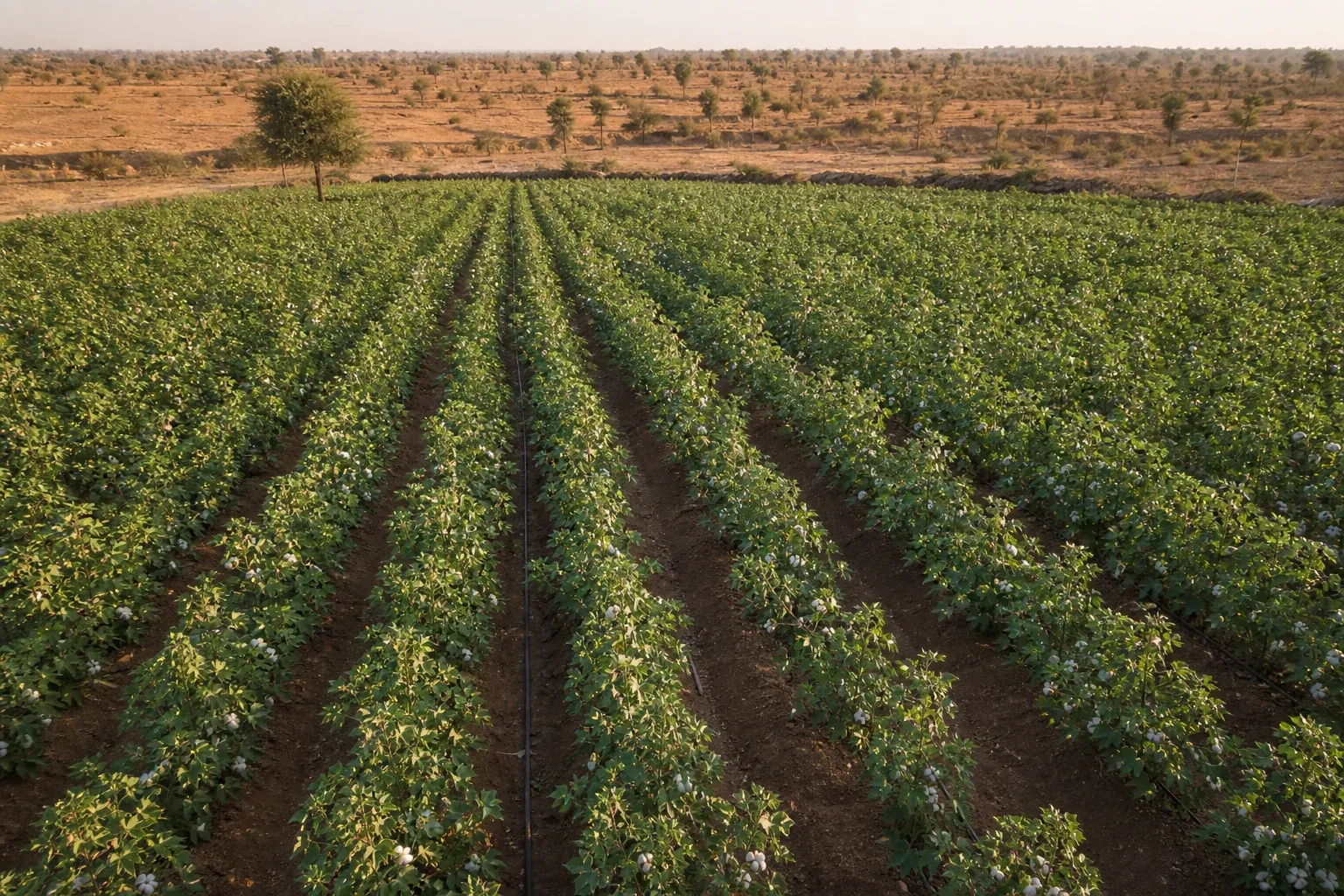
Cotton covers roughly 2.5% of the world's cultivated land but accounts for nearly 16% of global insecticide use and a disproportionate share of agricultural water withdrawals. In India, which produces about 23% of the world's cotton, the crop is grown predominantly in semi-arid regions where rainfall is seasonal and groundwater is already under stress. States like Maharashtra, Gujarat, and Telangana have seen significant groundwater depletion in districts where cotton is the dominant crop.
Conventional cotton farming compounds the problem in two ways. First, flood and furrow irrigation — still the dominant method across smallholder farms, delivers water inefficiently, with large volumes lost to evaporation and runoff before reaching the root zone. Second, decades of synthetic fertilizer use and deep tillage have degraded soil structure, reducing the land's natural ability to absorb and hold rainfall. The result is a system that demands more water to produce the same yield, season after season.
For textile brands, this creates a supply chain vulnerability that is becoming harder to ignore. The WWF's cotton risk assessment identifies water scarcity as one of the top material risks for cotton sourcing globally. Emerging frameworks like the EU Corporate Sustainability Reporting Directive (CSRD) are beginning to require water-related disclosures across supply chains. Brands that cannot demonstrate responsible water stewardship in their cotton sourcing will face growing compliance exposure.
The good news is that regenerative cotton farming addresses the root causes of water inefficiency, not just the symptoms. The practices below work together as a system, each reinforcing the others to build farms that are genuinely more water-resilient.
1. Restore Soil Health to Build a Natural Water Reservoir
Healthy soil is the foundation of water-efficient cotton farming. This is not a metaphor, it is a measurable physical reality. Soil organic matter (SOM) acts like a sponge, holding water in the pore spaces between soil particles and releasing it slowly to plant roots. Research consistently shows that a 1% increase in soil organic matter can increase a soil's water-holding capacity by approximately 20,000 litres per hectare. On a degraded cotton farm where SOM has dropped to 0.3, 0.5% (common in long-farmed Indian cotton soils), restoring it to even 1.5% represents a dramatic improvement in the land's ability to buffer against dry spells.
Conventional tillage is one of the primary destroyers of this capacity. Deep ploughing breaks up soil aggregates, exposes organic matter to oxidation, and disrupts the fungal networks and earthworm channels that create the macro-pores through which water infiltrates. The result is a compacted, low-porosity soil that sheds rainfall as runoff rather than absorbing it.
Regenerative practices that rebuild SOM include:
- Compost and vermicompost application, adding organic matter directly to the soil profile
- Biological inputs, microbial inoculants that accelerate organic matter decomposition and nutrient cycling
- Reduced or minimum tillage, preserving soil structure and the organisms that build it
- Crop residue retention, leaving cotton stalks and other residues to decompose in place rather than burning them
Brands sourcing regenerative cotton should ask suppliers for baseline and current SOM measurements as a proxy for water efficiency. A supplier who can show a documented increase in SOM over two or three seasons is demonstrating real, verifiable progress, not just a certification label. For a deeper look at how these practices connect to broader soil restoration goals, see our guide on sustainable farming and regenerative agriculture.
2. Apply Biochar to Amplify Soil Moisture Retention
Biochar deserves its own section because its water retention benefits are distinct from those of compost or cover crops. Biochar is a highly porous carbon material produced by heating organic matter (crop residues, wood waste) in a low-oxygen environment. Its internal surface area is enormous, a single gram of biochar can have a surface area of several hundred square metres, and those surfaces hold both water and nutrients in the root zone where plants can access them.
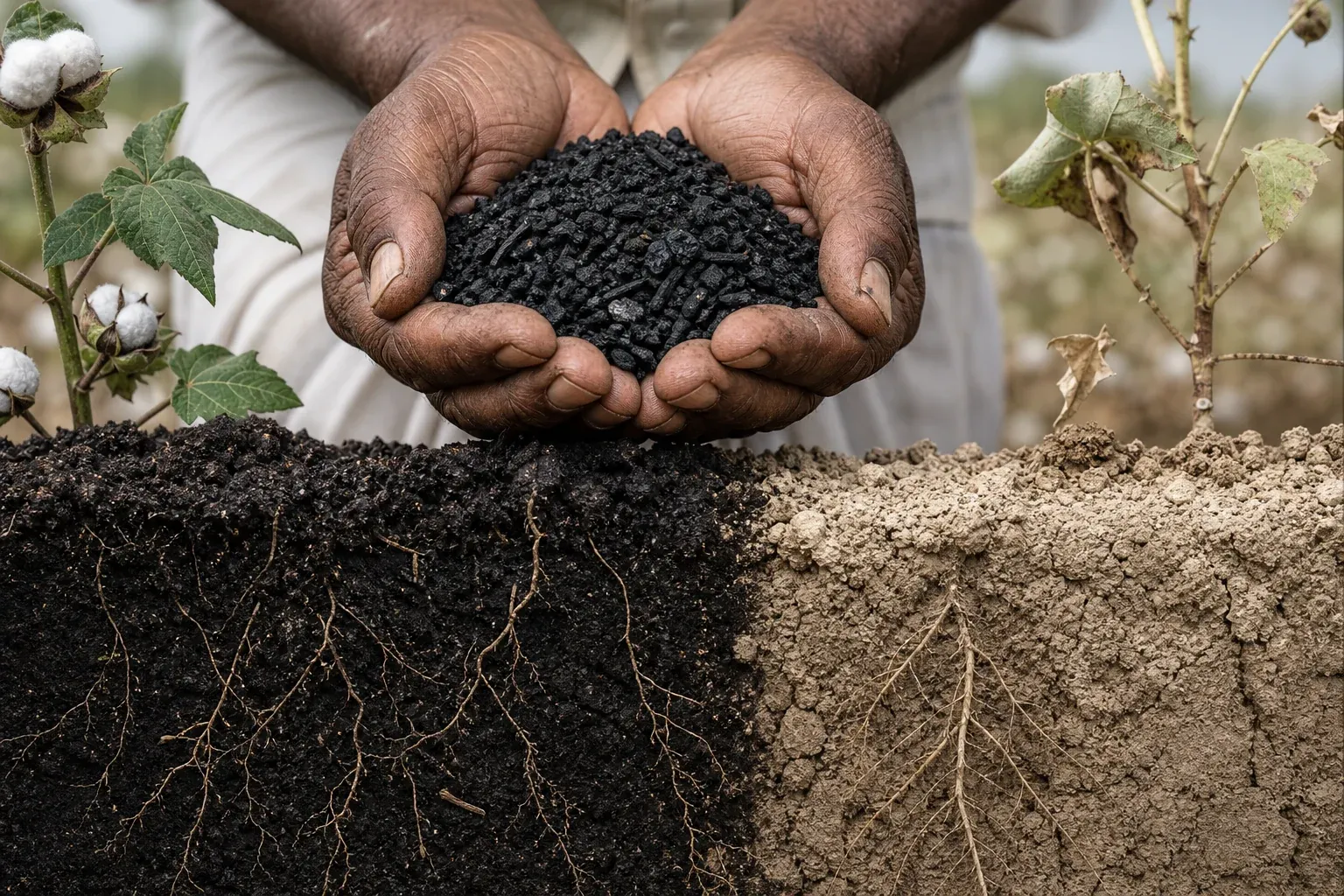
In cotton-growing regions of India, biochar application rates of 2, 5 tonnes per hectare have shown measurable improvements in soil moisture retention, particularly during dry spells between irrigation cycles. Farmers report needing fewer irrigation events to maintain crop health, and soil moisture monitoring data from biochar-amended plots shows slower moisture depletion compared to control plots.
Beyond water efficiency, biochar delivers a second benefit that matters to textile brands: it is a durable carbon sink. Biochar carbon is stable for hundreds to thousands of years, making it one of the most credible forms of carbon sequestration available in agricultural systems. This means that a single biochar application program simultaneously improves water efficiency on the farm and generates verifiable carbon removal credits that brands can use for their net zero commitments.
At Beetle Regen, biochar production and application is integrated into our regenerative cotton programs across Maharashtra and Madhya Pradesh. Farmers receive training on biochar production from locally available crop residues, reducing input costs while building long-term soil resilience. To understand how biochar fits into a broader carbon strategy for textile brands, see our post on carbon insetting solutions for textile supply chains.
3. Switch to Drip Irrigation for Precision Water Delivery
Soil health improvements reduce how much water a cotton crop needs. Drip irrigation determines how efficiently that water is delivered. The two work together, and the combination is where the most dramatic water savings occur.
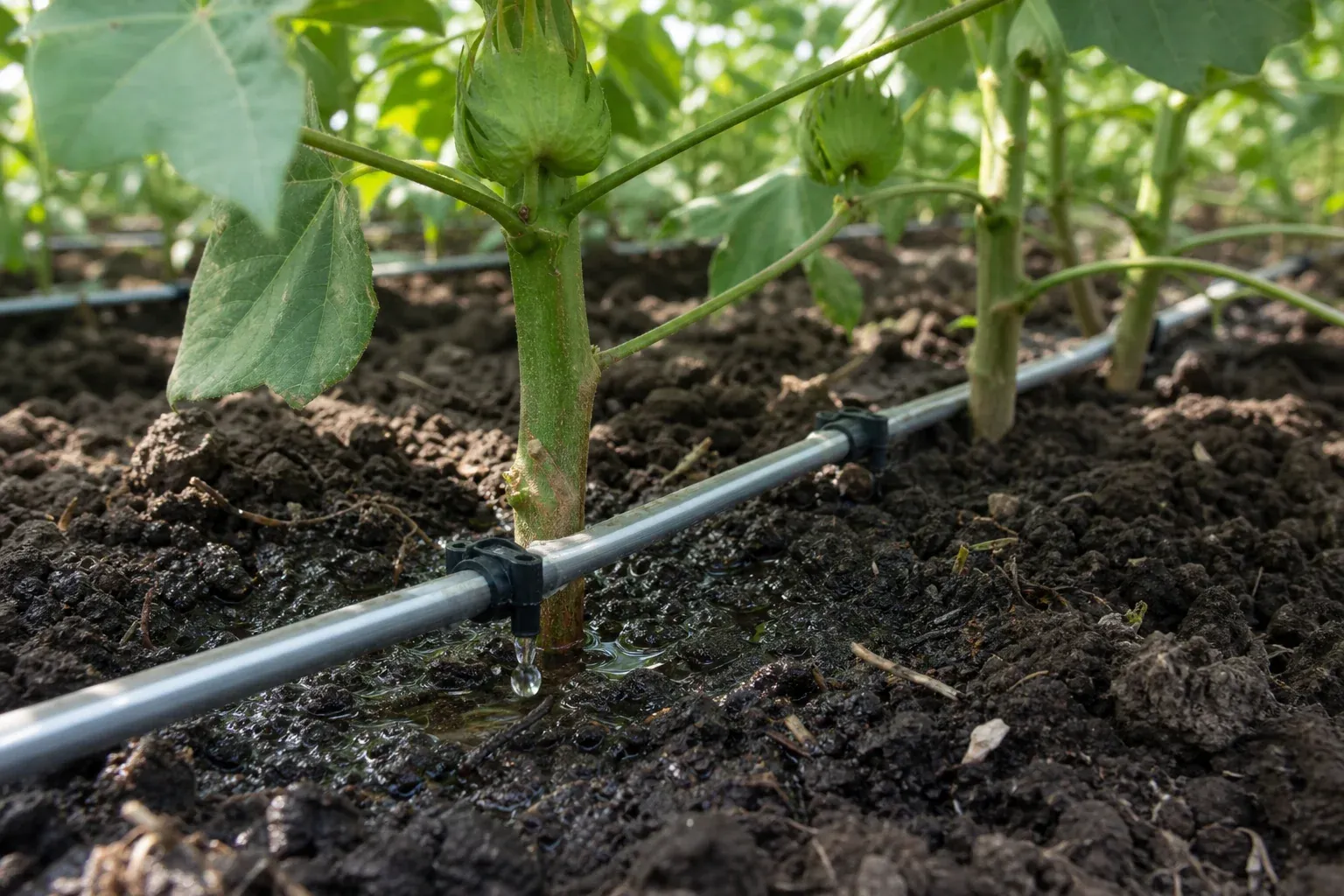
Flood and furrow irrigation, the conventional method used across most smallholder cotton farms in India, delivers water across the entire soil surface. A large proportion of that water never reaches the root zone. It evaporates from the soil surface, runs off into drainage channels, or percolates below the root zone where plants cannot access it. Drip irrigation eliminates most of these losses by delivering water directly to the root zone through a network of emitters placed at or below the soil surface.
The water savings are substantial. Studies comparing drip to flood irrigation in cotton production in India have documented reductions of 30, 50% in total water applied, with equivalent or improved yields. The FAO's irrigation efficiency data supports this range, noting that drip systems typically achieve application efficiencies of 85, 95% compared to 50, 60% for surface irrigation methods.
Drip irrigation also enables fertigation, the delivery of soluble fertilizers and biological inputs through the irrigation system directly to the root zone. This reduces the total volume of inputs needed, cuts costs, and prevents the nutrient runoff that contributes to water pollution downstream.
Feasibility for Smallholder Farmers
The upfront cost of drip installation has historically been a barrier for smallholder farmers. However, the Government of India's Pradhan Mantri Krishi Sinchayee Yojana (PMKSY) scheme provides subsidies of 45, 55% on drip irrigation equipment for small and marginal farmers, with higher subsidies available in water-stressed districts. Several state governments in Maharashtra and Gujarat offer additional top-up subsidies. When combined with the input cost savings from reduced water and fertilizer use, drip systems typically achieve payback periods of two to three seasons for cotton farmers.
4. Use Cover Crops and Intercropping to Reduce Evaporation
Bare soil loses water fast. On a hot day in a cotton-growing district of Vidarbha, an unshaded soil surface can lose several millimetres of moisture to evaporation within hours of irrigation. Cover crops address this directly by shading the soil surface, reducing surface temperature, and physically blocking the air movement that accelerates evaporation.
In regenerative cotton systems, cover crops are typically planted in the inter-row spaces during the cotton growing season or as a full-season cover between cotton crops. Leguminous cover crops, such as cowpea, horsegram, or cluster bean, are particularly well-suited to cotton-growing regions in India because they fix atmospheric nitrogen, reducing the need for synthetic fertilizers while simultaneously conserving soil moisture.
The water conservation mechanisms of cover crops include:
- Reduced evaporation, canopy cover shades the soil surface and lowers surface temperature
- Improved infiltration, cover crop roots create channels that allow rainfall to penetrate rather than run off
- Mulching effect, when cover crop residues are terminated and left on the surface, they act as a physical mulch layer that further reduces evaporation
- Improved soil structure, root activity and organic matter addition from cover crops builds the aggregate structure that holds water
Intercropping cotton with short-duration legumes also provides farmers with an additional income stream from the intercrop harvest, improving the economic resilience of the farming system. For a comprehensive look at how cover crops function in regenerative systems, our guide on cover crops in regenerative agriculture covers species selection, establishment, and termination in detail.
5. Reduce Tillage to Protect Soil Structure and Water Pathways
Every time a plough passes through a cotton field, it disrupts the physical architecture that makes soil water-efficient. Earthworm burrows, fungal hyphae networks, and the channels left by decomposed root systems all act as preferential pathways for water infiltration, moving rainfall quickly from the surface down into the soil profile where it can be stored. Deep tillage destroys these pathways and forces water to move through a more uniform, compacted matrix that infiltrates slowly and runs off easily.
Minimum tillage and no-till approaches preserve these biological water pathways. In practice, transitioning a cotton farm to low-till systems involves:
- Replacing deep mouldboard ploughing with shallow surface cultivation or direct seeding
- Using subsoil aeration tools (like a chisel plough) only where compaction is severe, rather than as a routine practice
- Retaining crop residues on the surface rather than incorporating them through tillage
- Building soil biology through compost and biological inputs so that natural tillage by soil organisms replaces mechanical tillage over time
The water benefits of reduced tillage compound over time. In the first season, farmers may see modest improvements in infiltration. By the third or fourth season, as soil biology recovers and organic matter accumulates, the difference in water-holding capacity between a low-till regenerative plot and a conventionally tilled plot becomes measurable and significant. This is why regenerative cotton programs need multi-year commitments, the water efficiency gains are real, but they build progressively.
6. Integrate Biological Inputs to Support Water-Efficient Plant Growth
Plants that are biologically healthy use water more efficiently. This is a principle that conventional agriculture has largely ignored in its focus on synthetic inputs, but it is central to how regenerative cotton systems achieve more with less.
Mycorrhizal fungi form symbiotic relationships with cotton plant roots, extending the effective root surface area by orders of magnitude. This extended network reaches water and nutrients in soil zones that the plant's own roots cannot access, effectively increasing the plant's drought tolerance without any additional irrigation. Mycorrhizal inoculants are now commercially available and are a standard component of regenerative cotton programs.
Other biological inputs that improve water efficiency include:
- Rhizobium and phosphate-solubilising bacteria, improve nutrient availability, reducing the plant's need to allocate resources to nutrient acquisition and freeing energy for growth and stress tolerance
- Humic and fulvic acid applications, improve soil aggregate stability and water retention at the micro-scale
- Seaweed-based biostimulants, contain natural compounds that improve plant stress responses, including drought stress
Reducing synthetic fertilizer dependency also has a direct water benefit that is often overlooked. High nitrogen applications increase a plant's transpiration rate, the plant grows faster and larger, but also pulls more water through its system. Regenerative programs that replace synthetic nitrogen with biological nitrogen fixation and slow-release organic sources produce plants that grow more steadily and use water more efficiently across the season.
These biological approaches connect directly to yield outcomes as well. For the evidence on how regenerative practices affect productivity, see our analysis of how regenerative agriculture increases crop yield.
What Textile Brands Should Ask Their Cotton Suppliers
Water efficiency claims are easy to make and hard to verify without the right questions. As water disclosure requirements tighten under frameworks like EU CSRD and the Science Based Targets initiative (SBTi), brands need supplier data that goes beyond general statements about "sustainable practices."

Here are the specific questions brands should be asking their cotton suppliers:
On Irrigation and Water Volume
- What is your current irrigation water use (IWU) per kilogram of lint produced? (Benchmark: regenerative systems targeting below 5,000 litres/kg vs. conventional averages of 8,000, 10,000 litres/kg)
- What percentage of your farmers have adopted drip irrigation, and what is the average water saving compared to their previous method?
- Do you have water meter data or flow monitoring at the farm level, or are water use figures estimated?
On Soil Health and Water Retention
- What are the baseline and current soil organic matter levels across your program farms?
- Do you track soil moisture levels during the growing season? What tools do you use?
- What is the average number of irrigation events per season, and how has this changed since transitioning to regenerative practices?
On Practices and Verification
- Are biochar, cover crops, and biological inputs part of your standard program, or optional add-ons?
- How are practice adoption rates monitored and verified? Is there third-party MRV in place?
- Can you provide farm-level traceability data that links water efficiency metrics to specific lots of cotton?
Suppliers who cannot answer these questions with data, not just narrative, are not yet operating at the level of transparency that regulatory frameworks and brand commitments will soon require. For guidance on building the traceability infrastructure that makes this data available, see our guide on supply chain traceability for regenerative cotton.
Brands that are building their broader sustainability sourcing strategy will also find it useful to understand how water data connects to carbon and compliance reporting. Our post on the fashion brand net zero roadmap covers how water, carbon, and biodiversity metrics fit together in a verified climate strategy.
Measuring Water Use Reduction: Metrics That Matter
Reducing water use is only meaningful if it can be measured, verified, and reported. The following metrics form the core of a credible water efficiency monitoring framework for regenerative cotton programs:
Water Productivity
Water productivity (kg of cotton lint per cubic metre of water applied) is the most useful single metric for comparing water efficiency across farms and systems. A conventional flood-irrigated cotton farm in Maharashtra might achieve 0.10, 0.12 kg/m³. A well-managed regenerative system with drip irrigation and healthy soils can reach 0.20, 0.25 kg/m³, roughly double the output per unit of water. This metric captures both the efficiency of delivery (irrigation method) and the efficiency of use (soil health, plant biology).
Irrigation Water Use (IWU)
Total irrigation water applied per hectare per season, measured in cubic metres or millimetres. This should be tracked alongside rainfall data to separate irrigation from total water input. Regenerative programs that improve soil water retention will show a reduction in IWU even in years with similar rainfall, because the soil is holding and releasing water more effectively.
Soil Moisture Monitoring
Capacitance-based soil moisture sensors (such as those used in precision agriculture systems) provide real-time data on soil water content at different depths. This data enables irrigation scheduling based on actual soil moisture rather than fixed calendars, reducing over-irrigation and improving water productivity. It also generates the time-series data that MRV systems need to verify water efficiency claims over multiple seasons.
Connecting Water Data to Carbon and Compliance Reporting
Water metrics do not exist in isolation. Soil organic matter improvements that drive water retention also drive carbon sequestration. Biochar applications that improve moisture retention also generate carbon removal credits. Cover crops that reduce evaporation also fix nitrogen and support biodiversity. Regenerative cotton programs that measure water, carbon, and soil health together generate a richer dataset that supports multiple reporting frameworks simultaneously, from CSRD water disclosures to Science Based Targets to carbon credit verification.
This integration of data streams is where programs like Beetle Regen's add the most value for brands. Rather than managing separate monitoring systems for water, carbon, and soil, a well-designed regenerative program generates interconnected data that serves all of these reporting needs from a single field-level monitoring framework. For a detailed look at how this data integration works in practice, see our guide on MRV and traceability systems for cotton.
Building Water Resilience Into Your Cotton Supply Chain
The six practices covered in this guide, soil health restoration, biochar application, drip irrigation, cover cropping, reduced tillage, and biological inputs, are not independent interventions. They work as a system. Healthy soil holds more water. Biochar amplifies that capacity. Drip irrigation delivers water precisely to where the soil can hold it. Cover crops reduce the evaporation that would otherwise deplete it. Reduced tillage preserves the biological architecture that makes all of it work. Biological inputs ensure the plant uses what is available as efficiently as possible.
The result is a cotton farming system that is genuinely more resilient to water stress, not just in a good monsoon year, but across the variable rainfall patterns that climate change is making the new normal in India's cotton belts. Farmers who have transitioned to these practices report greater confidence in their ability to manage dry spells, reduced dependence on groundwater, and more stable yields across seasons.
For textile brands, sourcing from these farms is not just an environmental choice. It is a supply chain risk management decision. Cotton grown on water-resilient farms is less vulnerable to drought-driven yield failures, price spikes, and the reputational and regulatory risks that come with sourcing from water-stressed regions without a credible stewardship story.
Water scarcity is becoming one of the biggest challenges facing cotton-growing regions. Regenerative cotton farming is a practical pathway to improving water efficiency while building long-term resilience, for farmers, for brands, and for the communities that share these watersheds.
At Beetle Regen, our regenerative cotton programs are designed to deliver measurable water efficiency outcomes alongside carbon sequestration, soil health improvement, and farmer income gains. We work directly with smallholder farmers across Maharashtra, Madhya Pradesh, and Gujarat to implement the practices described in this guide, and we provide the MRV and traceability infrastructure that brands need to verify and report on those outcomes.
If your brand is building a sustainable cotton sourcing strategy and needs verified water efficiency data from your supply chain, we would welcome the conversation. Reach out to the Beetle Regen team to discuss how a regenerative cotton program can address your water, carbon, and compliance goals in one integrated approach.