How to Buy Carbon Credits in India: A Brand's Guide
You buy carbon credits in India by choosing a verified project type first, biochar-based carbon insetting or a generic offset, then confirming farm-level traceability, checking the verification standard, and running due diligence on the supplier before signing. For textile and fashion brands, insetting inside your own cotton supply chain now beats buying anonymous offsets, because it produces auditable Scope 3 data that regulators and boards actually accept.
Key Takeaways
- Insetting beats generic offsets for textile brands: Biochar credits generated inside your own cotton or rice supply chain give you Scope 3 evidence that CSRD auditors and brand boards can verify, unlike anonymous offset certificates.
- Verification standard matters more than price: Look for Puro.earth, Verra, or Gold Standard methodology backing, plus third-party MRV (measurement, reporting, verification) reports tied to named farms.
- Traceability to a named farm is non-negotiable: A credit tied to "a region in Madhya Pradesh" is a weaker claim than one tied to a specific cooperative and kiln batch record.
- Due diligence takes five checks: farmer onboarding records, kiln safety training logs, soil baseline data, third-party audit rights, and co-benefit documentation (income, water, biodiversity).
- Buy to a number, not a feeling: Calculate your residual Scope 3 gap first, then size your credit purchase and reporting cadence around that number, not a marketing target.
At a Glance: Buying Carbon Credits in India
| Factor | Generic Voluntary Offset | Biochar-Based Insetting |
|---|---|---|
| Traceability | Regional or portfolio-level, often anonymized | Farm and cooperative level, batch-tracked |
| Typical price band | Varies widely by project type and vintage | Generally priced higher than cheap forestry offsets due to permanence and MRV depth |
| Verification standards commonly used | Verra VCS, Gold Standard | Puro.earth, Verra biochar methodology, Gold Standard |
| Carbon permanence | Ranges from years (avoidance) to centuries (some removals) | Decades to centuries, biochar resists decomposition |
| Scope 3 / CSRD relevance | Limited, hard to link to your own supply chain | High, ties directly to your fiber sourcing footprint |
| Co-benefits documented | Sometimes, project-dependent | Farmer income, soil health, reduced residue burning |
| Best fit | Brands needing quick residual offsetting outside core supply chain | Textile brands sourcing cotton or rice from India wanting insetting inside Scope 3 |
1. Decide Whether You Need Offsets or Carbon Insetting
Before you buy carbon credits in India, decide what kind of credit actually fits your supply chain. Generic offsets let you fund a project anywhere on the planet, a wind farm in one state, a forestry scheme in another, with no direct link to your own sourcing. That's fine for closing a small residual gap. It does very little for a textile brand whose Scope 3 emissions come mostly from cotton farming, ginning, and dyeing inside India and Bangladesh.
Carbon insetting flips that model. You fund emission reductions inside your own value chain, on the same farms that already grow your cotton or rice. Biochar production from crop residue is the clearest example: instead of farmers burning cotton stalks or rice husks in the field, they convert that biomass into biochar, locking carbon into a stable form while also improving the soil those crops depend on. You can read a full breakdown of the mechanics in our guide on how biochar carbon insetting works for textile brands.
The tradeoff is straightforward. Offsets are often cheaper and faster to procure. Insetting costs more per tonne but gives you data you can put directly into a CSRD disclosure or a board report, because the carbon reduction happened on farms already inside your supplier list. If your Net Zero roadmap depends on defensible Scope 3 numbers, insetting is worth the extra diligence.
2. Check Verification Standards Before You Pay
Any credible carbon credit needs a methodology behind it, a document that spells out exactly how the carbon reduction gets measured, reported, and verified. This is often shortened to MRV. Three names show up most often in the Indian market: Verra (VCS), Gold Standard, and Puro.earth, which runs a specific methodology for biochar carbon removal.
Ask your supplier three direct questions before you pay for anything:
- Which methodology and registry certifies this credit, and can you show the registration number?
- Who conducted the third-party audit, and how often does re-verification happen?
- Does the MRV report include farm-level soil or biomass data, or only aggregate project totals?
If a supplier can't answer the third question with specifics, treat that as a warning sign. Aggregate numbers without farm-level backing are exactly the kind of claim that draws scrutiny under the EU's Corporate Sustainability Reporting Directive. The Food and Agriculture Organization's soils portal and India's own Ministry of Environment, Forest and Climate Change both publish guidance that credible carbon accounting has to trace back to measurable, site-specific data, not portfolio averages.
3. Trace the Credit Back to a Named Farm, Not Just a Region
A tonne of carbon sold as coming from "central India" tells you almost nothing. A tonne tied to a named cooperative, a specific kiln batch, and a soil test from before and after the season tells you everything a compliance auditor will eventually ask for. This is the difference between a credit you can defend in a board meeting and one you have to explain away.
Beetle Regen builds its biochar credits this way. Each tonne links to a farmer cooperative in Madhya Pradesh or Maharashtra, a documented kiln operation trained under safe-handling protocols, and a soil organic carbon baseline taken before the program started. You can see how that farmer-first model plays out in practice in our piece on how one cotton farmer doubled his soil organic carbon in two seasons, or explore the wider footprint in biochar projects in India scaling carbon insetting for textile supply chains.
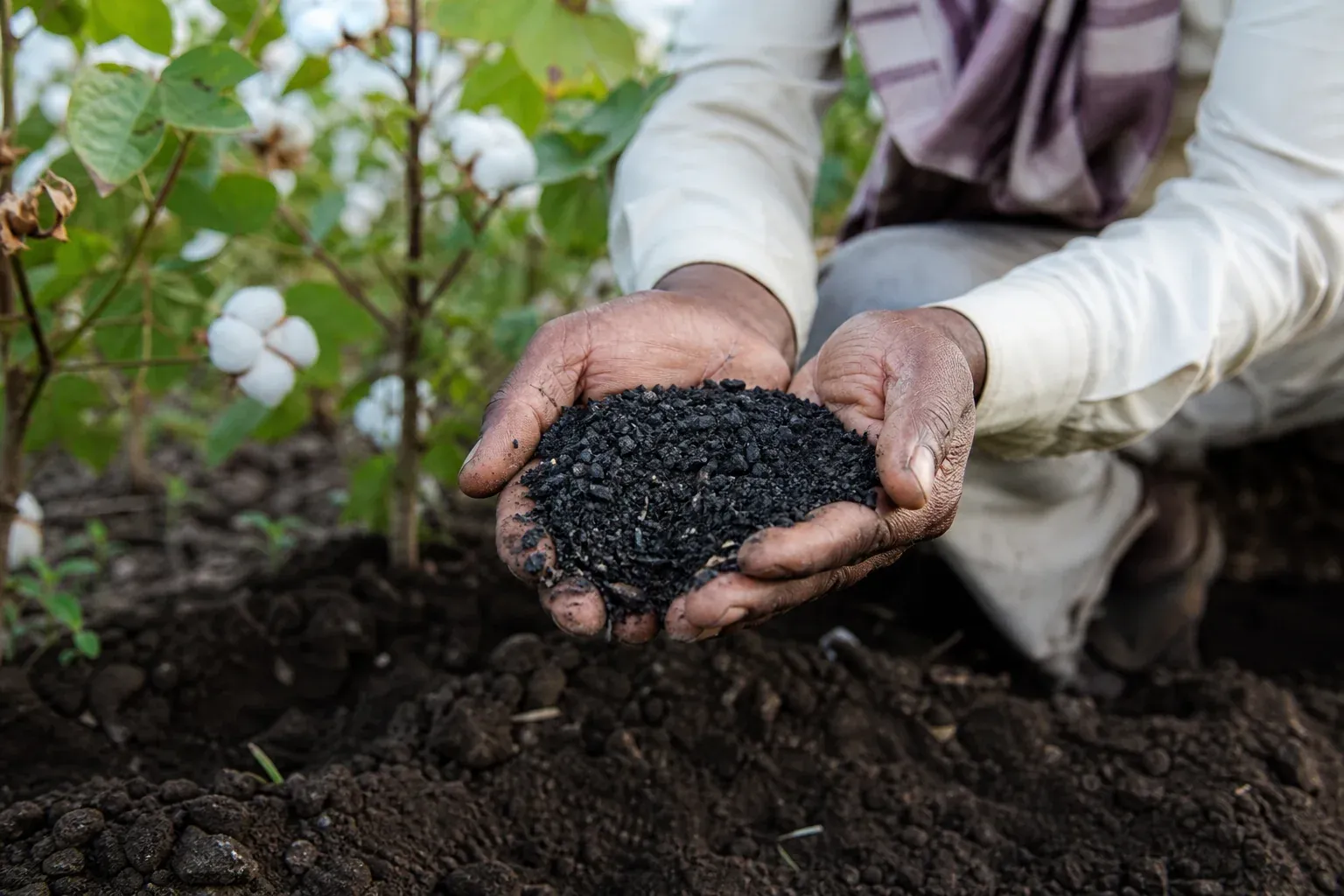
This farm-level tracing also protects you from greenwashing risk. If a journalist, an NGO, or an auditor ever asks where your carbon claim comes from, "a cooperative of 40 farmers near Yavatmal, verified against this soil test" holds up. "A regional average" does not. If you're weighing multiple suppliers on this exact point, our comparison of regenerative vs conventional cotton and what brands pay for walks through the pricing logic behind traceable versus generic claims.
4. Run Due Diligence Before You Sign
Buying carbon credits in India without a due diligence process is how brands end up with credits they can't defend later. Build your checklist around five things:
- Farmer onboarding records: Ask for enrollment documentation showing which farmers joined, when, and under what terms.
- Kiln safety and training logs: Biochar production involves controlled burns. Suppliers should be able to show training records, not just a claim that farmers "know how."
- Soil baseline and follow-up testing: Request the actual lab results, not a summary paragraph. A real baseline includes dates, plot IDs, and a testing lab name.
- Audit rights in the contract: Make sure your agreement lets you or a third party visit project sites and pull records on request.
- Co-benefit documentation: Farmer income change, reduced field burning, and women's participation rates all strengthen your ESG story beyond the raw tonnage number.
Don't skip site visits if your purchase volume is significant. A short trip to see a kiln operation and talk to a cooperative lead tells you more in an afternoon than three months of email exchanges. For a broader checklist on vetting any biochar partner, see our guide to how biochar carbon insetting works for textile brands.
5. Match Credit Volume to Your Net Zero Roadmap
Buying credits without first calculating your residual emissions gap is a common and expensive mistake. Start with a proper carbon footprint of your cotton or textile supply chain, farm inputs, ginning, spinning, dyeing, transport, so you know how many tonnes you actually need to address. Only after that number exists should you shop for credits.
Most brands find that a mix works best: insetting credits covering the farm-level portion of Scope 3 that sits inside your own supply chain, plus a smaller volume of external offsets for emissions you can't yet reach through insetting. Lock in multi-year purchase agreements where possible. Farmer cooperatives plan their kiln operations and residue collection around predictable buyer commitments, and a single-season order leaves both sides guessing. Our guide on what KPIs to track in a regenerative cotton program is a useful companion here if insetting sits alongside a wider regenerative cotton sourcing plan.
6. Monetization Pathways and Reporting
Once you've bought insetted or offset credits, the work isn't finished. You still need to report them correctly. CSRD and most voluntary Net Zero frameworks expect you to show, tonne by tonne, where a reduction happened and how it was verified, not just a total offset figure in a sustainability PDF.

Build your reporting around three layers: the credit's registry certificate, the farm-level MRV data behind it, and a plain-language summary a board member without a climate background can follow. If you need a template for that last layer, our post on how to report regenerative program results to a brand board breaks down exactly which numbers to lead with.
Farmer cooperatives also benefit from this reporting discipline. When a brand's carbon purchase ties directly to their kiln output and soil data, cooperatives can negotiate stronger long-term contracts and reinvest in training. That's the monetization loop Beetle Regen is built around: farmers earn from residue they used to burn, and brands get insetted credits with a documentation trail that survives an audit. You can also review how this connects to wider traceability requirements in why traceability in cotton matters for brand compliance.
Frequently Asked Questions
Is carbon accounting software enough on its own?
No. Carbon accounting software measures and reports your footprint, it doesn't reduce it. Fashion brands searching for carbon accounting tools still need an actual reduction pathway, whether that's insetting, offsets, or process changes in manufacturing, to close the gap the software identifies.
What's the difference between carbon accounting and buying credits?
Carbon accounting measures your emissions across Scope 1, 2, and 3. Buying carbon credits is one method to address the portion of those emissions you can't eliminate directly, either through insetting inside your own supply chain or offsetting elsewhere. You need accounting first to know how many credits, if any, to buy.
Can small and mid-size brands buy directly from Indian projects?
Yes. Many biochar and regenerative agriculture projects in India work with brands well below the scale of global retailers, especially when the brand can commit to a defined cotton or fiber volume over a season or two. Smaller buyers often get more direct access to farm-level data because the supplier isn't managing dozens of simultaneous corporate accounts.
How does biochar carbon compare to other regenerative practices for credit generation?
Biochar produces a more measurable, longer-lasting carbon store than practices like cover cropping alone, because the carbon is converted into a stable solid rather than left to decompose at variable rates in the soil. Many programs combine both, using biochar as the anchor credit and soil carbon gains from broader regenerative practices as a supporting co-benefit.
If your team is ready to move past generic offset certificates and buy carbon credits in India that trace back to a named farm, a documented kiln, and a verified soil baseline, Beetle Regen's farmer-first biochar program is built for exactly that. Contact us to walk through your Scope 3 numbers and see which credit volume and verification standard actually fits your Net Zero roadmap.