Regenerative Agriculture Capacity Building: How to Design Farmer Training That Sticks Beyond the Workshop
Regenerative agriculture capacity building works when training treats farming as a skill that develops over seasons, not a one-day lesson to be checked off. Programs that pair short, repeated field sessions with demonstration plots, peer champions and season-long follow-up see practices like biochar application, alternate wetting and drying, and intercropping actually survive into year two and three, long after the workshop banners come down.
Key Takeaways
- One workshop rarely changes behavior: Farmers need contact across sowing, mid-season, and harvest to see how a practice performs under their own soil and weather.
- Demonstration plots outperform lectures: Farmers trust what they see growing on comparable land more than what they hear in a classroom.
- Local champions carry knowledge between visits: A trusted peer answering questions mid-season keeps adoption alive when program staff are elsewhere.
- Every practice needs its "why": Farmers who understand soil biology behind composting or biochar adapt the practice instead of abandoning it when conditions shift.
- Adoption must be measured after the session, not just attendance: Continued practice, peer teaching, and yield or soil change across seasons are the real signals of success.
At a Glance: What Makes Farmer Training Stick
| Training Element | Weak Approach | What Works Better |
|---|---|---|
| Session structure | Single classroom-style workshop | Repeated touchpoints across the crop cycle |
| Content delivery | Generic slide-based instruction | Demonstration plots and hands-on field practice |
| Local reinforcement | No follow-up between visits | Regen Ambassadors or local champions in-village |
| Practice framing | Instructions without reasoning | Linking soil test results to the practice's purpose |
| Farmer role | Passive recipient of instructions | Active experimenter with room to observe and adapt |
| Success measure | Attendance count | Season-over-season adoption and peer teaching data |
Why Regenerative Agriculture Cannot Be Taught in One Sitting
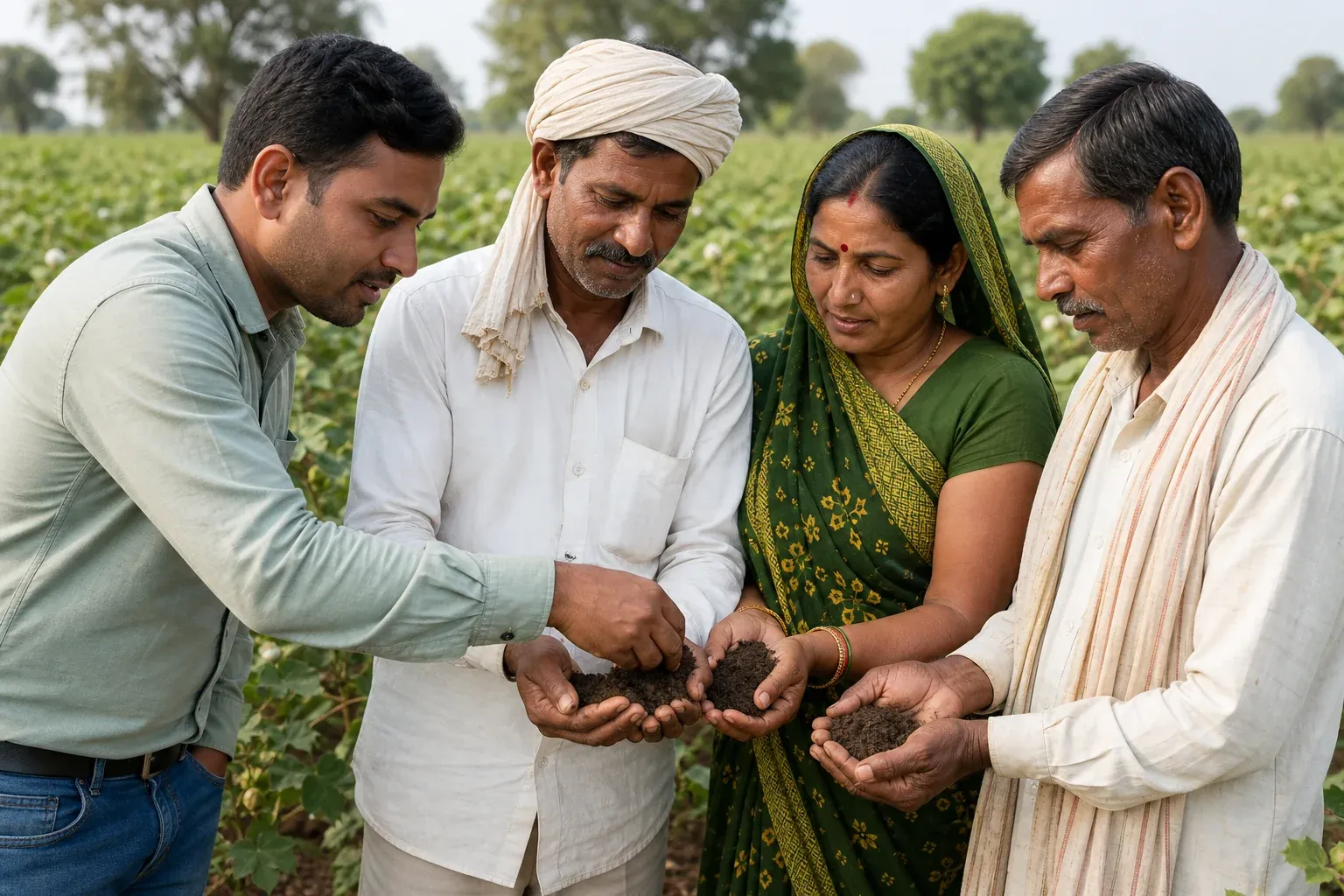
Regenerative agriculture is a set of decisions farmers make and remake as conditions change, not a fixed recipe handed down once. A cotton farmer in Madhya Pradesh faces different pest pressure, rainfall timing and soil moisture every season. A rice farmer in Bangladesh manages water differently depending on how the monsoon behaves that year.
The scale of the underlying soil problem is why this matters beyond any single farm. Global assessments have found that more than 1 billion hectares of cropland and pastureland worldwide are now classified as degraded. Soil management is rated poor or very poor across roughly half of the world's regions and subregions. Proven fixes exist, but they are still not being adopted at the pace or scale needed. That gap between known solution and actual field practice is exactly what season-long training is meant to close.
Because the underlying conditions shift, the skill a farmer needs is not memorization of steps. It's judgment: when to apply biochar, how deep to draw down water under an alternate wetting and drying schedule, or how to time intercropping against a neighbor's planting calendar. That judgment only builds through repeated exposure and feedback, not a single afternoon of instruction.
This is why capacity building differs from a training calendar. A calendar tracks sessions delivered. Capacity building tracks whether a farmer can make a sound call on their own plot without someone standing next to them.
Why One-Off Workshops Fail to Change Field Practice
A single workshop cannot cover an entire crop cycle, and knowledge fades fast without reinforcement. Farmers who hear about composting in June but don't apply it until September often forget the details that mattered, like ratios, timing, or moisture levels, and default back to familiar habits.
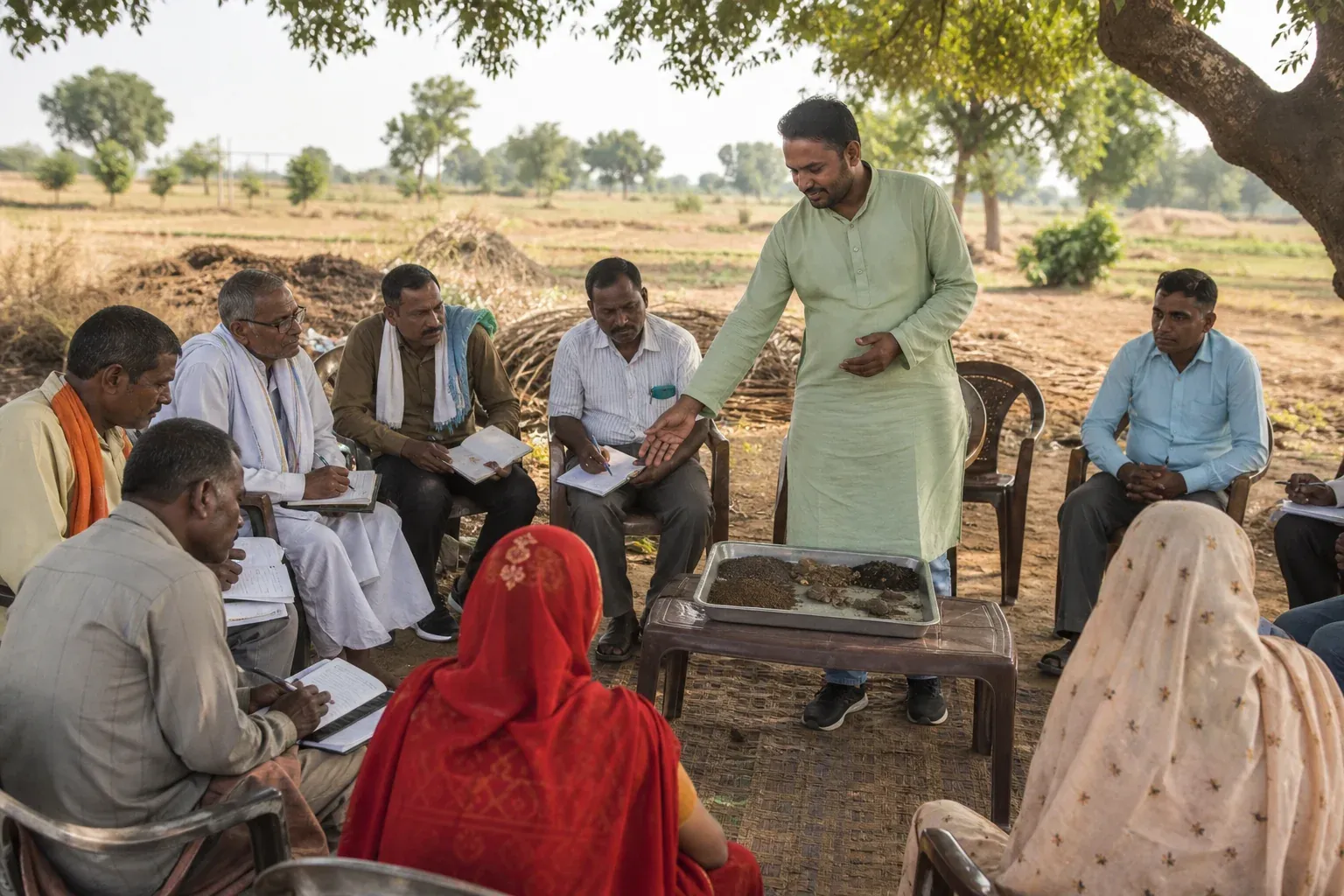
We've seen program designs collapse into an attendance-tracking exercise: mark the sign-in sheet, hand out a leaflet, move to the next village. That model produces good numbers on a slide deck. It rarely produces a farmer who changes what happens on their own three acres.
Adults retain skills better through spaced repetition and applied practice than through a single information dump. Farming adds another layer. A practice has to be tested against real weather, real pests, and real market timing before a farmer trusts it enough to repeat it without supervision.
The fix isn't more content in one sitting. It's shorter, more frequent touchpoints spread across sowing, mid-season and harvest, each one building on what the last one taught. The sample schedule and steps below outline how to design that kind of program in practice.
A Sample Season-Long Touchpoint Schedule
- Pre-sowing (Week 0): Baseline soil test shared with each farmer; results used to set that farmer's own targets for organic carbon and water-holding capacity.
- Sowing (Week 1–2): Field demonstration comparing a treated plot (biochar, green manure) against an untreated control on comparable land.
- Early-season (Week 4–6): Local champion check-in at each participating farm to troubleshoot early problems: pest pressure, uneven germination, water timing.
- Mid-season (Week 8–10): Farmer group meeting at the demonstration plot to compare progress, discuss what's diverging from the treated plot, and adjust spacing or input timing.
- Pre-harvest (Week 14–16): Second soil check where feasible, plus a peer-teaching session where early adopters walk newer farmers through what worked.
- Post-harvest (Week 18+): Data collection on yield, input cost, and whether the farmer plans to repeat, adjust, or drop the practice next season.
This is a starting template, not a fixed rule. The exact week numbers shift with crop and region. But the shape, a pre-season baseline, at least two in-season check-ins, and a post-harvest review, holds across cotton and rice programs alike.
1. Design Training Around the Farmer, Not a Generic Curriculum
Farmer-centric training starts with the local language, the local crop calendar and the specific soil type in front of the farmer, not a generic curriculum written for a different region. A cotton farmer near a rainfed block in Maharashtra needs different water guidance than one on canal-irrigated land, even if both are enrolled in the same program.
Good training also respects what farmers already know. Most smallholders have inherited decades of observation about their own land. A program that opens with "here is what you're doing wrong" loses trust fast. One that opens with "tell us what you've noticed about your soil" builds a working relationship instead of a lecture hall.
Practical framing matters as much as accuracy. Explaining nitrogen cycling in technical terms means little to a farmer deciding whether to skip a round of synthetic fertilizer this season. Explaining it through a visible result, darker soil, fewer cracked patches after rain, sturdier roots when pulled, gives the same information in a form a farmer can act on immediately.
Demonstration Plots, Field Visits and Peer Learning
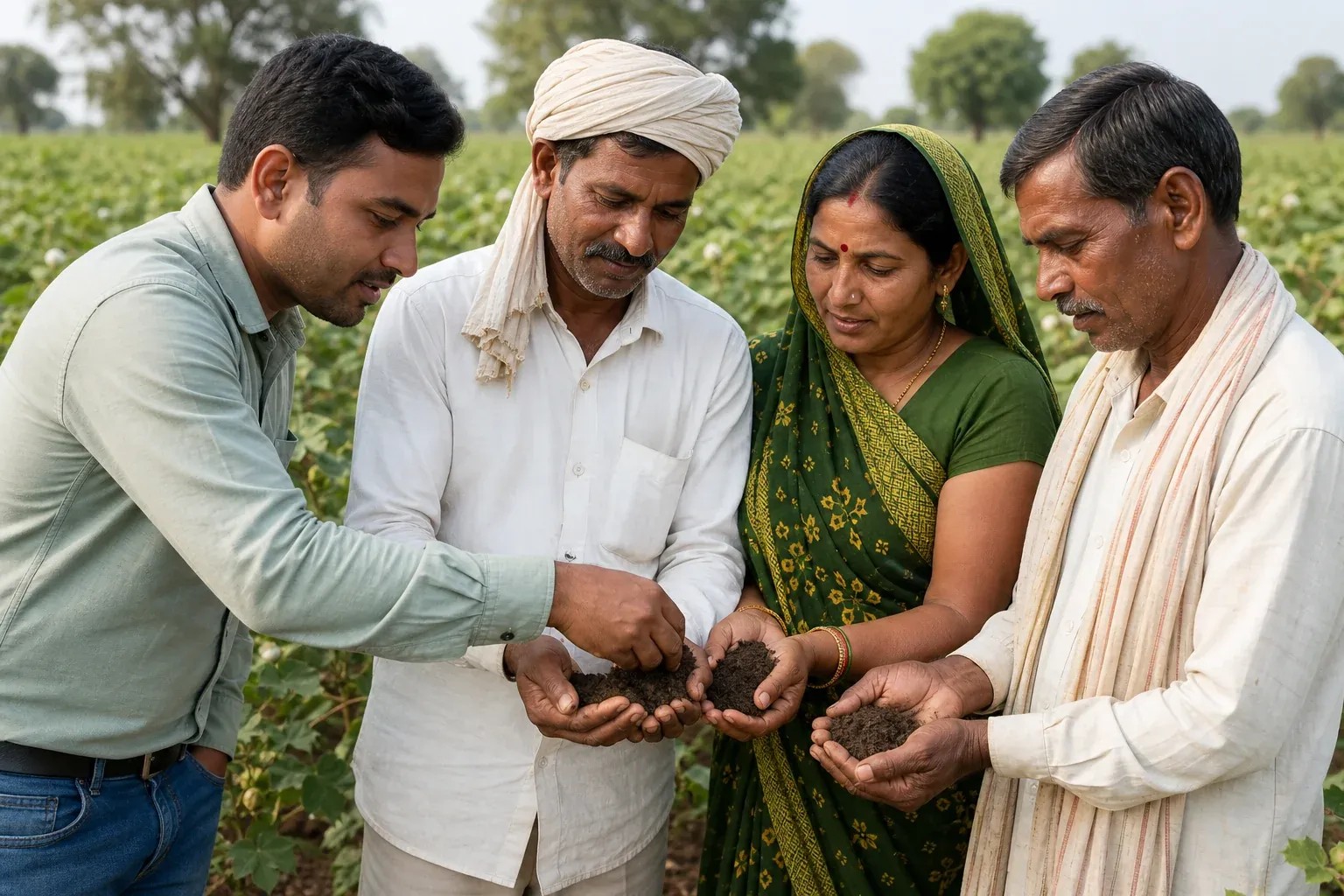
Demonstration plots work because they remove guesswork. A farmer can walk next door and see biochar-treated soil against untreated soil on comparable land, under the same rain. That side-by-side comparison convinces faster than any slide.
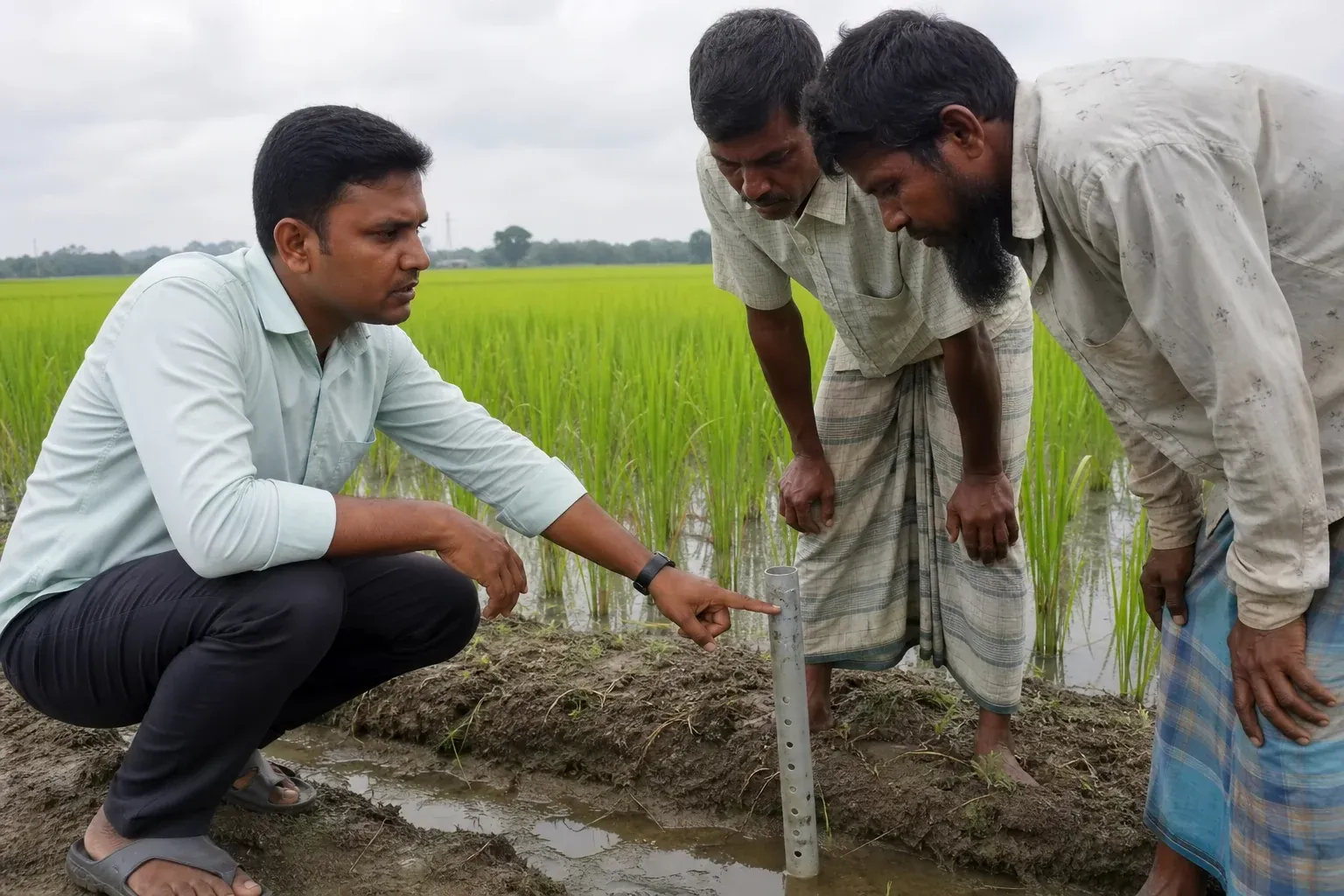
Field visits and farmer meetings add a social layer that a classroom session can't replicate. When five farmers walk a plot together and debate what they're seeing, they're teaching each other in a language and frame of reference no outside trainer can fully match. That dynamic is central to how farmer collaboration drives regenerative agriculture at scale, rather than one household at a time.
Peer-to-peer learning also does something a program team cannot do alone. It normalizes a new practice within a community. A farmer is far more likely to try alternate wetting and drying after watching a neighbor's yield hold steady than after hearing a projection from an outside expert.
2. Put Local Champions and Regen Ambassadors Between Visits
A program team visits a village on a schedule. A local champion lives there. That difference matters most in the gaps between visits, when a farmer notices a pest outbreak or an unexpected dry spell and needs an answer that week, not next month.
Regen Ambassadors and similar local champion models work because they carry program knowledge in a form that fits daily village life. They can answer a quick question at a tea stall, walk over to check a plot the same afternoon, or flag an early problem to the program team before it spreads across a block.
They also carry trust that an outside trainer has to earn from scratch. A farmer who has known a champion for years extends that trust to whatever new practice the champion is recommending. This is one reason stakeholder engagement in regenerative agriculture programs succeeds or fails largely on how well local leadership is built into the design, not bolted on afterward.
3. Connect Every Practice to Its Purpose
Soil testing, biochar, composting, green manuring, water management and intercropping only stick when farmers understand why each one matters, not just how to perform it. A farmer told to "apply biochar" without context treats it as one more input to buy. A farmer who sees their own soil test result, and understands what it means for water retention and root depth, treats biochar as a tool solving a problem they already recognize.
Soil testing works best as the opening chapter, not a footnote. When a farmer sees their own numbers, low organic carbon, poor water-holding capacity, the rest of the training plan follows logically. Composting and green manuring stop being abstract recommendations and become direct responses to a measured gap. Roughly a third of agricultural land globally falls short of the condition needed to sustain long-term productivity. That global figure is the scale of problem a single farmer's soil test is actually a small, local read on.
Biochar training benefits the same way. Farmers who understand that biochar's structure holds nutrients and water in the soil for years, not just one season, are more patient with a practice that shows gradual rather than immediate results. Programs exploring this connection in depth can look at how biochar boosts farmer income in regenerative agriculture and how regenerative agriculture restores soil fertility for the mechanics behind the practice.
Reduced input dependency, cutting back on synthetic fertilizer and pesticide, is the hardest sell without this "why" step. Farmers who fear an immediate yield drop need to see the trade-off explained: lower input cost, more stable yield over several seasons, and stronger soil that needs less rescuing after a bad rain year.
4. Give Farmers Room to Experiment and Adapt
Farmers need room to test a practice on their own terms, not follow a rigid protocol handed down unchanged from one region to another. A high-density planting layout that performs well on one soil type might need spacing adjustments on a plot with different drainage. A farmer who is allowed to adjust and observe, rather than penalized for deviating, ends up with a version of the practice that actually fits their land.
This space to experiment also builds confidence that outlasts the program's presence. A farmer who has tried, adjusted, and succeeded once is far more likely to try the next new practice independently than one who has only ever followed instructions handed to them step by step.
Questions matter here too. A training design that treats farmer questions as interruptions signals that the farmer's judgment doesn't count. A design that treats questions as the point, what's not working, what looks different this season, builds the two-way relationship that keeps a practice alive after the formal program winds down.
5. Measure What Happens After the Workshop
Measuring what happens after the workshop matters because attendance tells you nothing about whether a farmer kept using a practice. Real signals are continued adoption into a second season, whether a farmer teaches a neighbor unprompted, and whether soil or yield data actually moved.
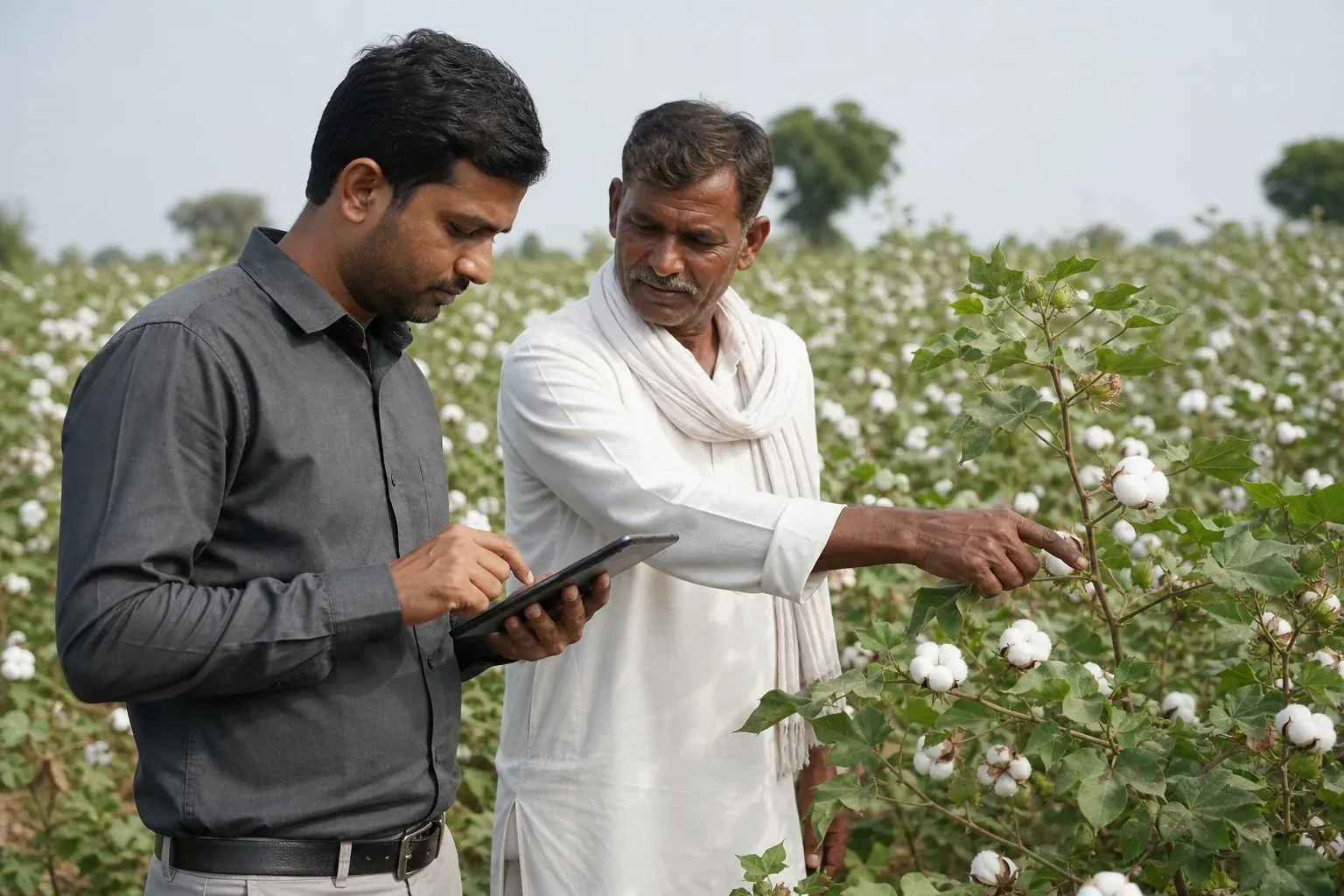
Programs that stop measuring at the training session miss the real test: does the practice survive contact with a bad season? A farmer who applies compost once during a good rain year and drops it the following dry year hasn't adopted the practice. They've only tried it. The distinction only shows up in data collected across multiple seasons, not a single post-training survey.
Field data, feedback loops and traceability systems make this visible. Recording which farmers keep practicing green manuring into year two, which plots show measurable organic carbon gains, and which farmers start informally training others gives a program team a real adoption curve instead of a training completion count. This kind of longitudinal tracking is also what makes it possible to integrate regenerative agriculture data across supply chains in a way brands and auditors can actually trust.
Quick Post-Season Checklist for Program Teams
- Did the farmer repeat the practice without a reminder visit?
- Did the farmer adjust the practice to fit their own plot, rather than abandon it?
- Did the farmer explain the practice to another farmer unprompted?
- Is there a second soil test or yield record to compare against the baseline?
- Is the local champion still fielding questions about this practice months after the training?
Planning Staffing and Budget for This Model
Program designers reading this often ask the same practical question first: how many people does a season-long model actually require, compared to a workshop tour? The honest answer depends on crop, terrain and how many villages a program covers in one cycle, so instead of a single ratio, use the touchpoint schedule above to build your own staffing map.
Start from the six touchpoints in the sample schedule: pre-sowing, sowing, early-season, mid-season, pre-harvest, and post-harvest. Each touchpoint needs someone physically present. That means program staff time scales with the number of touchpoints multiplied by the number of villages, not with the number of farmers enrolled. A village with fifty farmers and a village with five hundred farmers cost the same in staff visits if both get one champion and one field officer.
The local champion or Regen Ambassador role is the piece that keeps per-farmer cost lower than a staff-only model. A champion who already lives in the village absorbs the early-season and mid-season troubleshooting load that would otherwise require a program officer to travel back and forth. Budget planning should treat champion stipends and champion training as a separate, smaller line item from field officer salaries and travel costs, since the two roles are covering different gaps in the schedule.
For a rough planning exercise, list every touchpoint in the schedule, then next to each one write down who has to be present: field officer, local champion, or both. That list becomes the basis for a staffing ratio calculation specific to your own program's village count, crop calendar, and travel distances, rather than a generic number borrowed from a different geography.
From Training Farmers to Building Farmer Capability
Regeneration is not something you teach once. It is something farmers learn, practice, adapt and carry forward across seasons, on their own land, in their own words. That shift, from delivering training to building capability, is the difference between a program that produces a completion certificate and one that produces a farmer who can make good decisions without anyone standing beside them.
Capability built this way pays off beyond the field. A farmer who understands soil biology and water timing makes better decisions on input spending, better decisions on when to sell, and better decisions on whether a new practice fits their land. That confidence carries into participation in cooperatives, in carbon programs, and in negotiations with buyers who increasingly want to know that a farm's practices are real, not paperwork.
We at Beetle Regen Solutions design our regenerative cotton and rice programs across India and Bangladesh around this principle. The design centers on seasons of contact, demonstration plots, local champions, and outcome tracking, not a single training day. It's slower to set up than a workshop tour, and it's the reason practices survive past the first season.
Some of this stays unresolved by design. How fast a farmer moves from following instructions to making independent calls varies by crop, by region, and by how much land is at stake if an experiment fails. No program schedule fully controls that timeline, and pretending otherwise sets false expectations for both farmers and the brands funding the work.
Frequently Asked Questions
How long does it take for farmer training to translate into lasting practice change?
Most programs need at least two to three full crop cycles before a practice becomes habit rather than an experiment. Cotton and rice each run on different seasonal timelines, so the exact number of months varies by crop and region.
What makes a demonstration plot effective?
An effective demonstration plot sits on land comparable to farmers' own fields, runs a visible side-by-side comparison, and gets revisited across the season so farmers see results developing, not just a single before-and-after snapshot.
Do Regen Ambassadors need formal agricultural qualifications?
No. The strongest local champions are usually respected farmers within the community who have already tried the practices themselves, backed by program-provided training and ongoing support rather than a formal degree.
How do you measure whether capacity building actually worked?
Track adoption into a second and third season, instances of farmers teaching peers unprompted, and measurable soil or yield outcomes, not just attendance at the original session.
If you're designing or scaling a regenerative training program for cotton or rice farming communities in India or Bangladesh, and want a framework built around seasons of practice rather than a single workshop, contact Beetle Regen Solutions to talk through what farmer-centric capacity building could look like for your supply chain.