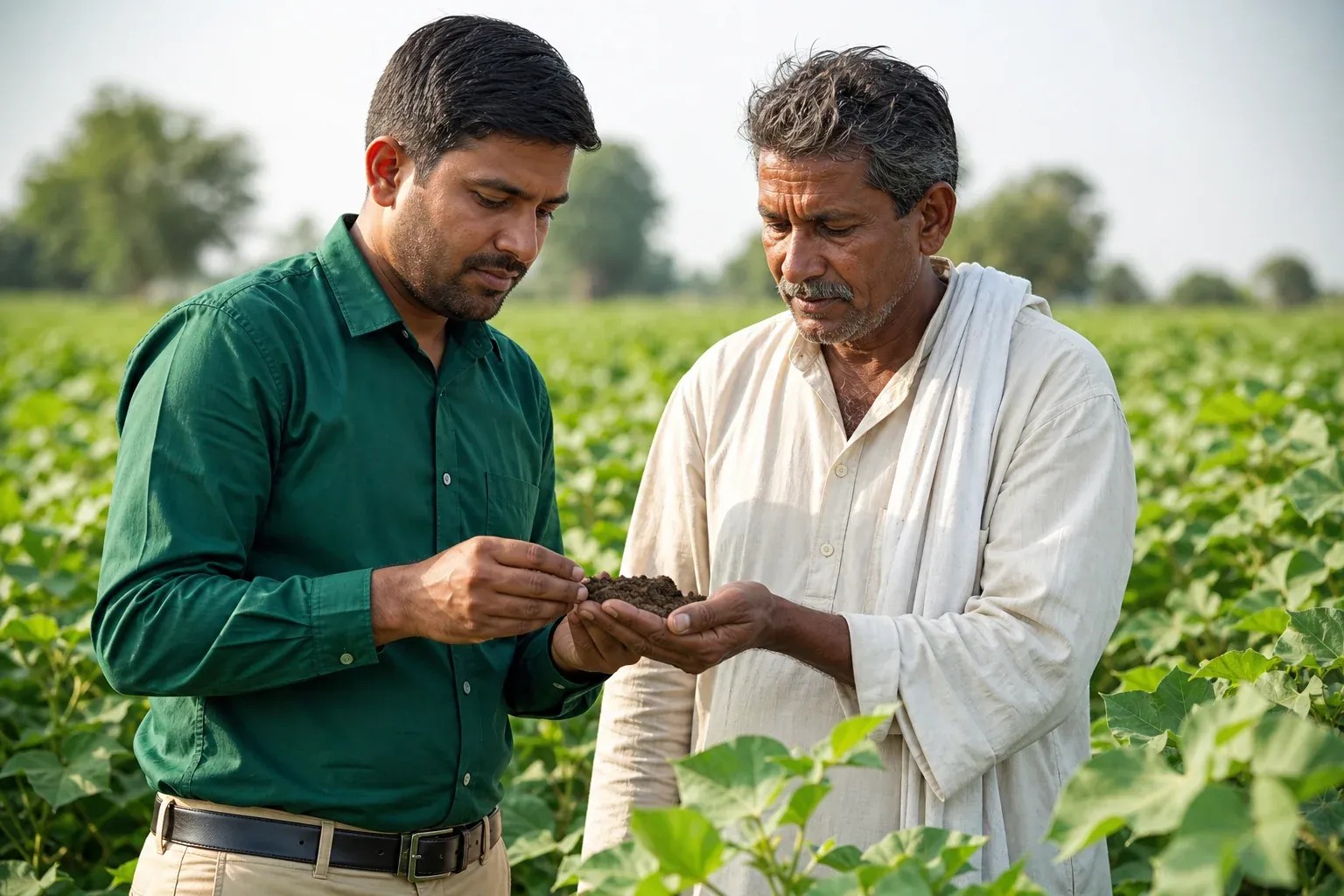
Three Years of Beetle Regen: A Journey Back to the Soil, and Beyond It
Three years ago, Beetle Regen started from one stubborn idea: regeneration cannot be sold as a single farming trick. It has to rebuild the whole relationship between soil, farmers, ecosystems, technology and markets. Today that belief has grown into a system reaching close to 120,000 farmers across cotton landscapes in India, with the first pilots now running in Bangladesh.
Before the case study, it helps to define the term plainly. A regenerative agriculture journey is not a single technique or a one-off certification. It is a staged progression: a farm or landscape moves from degraded or input-heavy practice toward soil that holds carbon and water, farmers who earn more from stable yields, and supply chains that can prove the change with real field data.
It usually unfolds over years, not one growing season, and it links four things together: soil practice, farmer economics, measurement, and market demand. Beetle's own path below is one version of that journey, built around cotton and, more recently, rice.
Key Takeaways
- The model widened, not just the map: Beetle moved from single interventions like biochar and High-Density Planting Systems (HDPS) to a connected chain linking soil, farm, landscape, supply chain and brand.
- Trust came before data: Regen Ambassadors and farmer-led demonstration plots built the adoption that top-down training never achieved.
- Geography expanded the toolkit: The Bangladesh pilots introduced Alternate Wetting and Drying and hogla-leaf biochar work outside the cotton belt.
- Partnerships did the heavy lifting: Field partners, carbon developers and industry bodies made scale possible where a single organisation could not.
- The next three years are about proof, not pledges: credible carbon insetting and landscape-level economics, checked against real farm data.
At a Glance: Beetle Regen's Three-Year Journey
| Milestone | Detail |
|---|---|
| Founded | 2023, by Amol Mishra and Hemant Rajput |
| Current farmer reach | Around 70,000 farmers directly, with wider outreach touching close to 120,000 across cotton landscapes |
| Core practices scaled | HDPS, farmer-led biochar, regenerative cotton agronomy, soil carbon monitoring |
| Geographies | Madhya Pradesh, Maharashtra, and first pilot interventions in Bangladesh |
| Key field partner | Niranjanlal Agrawal Foundation (NAF), leading grassroots mobilisation and field data collection |
| Carbon project partners | Boomitra, Asvata and Kosher Climate, each running soil carbon projects on the Verra VM0042 methodology |
| Next phase focus | Regenerative value chains, farmer income, credible carbon insetting, landscape economics |
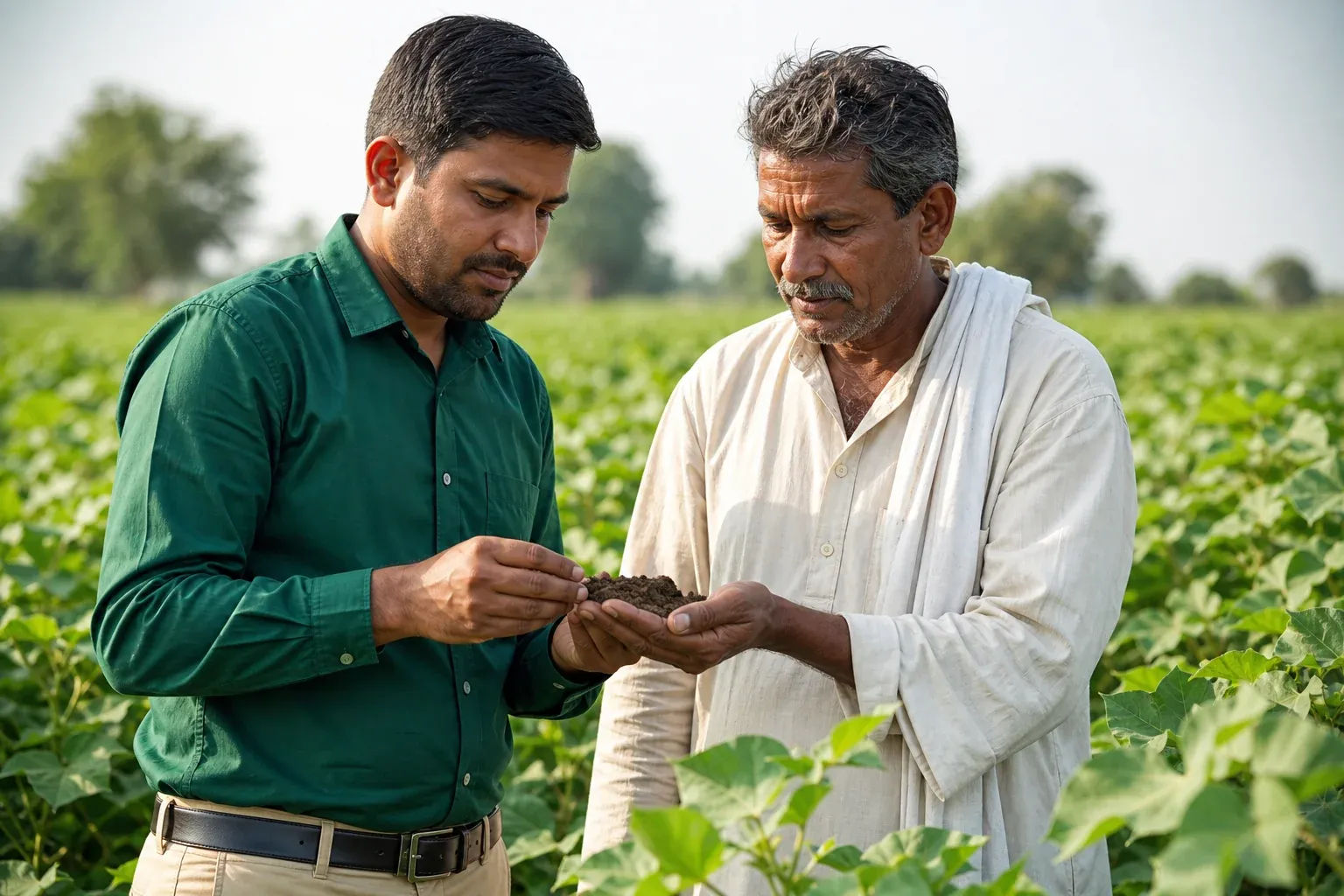
Why We Started With a Belief, Not a Technique
Beetle did not begin as a biochar company or an HDPS company. It began with a conviction that farming, soil and markets had been treated as separate problems for too long. Fixing one without the others just moves the pressure somewhere else.
Cotton farming across Madhya Pradesh and Maharashtra had settled into a pattern: heavy chemical input, shrinking margins, and soil that could not hold water through a dry spell. A regenerative agriculture journey that started only with a technique, say better seed spacing, would have improved yield for a season and left the deeper problem untouched.
So the starting design was a system: soil health work paired with farmer income, paired with data that a textile brand could actually trust, paired with market linkages that made the whole thing worth a farmer's time. Each piece depends on the others holding.
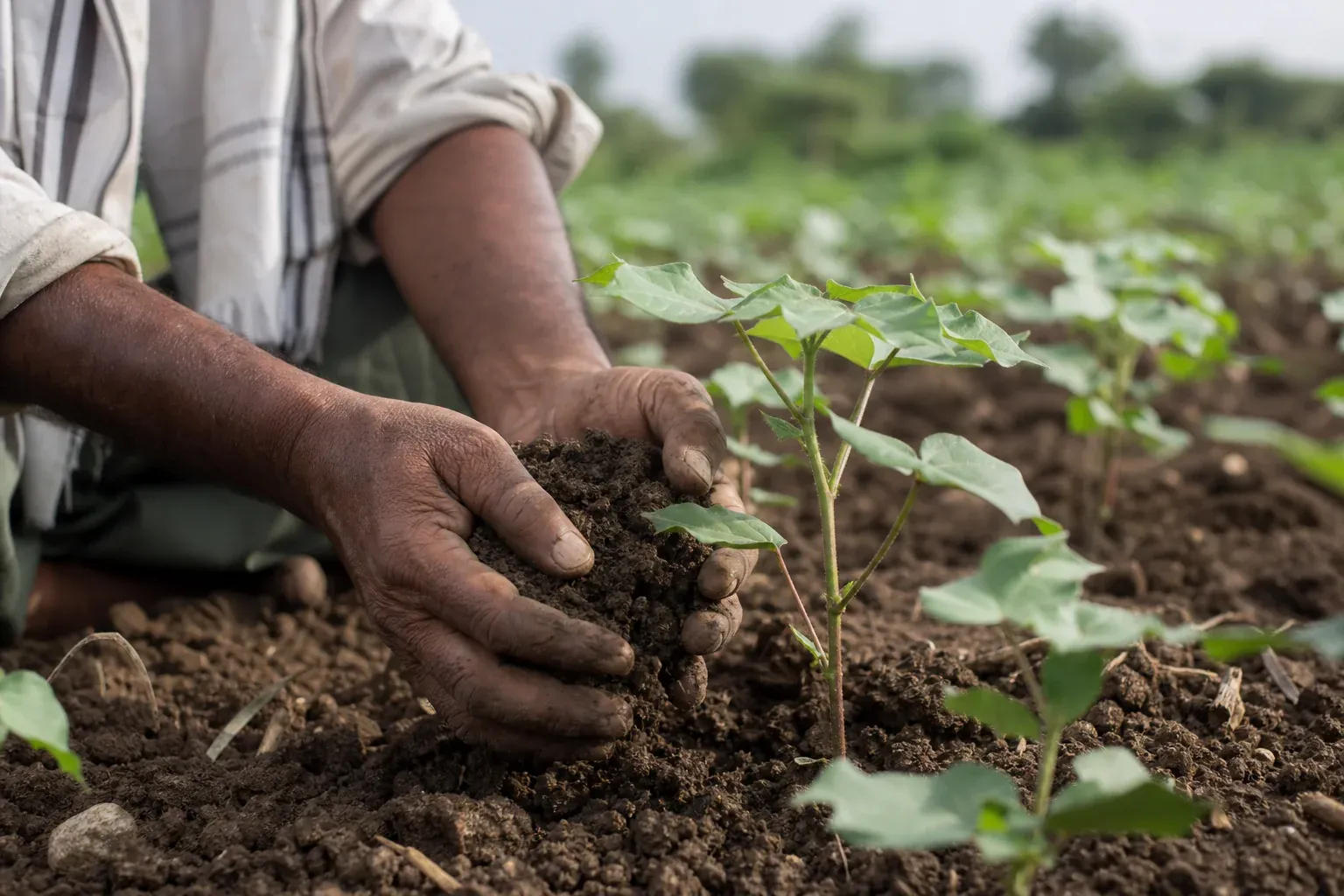
What Farmers Taught Us in the First Year
The first hard lesson: regeneration is built with farmers, not delivered to them. A training session delivered from a stage does not change what happens on a two-acre plot the next morning. What changes behaviour is a neighbour's field looking visibly better.
This is where Regen Ambassadors, farmers trained to lead demonstrations in their own villages, became central to the model. They ran field days, answered questions in local dialect, and carried credibility that no outside consultant could match on day one.
Early HDPS and biochar demonstration plots did the rest of the persuading. Farmers who saw a denser cotton stand hold up better under water stress, or a stalk pile turned into usable soil input instead of smoke, started asking for the practice on their own land the following season. Farmer collaboration is not a soft add-on to a regenerative programme; it is the delivery mechanism.
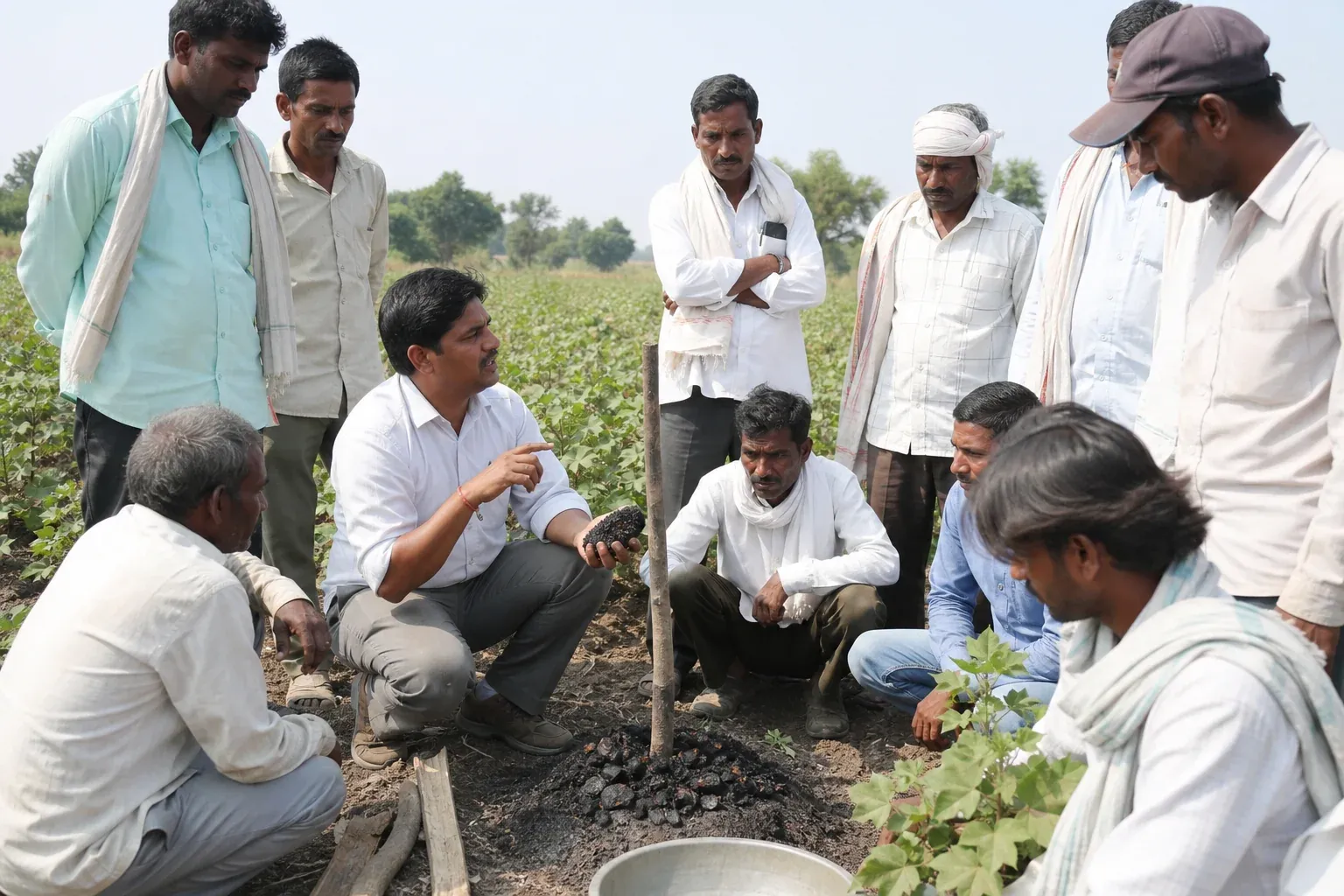
How does farmer trust actually get built in a regenerative agriculture programme?
Trust builds through repeated, visible proof on a neighbour's field rather than a single training day. Regen Ambassadors, season-long follow-up, and demonstration plots that show real yield or cost differences convince farmers faster than any pitch delivered from outside the village.
From Single Practices to a Connected System
By the second year, the individual pieces started needing to talk to each other. A biochar pit on its own improves soil carbon. Paired with soil testing, it becomes a nutrient decision. Paired with an MRV framework, it becomes a data point a carbon buyer can trust.
Water resilience work followed the same widening path. In Bangladesh, Alternate Wetting and Drying started as a water-saving idea for rice paddies and grew into a methane-reduction lever with real relevance to a farmer's input cost. HDPS and biochar in India, and AWD in Bangladesh, are now treated as parts of one regenerative toolkit rather than separate pilots.
The shift moved Beetle from a farm-level intervention to work spanning soil, farm, landscape, supply chain and brand, each layer feeding the next with better information. Water management strategies and biochar income pathways now sit inside the same farmer conversation instead of competing for attention.
Madhya Pradesh and Maharashtra: Where the Model Was Built
Madhya Pradesh and Maharashtra remain the backbone of the regenerative agriculture journey. Regenerative cotton and farmer-led biochar programmes here proved that a smallholder with two to six acres could shift practice without losing a season's income, provided the support was consistent.
The Niranjanlal Agrawal Foundation carried much of the ground-level weight, leading farmer mobilisation, demonstration plot management and continuous field engagement in these states. Their reach into local communities made the difference between a pilot that farmers tolerated and one they actually adopted, including a biochar awareness programme run with women farmers in Jalgaon around International Women's Day this year.
Traceability and MRV work also took shape here first. Soil carbon projects with Boomitra, Asvata and Kosher Climate, each structured around the Verra VM0042 methodology for Improved Agricultural Land Management, gave Beetle its first real test of turning field-level practice change into a documented, verifiable claim. Work on a cotton Life Cycle Assessment with Texprocil, the Cotton Textiles Export Promotion Council, added a second layer of rigour on the supply chain side.
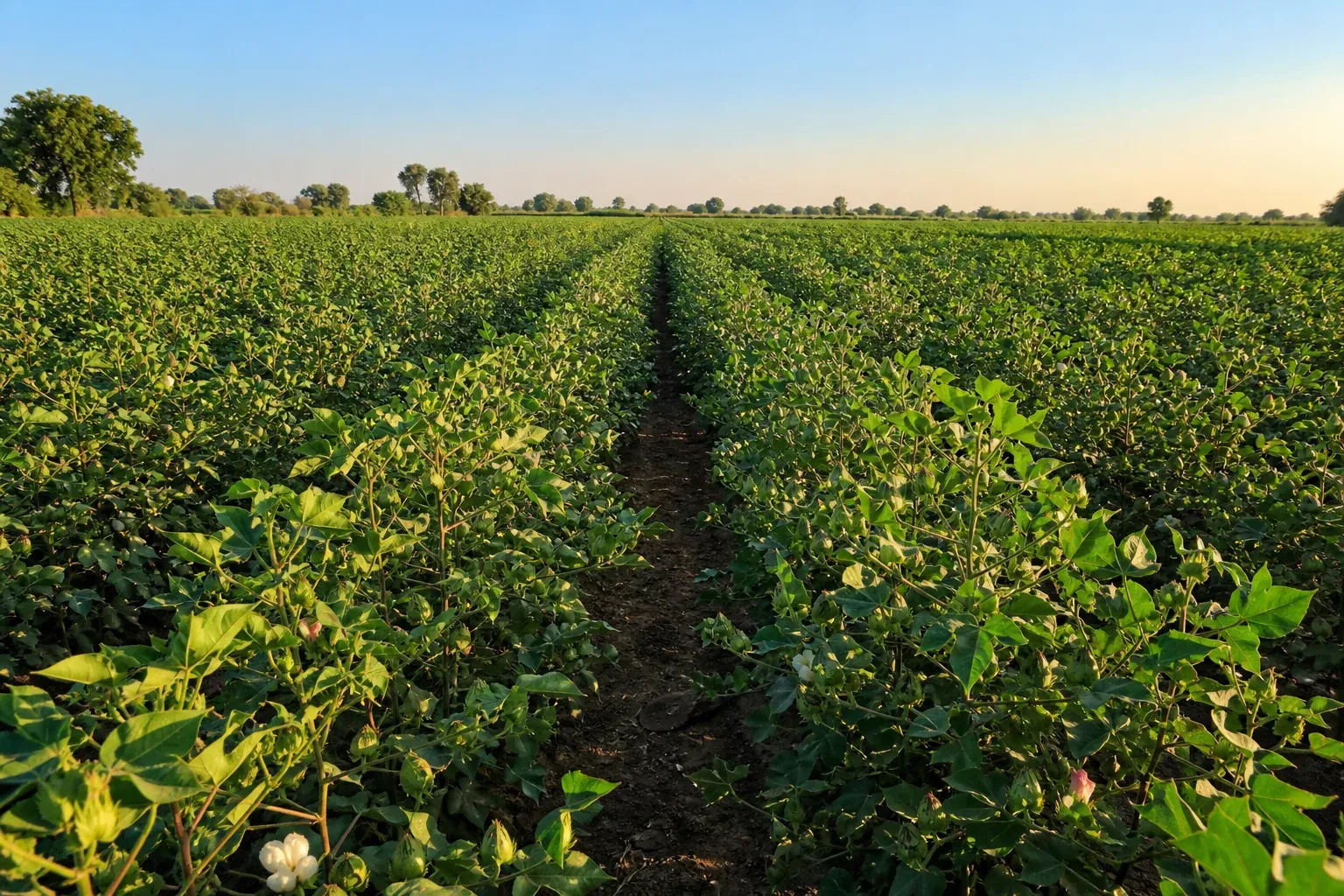
HDPS deserves its own honest note here. Independent trial work in Telangana has recorded average cotton yield increases in the range of 30 to 39 percent under HDPS compared to conventional spacing, depending on soil type, according to reporting on Rajya Sabha data. That range is a useful reference point, though results still vary by district, seed choice and season.
Crossing Into Bangladesh: Testing the Model Beyond Cotton
Extending into Bangladesh forced Beetle to test whether the underlying system, not just the cotton-specific practices, actually held. Rice is not cotton. Paddy water management is not dryland soil carbon work. And a new geography means new institutions, new farmer relationships, and no existing trust to draw on.
The first pilots there centred on Alternate Wetting and Drying for water and methane reduction, alongside early exploration of biochar using hogla leaves, a locally available residue rather than cotton stalks. That single substitution says something important: the regenerative agriculture journey is a method for reading a landscape, not a fixed recipe transplanted wherever land is available.
What stayed constant was the sequence. Start with trust and a visible demonstration, then layer in measurement, then connect the results to a market. What changed was everything else, the crop, the water logic, the residue, and the local partner network needed to reach farmers at all.
What This Regenerative Agriculture Journey Has Cost Us in Lessons
Three years in, some lessons only make sense written down plainly, without the polish a report usually gets.
Regeneration takes time. Soil organic carbon does not move in one season, and neither does farmer confidence. Programmes that promise fast transformation set expectations that field reality cannot meet.
Farmers are partners, not beneficiaries. The moment a programme frames farmers as recipients of help rather than co-owners of the outcome, adoption slows. The language matters because it shapes who gets listened to when a practice does not work as expected.
Credibility depends on data, not intention. A carbon claim, a Scope 3 disclosure, or a brand's net zero statement is only as strong as the farm-level record behind it. This is why soil testing, MRV frameworks and third-party methodologies like VM0042 carry more weight than a good story.
Partnerships are the real engine of scale. No single organisation can mobilise 70,000 farmers, run field demonstrations, manage carbon methodology, and hold brand relationships alone. NAF's grassroots reach, carbon developers' technical infrastructure, and industry bodies like Texprocil each cover ground Beetle could not cover solo.
The last mile is the hardest part. Designing a good practice is the easy half. Getting a farmer in a specific village, on a specific soil type, with a specific water constraint, to apply it correctly and consistently season after season is where most programmes actually fail. Capacity-building design that survives past the first workshop is the difference between a pilot and a movement.
Where This Regenerative Agriculture Journey Goes Next
The next phase leans harder on scaling regenerative value chains, not just regenerative plots. That means connecting farmer-level practice change directly to what a textile brand can report and act on, rather than treating farm data and brand disclosure as separate workstreams.
Stronger farmer livelihoods stay the anchor. India's own policy direction supports this shift: the government's Mission for Cotton Productivity, approved with a ₹5,659.22 crore outlay, aims to lift average cotton lint productivity from roughly 428 kg per hectare toward a considerably higher target by 2030-31. Programmes like Beetle's HDPS and biochar work sit directly inside that national push, even where the mechanisms differ.
Credible carbon insetting is the other priority, distinct from generic offsetting. A brand buying a farm-linked carbon credit through a documented methodology gets a defensible Scope 3 story; a brand buying an anonymous offset does not.
Landscape-level regeneration, spread across whole watersheds rather than isolated farms, is the harder, slower version of this same goal, and it remains the part of the plan we have not fully proven yet. That is worth saying plainly rather than glossing over.
How Brands and Partners Can Join This Journey
Textile brands, cooperatives and policy bodies looking to plug into this work do not need to start from zero. Beetle's Sustainability as a Service model was built precisely so a brand can access verified farm-level data, traceability, and carbon insetting support without building that infrastructure in-house.
For agricultural cooperatives and farmer networks weighing whether to join a regenerative programme, the honest answer is that the payoff builds over seasons, not weeks, and depends on consistent field support, not a single training visit. Based on how Beetle's own programme is actually structured, here is a practical checklist to work through before committing:
- Farm size and farmer profile: Beetle's model was proven with smallholders on two to six acres in Madhya Pradesh and Maharashtra. A cooperative with a similar smallholder base, rather than large consolidated farms, is closer to the conditions this model was built for.
- A field partner on the ground: Beetle's work depended on the Niranjanlal Agrawal Foundation for farmer mobilisation and continuous field engagement. Ask whether your region has, or can build, an equivalent local partner before assuming a programme can run remotely.
- Willingness to run demonstration plots first: Adoption in Beetle's own journey came from Regen Ambassadors and visible demonstration plots, not top-down training. A cooperative should expect to start with a handful of visible plots, not a blanket rollout.
- Capacity to collect and share field data: Carbon claims and brand disclosure only hold up with a documented record. Expect to commit to soil testing and data collection under a recognised methodology, such as the Verra VM0042 framework Beetle's carbon partners use.
- A multi-season timeline: Soil organic carbon and farmer confidence both move slowly. Programmes that promise fast transformation, in a single season, are setting expectations the field cannot meet; plan in seasons and years, not weeks.
- Clarity on what "success" will be measured against: Decide up front whether the goal is yield, input cost reduction, a carbon credit, or a brand disclosure claim, since each requires a different data trail from day one.
For brands under growing disclosure pressure, the value is a supply chain claim backed by named farms and dated field records rather than an industry average. Read more on how these pieces connect in our guide to supply chain transformation through regenerative agriculture consulting.
If your organisation is exploring a regenerative sourcing partnership, a farmer capacity programme, or a carbon insetting pathway grounded in real field data, contact us to talk through where your supply chain or landscape stands today, and what the next three years of this work could look like for you.