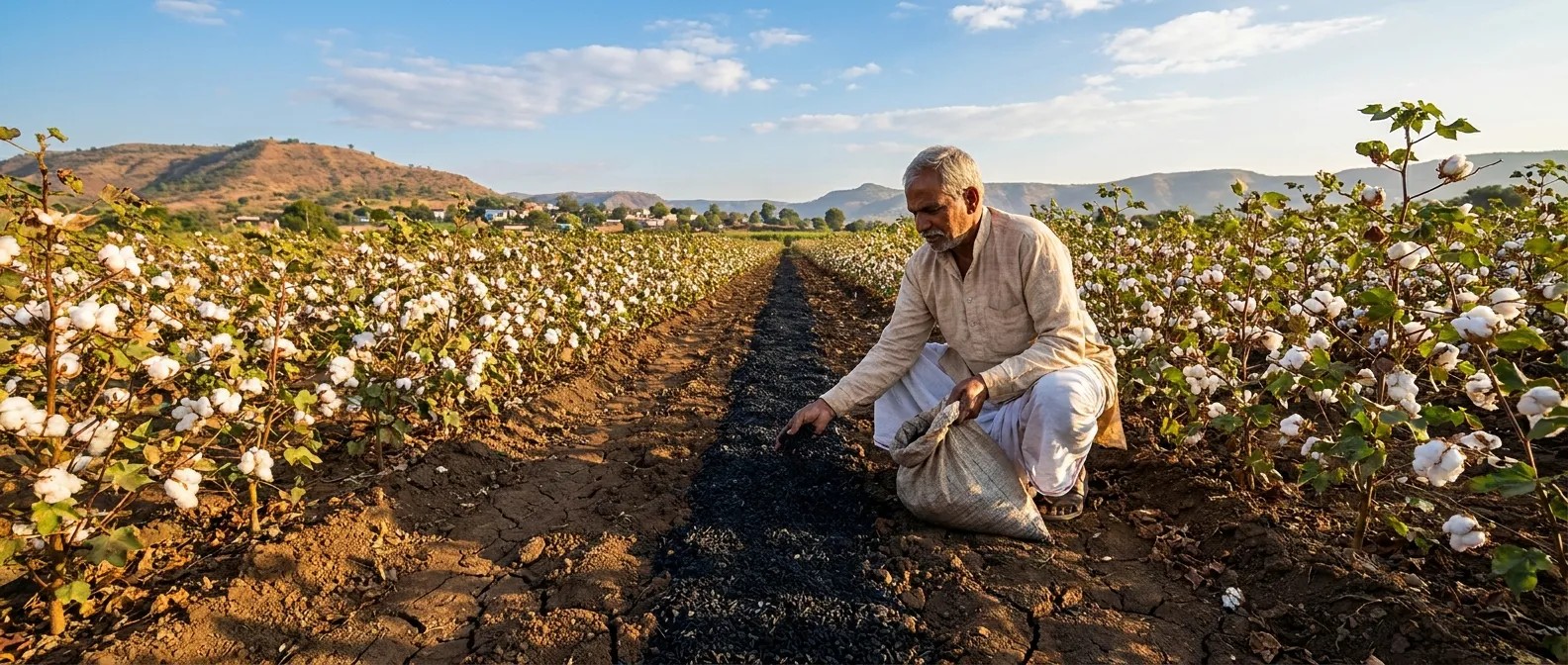
Biochar Benefits for Soil Carbon in Indian Cotton Farming
The biochar benefits for soil carbon have been documented extensively in controlled laboratory studies. But when program designers, carbon accountants, and textile brands ask the harder question — "How much carbon will biochar actually sequester in our cotton supply chain?" — the answer depends heavily on where the soil is, what it's made of, and how the biochar is applied. In India's cotton belt, that variability is enormous. This case study presents field trial data from biochar application programs across Maharashtra's Vertisol soils and Gujarat's Alfisol soils, giving you the evidence base you need to design credible, high-impact biochar carbon insetting programs.
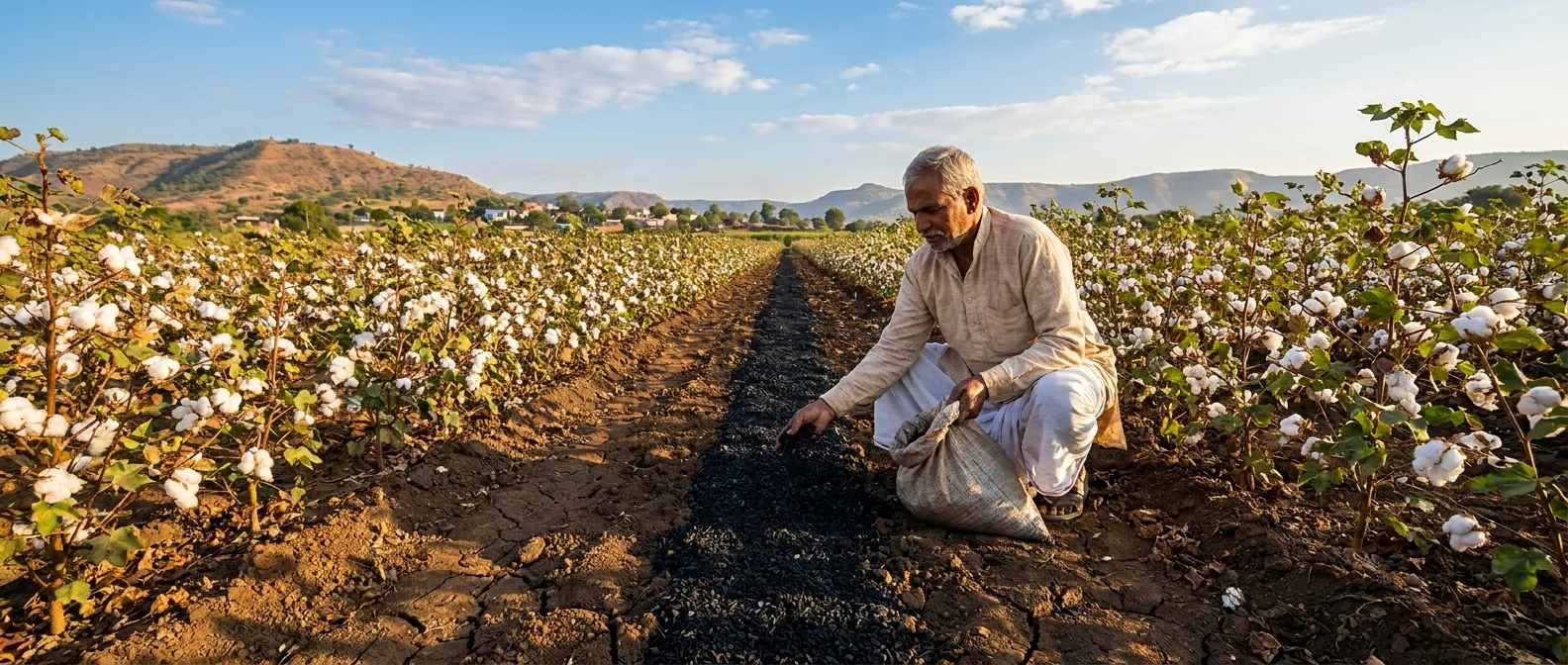
Why Biochar Benefits for Soil Carbon Matter in Indian Cotton Farming
India is the world's second-largest cotton producer, with over 12 million hectares under cultivation. Yet the soils supporting this industry are under serious stress. According to the UN Food and Agriculture Organization, 33% of global soils are already degraded, and India's cotton-growing regions are among the most affected. Decades of intensive tillage, synthetic fertilizer dependency, and residue burning have stripped organic carbon from soils that once held it in abundance.
This matters for three distinct groups. For farmers, low soil organic carbon (SOC) means reduced water retention, weaker nutrient cycling, and declining yields. For textile brands with net zero and carbon neutral commitments, it means a measurable opportunity to address scope 3 emissions through supply chain carbon insetting. And for program designers and carbon accountants, it means the difference between a credible carbon claim and a liability.
The biochar benefits for soil carbon are well-established in principle: biochar's highly stable aromatic carbon structure resists microbial decomposition, locking carbon in soil for hundreds to thousands of years. But real-world sequestration rates vary by a factor of three or more depending on soil type, feedstock, pyrolysis temperature, and application rate. India's two dominant cotton soil types — Vertisols in Maharashtra and Alfisols in Gujarat and parts of Andhra Pradesh, respond to biochar in meaningfully different ways. Understanding those differences is the foundation of any serious biochar program.
For a broader framework on how carbon sequestration works across agricultural systems, see our guide on Carbon Sequestration in Agriculture: A Complete Framework.
Understanding Biochar: Feedstock, Production, and Carbon Stability
Biochar is a carbon-rich solid produced by heating organic biomass in a low-oxygen environment, a process called pyrolysis. It is not compost, not biosolids, and not activated carbon. Its defining characteristic is recalcitrance: the resistance of its aromatic carbon structures to biological breakdown. This is what makes biochar a genuine carbon sequestration tool rather than simply a soil amendment.
Feedstocks Available in India's Cotton Regions
Feedstock selection is one of the most consequential decisions in biochar program design. In India's cotton belt, three feedstocks dominate:
- Cotton stalks: Abundant, low-cost, and circular, stalks are a direct byproduct of the cotton harvest. Cotton stalk biochar typically yields 25, 30% biochar by weight and produces a product with moderate carbon content (65, 72% C by mass).
- Rice husk: Widely available in Gujarat and Maharashtra, rice husk biochar has a higher silica content, which affects its physical structure and nutrient profile. Carbon content is typically 35, 45% C by mass, lower than cotton stalk biochar.
- Sugarcane bagasse: Available in Maharashtra's sugarcane belt, bagasse biochar offers high carbon content (70, 78% C) but competes with other industrial uses of the feedstock.
Pyrolysis temperature matters significantly. Higher temperatures (550, 700°C) produce more stable, recalcitrant biochar with greater carbon permanence, critical for carbon credit issuance. Lower temperatures (350, 450°C) produce biochar with more labile carbon fractions and higher nutrient content, which may benefit soil fertility more in the short term but offers less permanence for carbon accounting purposes.
For textile brands assessing biochar as a tool to address scope 3 emissions in their supply chains, feedstock circularity is also a key consideration. Using cotton stalk biochar within a cotton supply chain creates a closed-loop narrative that strengthens both the carbon story and the sustainability reporting case. This aligns directly with the kind of regenerative agriculture supply chain visibility that leading brands are now demanding from their sourcing partners.
Biochar Benefits for Soil Carbon: Field Trial Data from Maharashtra Vertisols
Maharashtra's cotton soils are predominantly Vertisols, deep, dark, clay-rich soils with a characteristic shrink-swell behavior. They are sometimes called "black cotton soils" for their color and their long association with cotton cultivation. Vertisols have a naturally high clay content (often 40, 60%), which gives them strong cation exchange capacity (CEC) but also creates challenges: they crack deeply in dry seasons, become waterlogged in monsoon, and have historically low soil organic carbon levels due to rapid oxidation in the hot, semi-arid climate.
Trial Design and Methodology
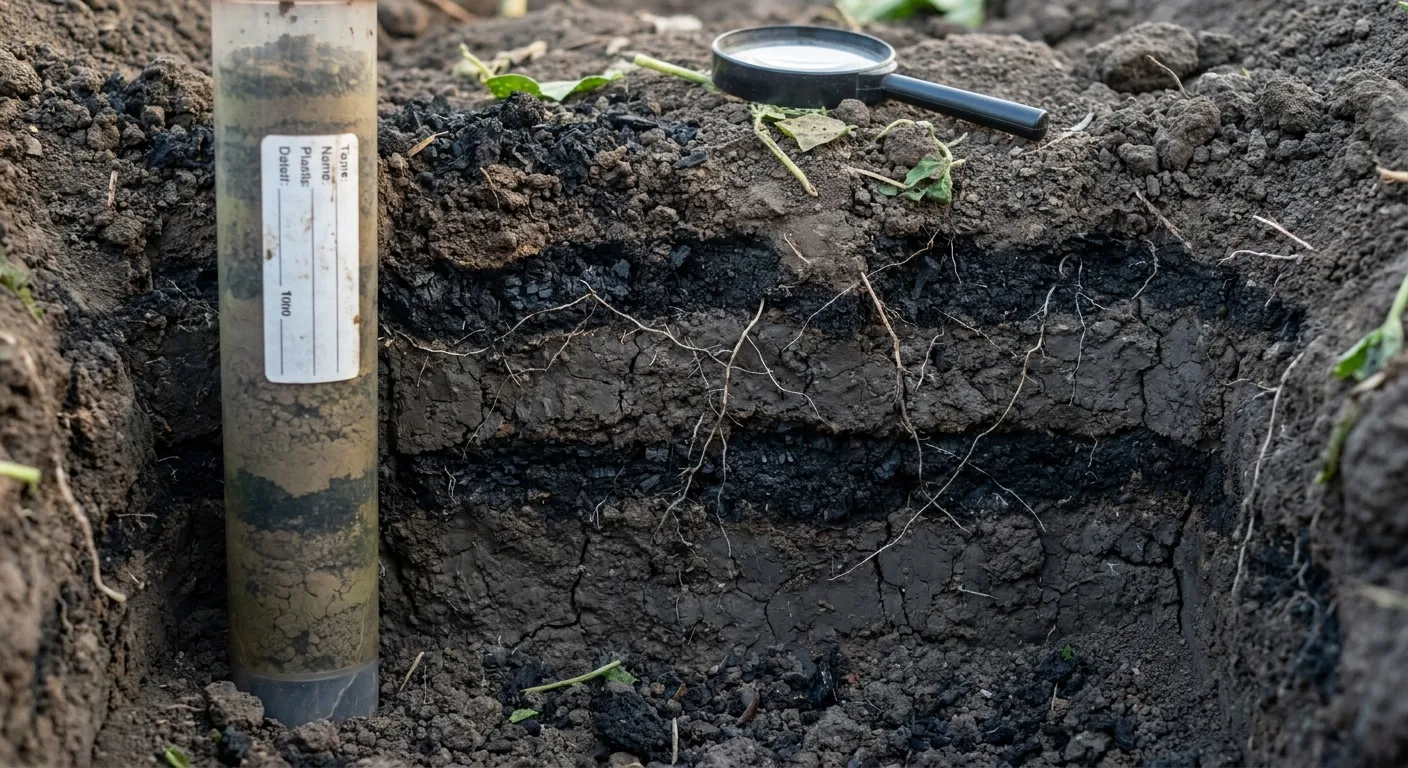
Field trials were conducted across smallholder cotton plots in Vidarbha and Marathwada districts of Maharashtra over two consecutive cotton seasons. Three application rates were tested: 1 t/ha, 2 t/ha, and 4 t/ha of cotton stalk biochar (produced at 600°C), alongside untreated control plots. Biochar was incorporated into the top 15 cm of soil prior to sowing. Soil samples were collected at 0, 15 cm and 15, 30 cm depths at baseline, end of Season 1, and end of Season 2. Soil organic carbon was measured using the Walkley-Black method, with cross-validation using loss-on-ignition (LOI) at select sites.
Sequestration Rates Measured
The results from Maharashtra Vertisols showed consistent and statistically significant increases in SOC across all application rates:
- 1 t/ha application: SOC increase of 0.18, 0.22% at 0, 15 cm depth after two seasons. Estimated sequestration: 1.4, 1.8 tCO2e/ha/year (accounting for biochar carbon stability factor of 0.85 per EBC standards).
- 2 t/ha application: SOC increase of 0.31, 0.38% at 0, 15 cm depth. Estimated sequestration: 2.6, 3.1 tCO2e/ha/year. This rate showed the best cost-to-carbon ratio across the trial.
- 4 t/ha application: SOC increase of 0.44, 0.52% at 0, 15 cm depth. Estimated sequestration: 3.8, 4.4 tCO2e/ha/year. However, diminishing returns were evident, the incremental carbon gain per additional tonne of biochar applied dropped significantly above 2 t/ha.
Secondary soil health benefits were pronounced in Vertisols. Biochar-amended plots showed a 12, 18% reduction in bulk density, improved aggregate stability, and measurably better water retention during the dry season. Soil pH, which tends toward alkalinity in Vertisols (pH 7.8, 8.2), was modestly buffered toward neutral in biochar-amended plots, improving phosphorus availability.
Yield Response in Maharashtra
Cotton lint yield in biochar-amended plots increased by 8, 14% at 2 t/ha compared to control plots over two seasons. The yield response was strongest in plots with the lowest baseline SOC, suggesting that biochar's benefits are most pronounced where soil degradation is most severe, precisely the conditions found across much of Vidarbha's smallholder cotton landscape.
Biochar Benefits for Soil Carbon: Field Trial Data from Gujarat Alfisols
Gujarat's cotton soils are predominantly Alfisols, lighter, sandy loam soils with moderate organic carbon levels but significantly lower water-holding capacity than Vertisols. Alfisols are more common in the Saurashtra and North Gujarat cotton regions. They are less prone to waterlogging but highly vulnerable to drought stress and nutrient leaching, making them a different challenge for biochar program design.
Trial Design and Methodology
Parallel trials in Gujarat used rice husk biochar (produced at 580°C) at the same three application rates, allowing direct comparison with the Maharashtra Vertisol data. The same soil sampling protocol and analytical methods were applied. Baseline SOC in Gujarat Alfisols averaged 0.52, 0.68%, compared to 0.38, 0.55% in the Maharashtra Vertisol sites, a slightly higher starting point, but still well below the 1.5, 2.0% threshold considered adequate for productive agriculture.
Sequestration Rates Measured
Gujarat Alfisols showed a faster initial SOC response to biochar application, but with a lower absolute sequestration ceiling:
- 1 t/ha application: SOC increase of 0.14, 0.19% at 0, 15 cm after two seasons. Estimated sequestration: 1.1, 1.5 tCO2e/ha/year.
- 2 t/ha application: SOC increase of 0.24, 0.31% at 0, 15 cm. Estimated sequestration: 2.0, 2.6 tCO2e/ha/year.
- 4 t/ha application: SOC increase of 0.33, 0.41% at 0, 15 cm. Estimated sequestration: 2.8, 3.4 tCO2e/ha/year. Diminishing returns were again evident above 2 t/ha.
The lower absolute sequestration in Alfisols compared to Vertisols reflects the lower clay content. Clay particles interact with biochar surfaces to form organo-mineral complexes that physically protect carbon from decomposition. In sandy loam Alfisols, this protective mechanism is weaker, meaning a greater proportion of biochar carbon is exposed to oxidation over time.
Nutrient Retention and Yield Response in Gujarat
Despite lower absolute carbon sequestration, Alfisols showed stronger improvements in nutrient retention. Biochar's porous structure significantly increased CEC in these low-clay soils, reducing nitrogen leaching by an estimated 15, 22% at 2 t/ha. Phosphorus availability improved markedly, reducing the need for phosphatic fertilizer applications.
Cotton lint yield in Gujarat biochar-amended plots increased by 10, 17% at 2 t/ha, slightly higher than the Maharashtra response, likely because Alfisols' water retention limitations were more directly addressed by biochar's moisture-holding properties. This yield uplift translates directly into improved farmer income, a co-benefit that strengthens the social case for biochar programs alongside the carbon case.
For more on how regenerative practices drive yield improvements and farmer income, see our analysis of How Regenerative Agriculture Increases Crop Yield.
Comparing Sequestration Rates: Vertisols vs. Alfisols Side by Side
The data from both trial regions allows a direct comparison that is essential for program designers making decisions about where to deploy biochar resources and what carbon claims to make.
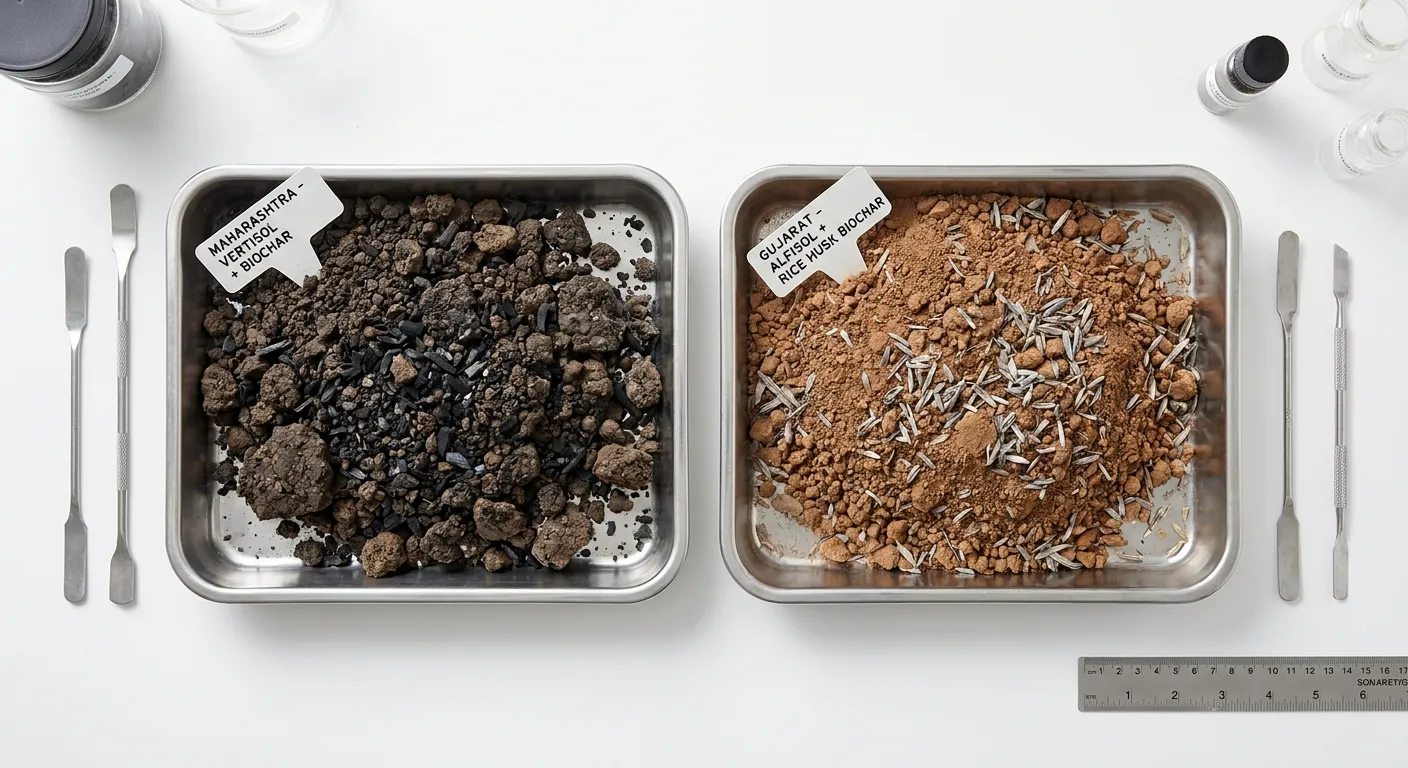
Summary Comparison: Key Metrics at 2 t/ha Application Rate
| Metric | Maharashtra Vertisols | Gujarat Alfisols |
|---|---|---|
| SOC gain (0, 15 cm, 2 seasons) | +0.31, 0.38% | +0.24, 0.31% |
| Estimated sequestration (tCO2e/ha/yr) | 2.6, 3.1 | 2.0, 2.6 |
| Cotton lint yield uplift | 8, 14% | 10, 17% |
| Water retention improvement | Moderate | High |
| Nutrient retention improvement | Moderate | High |
| Recommended feedstock | Cotton stalk biochar | Rice husk biochar |
Critical Implications for Carbon Accounting
Soil type is the single most important variable in biochar carbon accounting. A program that applies a uniform sequestration rate across mixed Vertisol and Alfisol geographies will either overstate or understate its carbon impact, both of which create problems. Overstating leads to credibility risk and potential regulatory exposure. Understating leaves value on the table and may make programs appear economically unviable.
The data also confirms a clear application rate sweet spot at 2 t/ha for both soil types. Above this rate, the incremental carbon gain per additional tonne of biochar applied drops sharply, while costs continue to rise linearly. For program designers optimizing cost per tonne of CO2e sequestered, 2 t/ha is the defensible recommendation for both soil types under current Indian field conditions.
Permanence and additionality are the two pillars of credible carbon credit issuance. On permanence, cotton stalk biochar at 600°C pyrolysis temperature has a mean residence time in soil estimated at 500, 1,000 years under Indian climatic conditions, well above the 100-year threshold required by major carbon standards. On additionality, biochar application is not standard practice in Indian cotton farming, it represents a genuine intervention above business-as-usual, satisfying additionality requirements under frameworks including the Gold Standard and Verra's Verified Carbon Standard (VCS).
For MRV (Measurement, Reporting, and Verification) design, these trials suggest that soil type stratification is non-negotiable. Programs should map soil types at the field level before assigning sequestration factors, and should plan for soil sampling at minimum at baseline and at 24-month intervals to track SOC trajectories. Integrating this data into digital platforms enables the kind of carbon accounting for fashion brands that meets the scrutiny of third-party auditors and sustainability reporting frameworks.
Learn how to structure this data flow in our post on How to Integrate Regenerative Agriculture Data Across Supply Chains.
Designing a Biochar Carbon Insetting Program for Cotton Supply Chains
For textile brands seeking to address scope 3 emissions through supply chain action, biochar carbon insetting offers a compelling combination: measurable, permanent carbon sequestration within the brand's own supply chain, paired with soil health and farmer income co-benefits that strengthen the broader ESG narrative.
Feedstock Selection for Indian Cotton Programs
The most defensible feedstock choice for a cotton supply chain insetting program is cotton stalk biochar. It is circular (the feedstock is a direct byproduct of the cotton being sourced), abundant, and produces biochar with high carbon stability. Rice husk biochar is a strong alternative in Gujarat, where rice cultivation is widespread and husk availability is high. Both feedstocks avoid the "food vs. fuel" criticism that affects some biomass energy programs.
Program designers should conduct a feedstock availability assessment before committing to a production model. Key variables include: seasonal availability, transport costs to pyrolysis units, competing uses of the biomass, and moisture content at harvest (which affects pyrolysis efficiency and biochar yield).
Application Rates and Timing
Based on the field trial data, the recommended protocol for Indian cotton programs is:
- Application rate: 2 t/ha as the baseline, with soil-type-specific adjustments (Vertisols may justify 2.5 t/ha in severely degraded plots; Alfisols should not exceed 2 t/ha without additional agronomic justification).
- Timing: Pre-sowing incorporation, ideally 2, 4 weeks before planting to allow biochar to equilibrate with soil moisture and microbial communities.
- Incorporation depth: 10, 15 cm, using minimum tillage methods where possible to avoid disrupting soil structure.
- Frequency: Annual application for the first two years, then biennial maintenance applications to sustain SOC gains.
Integrating Biochar Data into Carbon Accounting and Sustainability Reporting
The biochar benefits for soil carbon only translate into verified carbon credits or credible sustainability reporting claims when the data behind them is robust, traceable, and auditable. This requires integrating soil testing data, biochar production records, application logs, and yield data into a unified digital system.
Blockchain traceability is increasingly being used to create immutable records of biochar production and application events, providing the audit trail that carbon standards and sustainability reporting frameworks require. When combined with satellite-based soil monitoring and periodic field sampling, this creates a defensible MRV system that can support both carbon credit issuance and brand-level sustainability reporting.
Beetle Regen's Biochar Production and Carbon Insetting service is built around exactly this kind of integrated approach, combining on-the-ground farmer programs with digital traceability infrastructure to produce carbon insetting claims that hold up to third-party scrutiny. For brands working toward a net zero fashion brand roadmap, this is the kind of supply chain action that moves the needle on scope 3 emissions in a way that offsets alone cannot.
See how this fits into a broader compliance and reporting strategy in our guide to Net Zero Agriculture: Complete Buyer's Guide 2026.
Co-Benefits Beyond Carbon: Soil Fertility, Farmer Income, and Biodiversity
The biochar benefits for soil carbon are the headline metric for carbon programs, but the co-benefits are often what make programs viable at scale. In India's smallholder cotton context, these co-benefits are not marginal, they are central to farmer adoption and program sustainability.
Soil Fertility and Reduced Input Costs
Across both Vertisol and Alfisol trial sites, biochar-amended plots showed measurable reductions in synthetic fertilizer requirements. Improved CEC and nutrient retention meant that applied nitrogen and phosphorus were held in the root zone longer, reducing leaching losses and allowing farmers to reduce fertilizer application rates by 10, 20% without yield penalty. Over a 3, 5 year horizon, this input cost reduction can offset a significant portion of the biochar application cost, improving the economics of the program for both farmers and program operators.
This connects directly to the broader goal of reversing soil degradation through regenerative farming, biochar is not a standalone solution but a powerful accelerant when combined with cover cropping, reduced tillage, and organic matter management.
Water Retention in Drought-Prone Regions
Gujarat's Alfisol regions are increasingly exposed to erratic monsoon patterns and extended dry spells. Biochar's porous structure significantly improves plant-available water in sandy loam soils, reducing crop stress during dry periods. Trial data showed a 15, 20% improvement in plant-available water capacity at 2 t/ha in Alfisol plots, a benefit that becomes more valuable as climate variability increases.
Farmer Income and Carbon Credit Revenue
The combination of yield uplift (8, 17% across soil types) and potential carbon credit revenue creates a meaningful income improvement for participating farmers. At current voluntary carbon market prices for high-quality agricultural biochar credits, a 2 t/ha program generating 2.0, 3.1 tCO2e/ha/year represents a carbon revenue stream that can supplement farm income by a meaningful margin, particularly for smallholders in Vidarbha, where farm income stress is a persistent challenge.
This farmer income dimension is critical for program longevity. Programs that deliver only carbon benefits to brands while leaving farmers economically neutral will struggle with adoption and retention. Programs that share carbon credit revenue with farmers, as Beetle Regen's model does, create aligned incentives that drive long-term participation.
Biodiversity and Soil Microbial Health
Biochar's porous structure provides habitat for soil microorganisms, supporting the microbial diversity that underpins healthy nutrient cycling. Trial sites showed increases in soil microbial biomass carbon (MBC) of 18, 28% in biochar-amended plots after two seasons, suggesting that biochar is actively supporting the soil food web rather than simply adding inert carbon. This biodiversity benefit aligns with the growing emphasis on nature-positive outcomes in corporate sustainability frameworks and ESG reporting.
For brands and program designers interested in how these co-benefits connect to circular economy goals, our post on the Circular Economy in Fashion: How Regenerative Agriculture Closes the Loop provides useful context.
Frequently Asked Questions About Biochar Benefits for Soil Carbon
How long does biochar last in soil?
High-temperature biochar (produced at 550, 700°C) has a mean residence time in soil estimated at 500, 1,000 years under tropical and semi-arid conditions. This makes it one of the most permanent forms of biological carbon sequestration available. Lower-temperature biochar has a shorter residence time but may offer greater short-term soil fertility benefits. For carbon credit purposes, most standards apply a stability factor (typically 0.8, 0.9) to account for the small fraction of biochar carbon that may decompose over the crediting period.
Can biochar replace chemical fertilizers?
Biochar is not a fertilizer replacement, but it is a powerful fertilizer efficiency enhancer. By improving CEC and reducing nutrient leaching, biochar allows farmers to achieve the same yield outcomes with 10, 20% less synthetic fertilizer input. In combination with organic amendments like compost or vermicompost, biochar can support a more significant reduction in synthetic inputs over time. The goal is not replacement but reduction, a key principle of regenerative agriculture.
What carbon standards apply to biochar insetting in India?
The most widely recognized standards for biochar carbon credits include the European Biochar Certificate (EBC), the Verified Carbon Standard (VCS/Verra), and the Gold Standard. For supply chain insetting (as opposed to offset credits), brands typically work within their own carbon accounting frameworks aligned with the GHG Protocol's scope 3 guidance. India does not yet have a domestic biochar-specific carbon standard, but the Bureau of Energy Efficiency (BEE) and the Carbon Credit Trading Scheme (CCTS) framework are evolving rapidly. Programs designed to international standards will be well-positioned as domestic frameworks mature.
How do textile brands verify biochar carbon claims?
Verification requires a combination of: (1) documented biochar production records including feedstock source, pyrolysis temperature, and biochar yield; (2) field application records with GPS coordinates and application rates; (3) baseline and follow-up soil sampling with laboratory analysis; and (4) third-party audit of the MRV system. Blockchain traceability platforms can automate much of the documentation chain, reducing audit costs and improving data integrity. Brands should require that their insetting partners provide this level of documentation as a minimum standard.
What is the minimum viable scale for a biochar insetting program?
From a cost-efficiency standpoint, biochar insetting programs become economically viable at approximately 500, 1,000 ha of enrolled farmland, which allows pyrolysis infrastructure costs to be amortized across sufficient carbon volume. Below this scale, per-tonne costs rise steeply. For brands with smaller supply chains, aggregated programs, where multiple brands share infrastructure and carbon volume, offer a practical path to viability. Beetle Regen's model is designed to support both dedicated brand programs and aggregated multi-brand insetting pools.
"The biochar benefits for soil carbon are real, measurable, and permanent, but only when programs are designed with soil-type specificity, rigorous MRV, and genuine farmer co-benefits built in from the start."
Taking the Next Step: From Field Data to Supply Chain Action
The field data from Maharashtra and Gujarat makes one thing clear: the biochar benefits for soil carbon in Indian cotton farming are substantial, soil-type-specific, and ready to be deployed at scale. Vertisols in Maharashtra offer higher absolute sequestration rates (2.6, 3.1 tCO2e/ha/year at 2 t/ha), while Alfisols in Gujarat deliver stronger yield and water retention co-benefits alongside meaningful sequestration (2.0, 2.6 tCO2e/ha/year). Both soil types respond best to 2 t/ha application rates, and both support credible carbon credit issuance under international standards when paired with robust MRV systems.
For textile brands, this data provides the evidence base needed to make biochar carbon insetting a credible part of your scope 3 emissions strategy, not a greenwashing risk, but a verifiable, farmer-positive intervention that strengthens your supply chain while advancing your carbon neutral and net zero goals. For program designers and carbon accountants, it provides the soil-type-specific sequestration factors needed to build defensible carbon accounting models.
Beetle Regen works with cotton supply chain stakeholders across India to design, implement, and verify biochar carbon insetting programs that deliver on both the carbon and the co-benefit promise. If you are a textile brand, sustainability team, or agricultural program designer ready to move from field data to supply chain action, connect with the Beetle Regen team to discuss how a biochar insetting program can be designed for your specific supply chain geography and carbon accounting needs.
You may also find value in exploring how regenerative agriculture aligns with climate policy as India's carbon markets continue to develop, ensuring your biochar program is positioned for both current and future regulatory frameworks.