
Sustainability as a Service Model: A Beginner's Guide
Your brand has a net zero pledge on the website. Your ESG report is due in four months. And your sustainability team — all two of them — are already managing supplier audits, packaging claims, and a board presentation on climate targets. Sound familiar? This is the exact scenario where the sustainability as a service model was built to help.
The sustainability as a service model is a managed, ongoing partnership in which an external expert team handles the operational delivery of your sustainability strategy — carbon footprinting, traceability implementation, compliance tracking, and supplier engagement, while your internal team retains full control over strategy, brand narrative, and governance. Think of it less like outsourcing and more like embedding a specialist sustainability function into your business without the overhead of building one from scratch.
This guide is written for corporate sustainability teams, procurement leads, and brand managers who understand the urgency of climate action but are honest about the gap between ambition and execution capacity. By the end, you will know exactly what a sustainability as a service model covers, what stays firmly in your hands, and how to evaluate whether it is the right fit for your business right now.

What Is the Sustainability as a Service Model?
The sustainability as a service model borrows its structure from the managed services world. Just as companies outsource IT infrastructure or payroll processing to specialist providers, they can now outsource the operational delivery of their sustainability programs to expert consultancies that embed directly into their value chain.
This is different from a traditional consulting engagement in one important way: it is not a one-time project. A conventional sustainability consultant might deliver a carbon baseline report and a roadmap, then hand it back to you. A sustainability as a service model means the partner stays involved, running the measurement cycles, managing supplier data collection, tracking regulatory changes, and updating your reporting frameworks as standards evolve.
For textile and fashion brands, this distinction matters enormously. Scope 3 emissions, the emissions embedded in your supply chain, from raw material cultivation to end-of-life disposal, can account for more than 90% of a brand's total carbon footprint. Measuring and reducing those emissions requires ongoing relationships with farmers, mills, and manufacturers across multiple geographies. That is not a project. It is a program, and it needs a partner who can run it continuously.
The sustainability as a service model typically covers five core areas: carbon accounting, supply chain traceability, compliance tracking, supplier engagement, and sustainability reporting. We will explore each of these in detail in the sections below.
Why Brands Are Turning to the Sustainability as a Service Model
The honest answer is pressure, from multiple directions at once. Regulatory frameworks are tightening faster than most internal teams can track. India's Business Responsibility and Sustainability Reporting (BRSR) framework now applies to the top 1,000 listed companies. The EU's Corporate Sustainability Reporting Directive (CSRD) is pulling global supply chain partners into its scope. The EU Green Claims Directive is raising the bar on what brands can actually say about their sustainability performance.
At the same time, most corporate sustainability teams are small. A 2024 survey by the Global Reporting Initiative found that the majority of mid-size companies manage their entire sustainability function with fewer than five dedicated staff. Those teams are expected to cover climate strategy, social compliance, biodiversity, water stewardship, and stakeholder reporting simultaneously. Something always falls through the cracks.
The sustainability as a service model addresses this capacity gap directly. Instead of asking your two-person team to become experts in GHG Protocol accounting, blockchain traceability, and Verra methodology simultaneously, you bring in a partner who already has those capabilities, and who can deploy them across your supply chain immediately.
There is also a speed argument. Building an in-house sustainability function capable of running a full scope 3 program takes 18 to 24 months at minimum: hiring, onboarding, tool selection, supplier engagement, and baseline measurement. A managed service partner with existing supplier relationships and proven methodologies can compress that timeline significantly. For brands with compliance deadlines approaching, that speed advantage is not a luxury, it is a necessity.
For textile brands sourcing from India and Bangladesh, the complexity is even greater. Supply chains span hundreds of smallholder farmers, multiple processing stages, and cross-border logistics. Understanding the carbon sequestration potential across an agricultural supply chain requires on-the-ground expertise that most brand teams simply do not have.
Core Components of a Managed Sustainability Service
A well-structured sustainability as a service model is not a single service, it is an integrated set of capabilities that work together to move your brand from pledge to verified performance. Here is what each component involves.
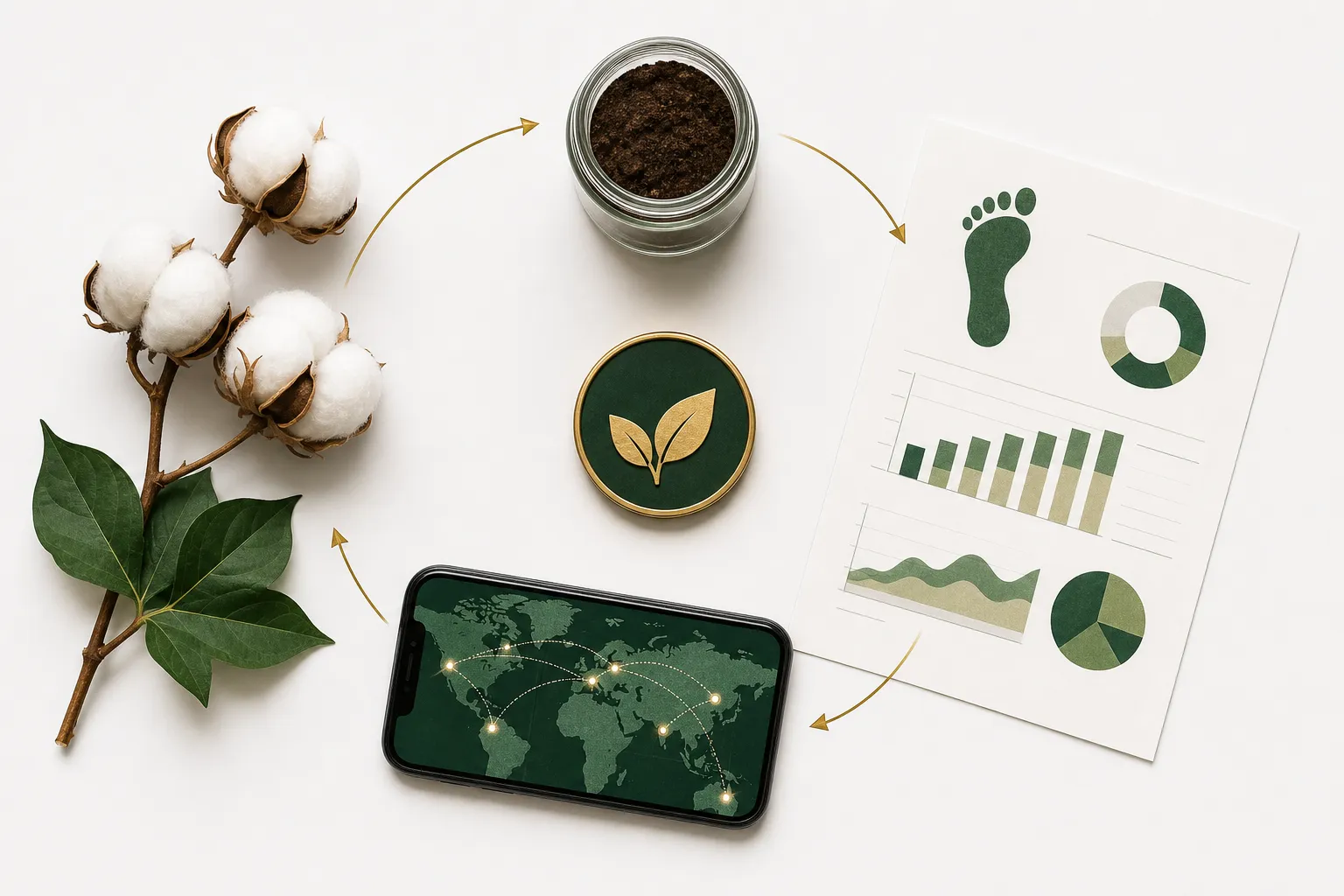
Carbon Footprinting and Emissions Accounting
Carbon accounting for fashion brands starts with a full baseline measurement across scope 1, 2, and 3 emissions. Scope 1 covers direct emissions from owned operations. Scope 2 covers purchased energy. Scope 3, the hardest and most important category, covers everything in your supply chain: raw material production, transportation, processing, and product use and disposal.
A managed service partner runs this measurement cycle on your behalf, using GHG Protocol-aligned methodologies and sector-specific emission factors. They collect data from your suppliers, apply appropriate calculation methods, and produce a verified carbon baseline that you can use for target-setting, reporting, and investor disclosure. This process repeats annually, so your carbon data stays current as your supply chain evolves.
Supply Chain Traceability Implementation
Traceability is the foundation of credible sustainability claims. Without it, you cannot verify where your raw materials come from, what farming practices were used, or whether your regenerative sourcing claims hold up to scrutiny. A sustainability as a service model includes the design and implementation of a blockchain traceability system that tracks the origin and journey of materials from farm to finished product.
This involves farmer registration, data collection protocols, digital tagging at key handoff points, and integration with your existing ERP systems. ERP integration is often the step that stalls internal teams, connecting farm-level data to procurement and inventory systems requires technical expertise that sits outside most sustainability functions. A managed service partner handles this integration as part of the standard delivery.
For a deeper look at how this data flows across a value chain, see our guide on integrating regenerative agriculture data across supply chains.
Compliance Tracking Across Regulatory Frameworks
Sustainability reporting requirements are multiplying. Brands operating in or sourcing from India need to track BRSR requirements. Brands selling into Europe must align with CSRD, the EU Taxonomy, and sector-specific directives. A managed service partner monitors these frameworks continuously, maps your current performance against each requirement, and flags gaps before they become compliance failures.
This is particularly valuable for textile compliance in India, where the regulatory landscape is evolving rapidly. Rather than assigning one of your team members to track every regulatory update across three jurisdictions, your service partner maintains that watch function and translates it into actionable steps for your team.
Supplier Engagement and Capacity Building
Reducing scope 3 emissions requires changing what happens at the farm and mill level, not just measuring it. A sustainability as a service model includes structured supplier engagement programs: training farmers in regenerative agriculture supply chain visibility practices, supporting mills in energy efficiency improvements, and building the data collection habits that make ongoing measurement possible.
This is where the difference between a data-only service and a truly embedded partner becomes clear. Beetle Regen's approach, for example, includes on-the-ground farmer training in regenerative cotton cultivation, biochar applications for soil carbon sequestration, and methane reduction through Alternative Wetting and Drying (AWD) in rice farming. These are not just measurement activities, they are the interventions that actually move your carbon numbers in the right direction.
Sustainability Reporting and ESG Documentation
The final component is translating all of this activity into the reports your stakeholders need. A managed service partner produces board-ready ESG summaries, investor disclosure documents, and public sustainability reports aligned with GRI, TCFD, or CDP frameworks. They also maintain the audit trail that regulators and third-party verifiers require, so when someone asks for evidence behind your claims, it is already organized and ready.
What Stays Internal: The Brand's Role in a SaaS Partnership
One of the most common concerns brands raise about the sustainability as a service model is loss of control. It is a legitimate question. Your sustainability narrative is part of your brand identity. Your net zero targets are commitments to your investors and customers. You cannot hand those over to an external party.
The good news is that you do not have to. A well-designed sustainability as a service model is built around a clear division of responsibility. Here is what stays firmly with your team.
- Strategic target-setting: Your team decides what net zero means for your brand, which timelines you commit to, and which frameworks you align with. The service partner provides the data and analysis to inform those decisions, but the decisions are yours.
- Stakeholder communication: How you talk to investors, customers, and the media about your sustainability performance is your brand's voice. The service partner provides the verified data and documentation behind those communications.
- Product and sourcing decisions: Which materials you use, which suppliers you work with, and how you design your products remain internal decisions. The service partner can advise on the sustainability implications of those choices, but the commercial decisions stay with your procurement and design teams.
- Brand narrative and public claims: Your sustainability story, the values, the mission, the commitments, is yours to own and tell. The service partner ensures that story is backed by verified data.
- Governance and accountability: Board-level accountability for sustainability performance stays internal. The service partner supports your governance structures with data, reporting, and expert input, but the accountability chain runs through your organization.
Think of the relationship as a specialist function embedded within your team, not a replacement for your team. The best sustainability as a service partnerships work because both sides are clear about where the boundary sits.
Is the Sustainability as a Service Model Right for Your Business?
The sustainability as a service model is not the right fit for every organization at every stage. Here are five scenarios where it tends to deliver the most value.
Scenario 1: You have made a net zero pledge but lack an implementation roadmap. Many brands committed to net zero targets between 2020 and 2023 without a clear plan for how to get there. If your pledge is public but your internal roadmap is still a work in progress, a managed service partner can build and run that roadmap for you, starting with a verified carbon baseline and working through to a net zero strategy that covers your full value chain.
Scenario 2: A compliance deadline is approaching and you do not have the internal expertise. BRSR reporting, CSRD alignment, or a major customer's supplier sustainability requirements, these deadlines do not move. A managed service partner can mobilize quickly, using existing methodologies and supplier relationships to get you compliant faster than an internal build would allow.
Scenario 3: Your supply chain is complex, agricultural, or multi-tier. If your raw materials come from smallholder farmers in India or Bangladesh, measuring and reducing your scope 3 emissions requires on-the-ground expertise and farmer relationships that most brand teams do not have. This is precisely the scenario where a partner like Beetle Regen, with existing farmer networks, regenerative agriculture programs, and traceability infrastructure, adds the most value.
Scenario 4: You want verified carbon insetting, not just offsetting. Carbon insetting, reducing emissions within your own supply chain rather than purchasing credits from unrelated projects, is increasingly preferred by investors and regulators. But it requires deep supply chain integration. A sustainability as a service model that includes regenerative agriculture programs and soil testing protocols can deliver verified insetting credits that strengthen your climate claims. Learn more about how this works in our guide to supply chain transformation through regenerative agriculture consulting.
Scenario 5: Your sustainability team is small and managing too many workstreams. If your team is stretched across climate, social, packaging, water, and biodiversity simultaneously, the quality of delivery on each workstream suffers. A managed service model lets you concentrate your internal team on the areas where their judgment and relationships matter most, while the service partner handles the operational delivery of your climate program.
How Beetle Regen's SaaS Model Works in Practice
Beetle Regen's sustainability as a service model is designed specifically for textile and fashion brands with agricultural supply chains in India and Bangladesh. It is built around five implementation stages that move a brand from baseline measurement to verified, ongoing performance improvement.

Step 1: Baseline Carbon Footprint Assessment
Every engagement starts with a full carbon footprint assessment across your value chain. This covers scope 1 and 2 emissions from your direct operations and a detailed scope 3 analysis covering raw material cultivation, fiber processing, yarn spinning, fabric production, garment manufacturing, and logistics. Beetle Regen uses GHG Protocol-aligned methodologies and sector-specific emission factors developed through years of work in Indian and Bangladeshi textile supply chains.
The output is a verified carbon baseline, a number you can report, a breakdown you can act on, and a benchmark against which future progress is measured. For brands that have never done this before, the baseline assessment often reveals that the largest emission reduction opportunities sit at the farm level, in raw material cultivation practices.
Step 2: Traceability System Design and ERP Integration
With the baseline established, the next step is building the data infrastructure that makes ongoing measurement possible. Beetle Regen designs and implements a supply chain traceability system that tracks materials from farm registration through to retail verification. This includes digital tagging at key handoff points, data collection protocols for farmers and processors, and ERP integration that connects farm-level data to your procurement and inventory systems.
The traceability system also provides the audit trail needed for third-party verification of your sustainability claims, a requirement that is becoming standard across major retail and brand sustainability programs. Understanding how this data architecture works is covered in detail in our post on integrating regenerative agriculture data across supply chains.
Step 3: Supplier Engagement and Regenerative Agriculture Onboarding
Measurement without intervention does not reduce emissions. This step is where Beetle Regen's on-the-ground presence in India and Bangladesh creates a genuine advantage. Farmer training programs introduce regenerative cotton cultivation practices, cover cropping, reduced tillage, compost application, and biochar applications for soil carbon sequestration. For rice-growing regions, methane reduction through Alternative Wetting and Drying (AWD) is implemented to reduce the significant methane emissions associated with flooded paddy cultivation.
These interventions do not just reduce your scope 3 emissions, they improve farmer income through better yields, lower input costs, and access to carbon credit revenue. That farmer-first design is what makes the emission reductions durable. When farmers benefit economically from regenerative practices, they continue them. When they do not, they revert. Beetle Regen's model is built around this reality.
Step 4: Compliance Tracking and Reporting Framework Setup
With data flowing and interventions underway, the fourth step establishes the compliance and reporting infrastructure your brand needs. Beetle Regen maps your performance against the regulatory frameworks relevant to your markets, BRSR for India, CSRD for European sales, and any customer-specific sustainability requirements. Gaps are identified, remediation plans are built, and reporting templates are set up to make annual disclosure straightforward.
This step also covers alignment with voluntary frameworks like the Science Based Targets initiative (SBTi), which is increasingly required by major retail customers and institutional investors. Understanding how your sustainability program aligns with broader climate policy is explored in our post on how regenerative agriculture aligns with climate policy.
Step 5: Ongoing Monitoring, Verification, and Reporting Cycles
The final stage is what makes this a service model rather than a project. Beetle Regen runs annual measurement cycles, updates your carbon baseline as your supply chain changes, monitors regulatory developments, and produces the verified reports your stakeholders need. Third-party verification of carbon credits generated through the program is managed through established protocols, Verra, Gold Standard, or soil carbon methodologies depending on the intervention type.
This ongoing cycle is what allows brands to demonstrate year-on-year progress against their net zero targets, not just a one-time baseline, but a continuous improvement trajectory backed by verified data.
What to Look for in a Sustainability as a Service Partner
Not all sustainability service providers are equal. Here are the criteria that matter most when evaluating a partner for a long-term managed sustainability engagement.
Deep sector expertise. A generalist sustainability consultant can help you build a carbon model. But if your supply chain runs through Indian cotton farms and Bangladeshi mills, you need a partner who understands the specific emission sources, farming practices, regulatory context, and supplier dynamics of those sectors. Generic expertise does not translate to effective intervention at the farm level.
End-to-end capability. The sustainability as a service model works best when a single partner can cover the full journey, from farm-level data collection to board-ready ESG reports. Fragmented service providers create coordination gaps that your internal team ends up filling. Look for a partner who can demonstrate capability across carbon accounting, traceability, supplier engagement, and reporting in a single integrated offering.
Verified methodologies. Any carbon claims your brand makes need to be backed by recognized methodologies. Ask potential partners which protocols they use, GHG Protocol for emissions accounting, Verra or Gold Standard for carbon credits, and sector-specific standards for agricultural interventions. Partners who cannot name their methodologies clearly are a risk to your credibility.
Technology integration capability. The sustainability as a service model generates data, a lot of it. That data needs to flow into your existing systems. A partner who can handle ERP integration and connect farm-level traceability data to your procurement and reporting infrastructure will save your team significant time and reduce the risk of data gaps in your reporting.
A farmer-first approach. For brands with agricultural supply chains, the sustainability of your program depends on the sustainability of the farming practices it is built on. A partner who treats farmers as data sources rather than program participants will struggle to maintain the on-farm behavior change that drives real emission reductions. Look for evidence of genuine farmer engagement: training programs, income improvement outcomes, and long-term farmer relationships.
Track record with comparable brands. Ask for examples of brands at a similar scale and supply chain complexity who have used the service. What did their carbon baseline look like before and after? What compliance milestones did they hit? What traceability coverage did they achieve? A credible partner will have concrete answers to these questions.
For context on what a comprehensive ESG framework looks like, the Modern ESG Dictionary is a useful reference for teams building their sustainability vocabulary alongside their program.
Frequently Asked Questions About Sustainability as a Service
How long does it take to implement a sustainability as a service model?
The initial baseline assessment and traceability system setup typically takes three to six months, depending on the complexity of your supply chain and the quality of existing data. Ongoing measurement and reporting cycles then run annually. Brands with compliance deadlines should plan for a minimum of four months from engagement start to first verified report.
Will we lose control of our sustainability narrative?
No. The sustainability as a service model is designed to give your team more control over your narrative, not less, because your claims are backed by verified data rather than estimates. Your service partner provides the evidence; your team decides how to communicate it. Strategic decisions, public commitments, and stakeholder relationships remain entirely internal.
How does a SaaS model differ from hiring a sustainability consultant?
A traditional consultant delivers a project, a report, a strategy, a roadmap, and then exits. A sustainability as a service model is an ongoing engagement. Your partner runs the measurement cycles, manages supplier data collection, tracks regulatory changes, and updates your reporting frameworks continuously. The relationship is operational, not advisory.
Can a SaaS model work if we already have a sustainability program in place?
Yes, and this is actually a common entry point. Many brands have existing sustainability programs that are strong on strategy but weak on operational delivery, particularly for scope 3 measurement and supplier engagement. A managed service partner can integrate with your existing program, fill the operational gaps, and strengthen the verification behind your existing claims without requiring you to start over.
What does a typical SaaS engagement involve in terms of our team's time?
The primary value of the sustainability as a service model is that it reduces the time burden on your internal team. Expect to invest time upfront in onboarding, sharing supply chain data, aligning on targets, and introducing the partner to key suppliers. After that, your team's ongoing involvement is typically limited to review and approval of reports, strategic input on target-setting, and stakeholder communication. The operational delivery sits with the service partner.
How does the sustainability as a service model handle carbon credits?
A well-designed sustainability as a service model can generate verified carbon credits through on-farm interventions, regenerative agriculture practices, biochar application, and methane reduction programs. These credits can be used for carbon insetting (retiring credits against your own scope 3 emissions) or, where appropriate, for offsetting residual emissions. The key is that credits are generated within your supply chain, making them directly attributable to your brand's climate action. For more on this, see our guide on carbon sequestration in agriculture.
Taking the Next Step with the Sustainability as a Service Model
The gap between a sustainability pledge and verified, ongoing performance is where most brands get stuck. The sustainability as a service model exists to close that gap, by embedding expert-led carbon accounting, traceability, compliance tracking, and supplier engagement directly into your operations, without requiring you to build a large internal team or sacrifice control over your strategy and narrative.
For textile and fashion brands with agricultural supply chains in India and Bangladesh, the opportunity is particularly significant. The same supply chain that currently represents your largest source of scope 3 emissions can, with the right partner, become a source of verified carbon reductions, traceable regenerative fiber, and credible ESG performance data. That transformation does not happen through a one-time project. It happens through an ongoing, embedded partnership, which is exactly what the sustainability as a service model is designed to deliver.
If your brand is ready to move from sustainability ambition to verified action, Beetle Regen's sustainability as a service model offers a clear path forward. From baseline carbon footprinting to regenerative agriculture onboarding to compliance-ready reporting, the program is built for brands that need expert capacity now, not in two years. Reach out to the Beetle Regen team to discuss how a managed sustainability partnership could work for your supply chain, and what your first verified carbon baseline could look like within the next quarter.