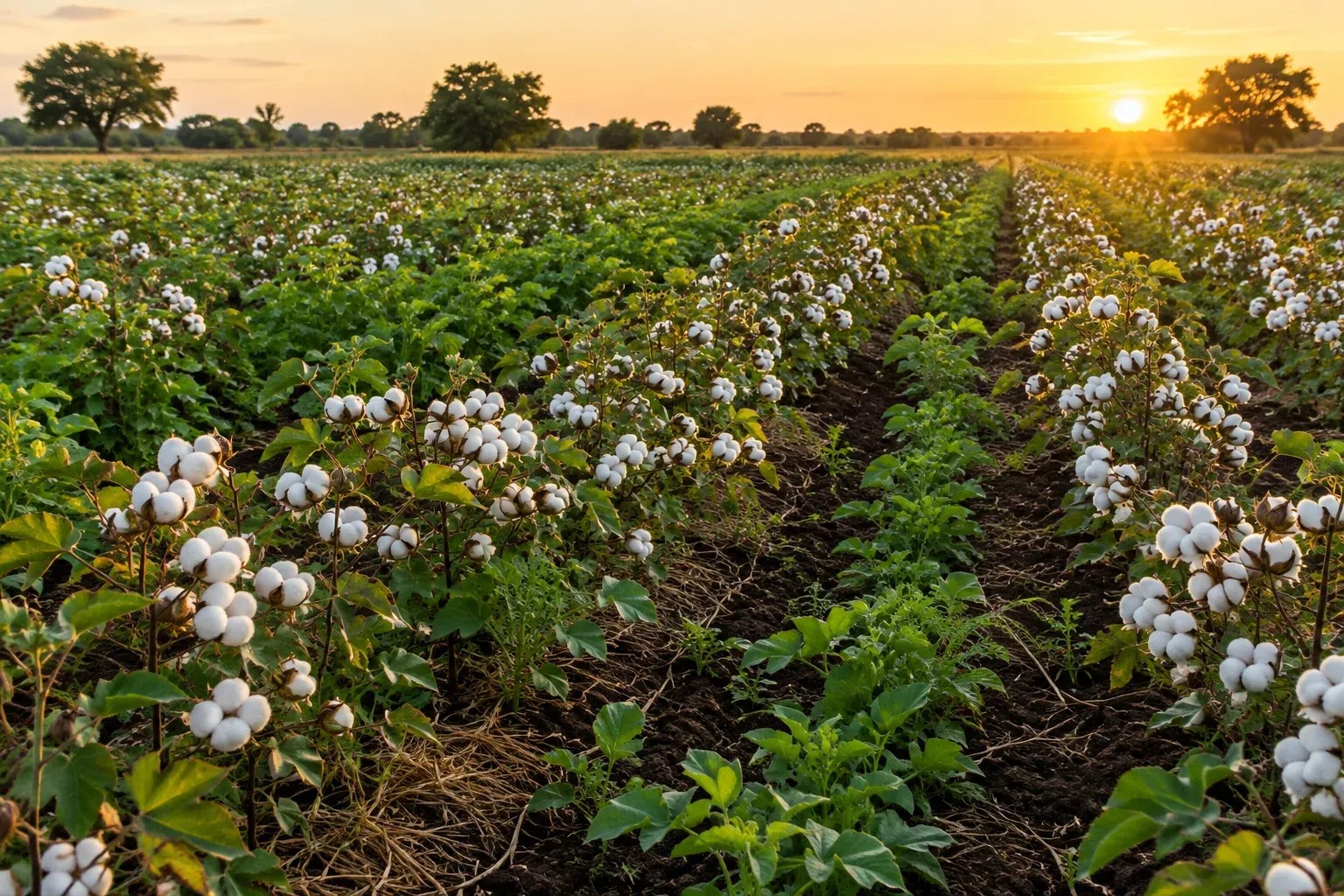
Regenerative Cotton vs Organic Cotton: Is It More Premium, and What Do Farmers Gain?
Regenerative cotton is not automatically more premium than organic cotton. It earns a premium only when its impact is verified and traceable to the farm. Organic mainly restricts inputs, while regenerative targets outcomes such as soil health, water use and biodiversity, and the two can overlap. In India, Beetle's 2025-26 programme data shows 18% higher yield and 38% higher net income for participating farmers.
Key Takeaways
Different tests: Organic cotton is judged mainly on what a farmer does not use (synthetic inputs). Regenerative cotton is judged on what happens to soil, water and carbon. A farm can be both, either or neither.
Premium comes from proof: Brands pay for farm-level data, a measured lower footprint and supply security. A label with no traceable record behind it will not hold a premium for long.
Farmer gains are measurable: In 2025-26 our participating farmers saw about 18% higher yield, about 38% higher net annual income, about 23% less chemical fertiliser and about 16% better water-use efficiency than control-group farmers.
Carbon money is not automatic: Farmer revenue from carbon depends on project design, verification, credit issuance, market value, costs and the benefit-sharing terms agreed before enrolment.
Three questions for suppliers: Can you trace cotton to the farm, how is the footprint measured, and how are farmers paid?
Regenerative vs Organic vs Conventional Cotton: Quick Facts
Question | Organic cotton | Regenerative cotton | Conventional cotton |
|---|---|---|---|
What is judged? | Inputs and compliance with organic standards | Outcomes: soil, water, biodiversity, carbon | Yield and cost; few sustainability tests |
Synthetic inputs | Prohibited | Reduced and optimised (not always banned) | Used as needed |
Where does a premium come from? | Certification and chain of custody | Verified, traceable impact data | None for sustainability |
Farmer lever | Premium price, lower input spend | Yield, input savings, carbon-linked income | Scale and mechanisation |
Beetle 2025-26 result | Not measured in this report | ~18% yield, ~38% income vs control farmers | Used as control group baseline |
Main risk | Yield and cost pressure on farmers | Inconsistent practice adoption without handholding | Soil and climate cost stays on the farm |
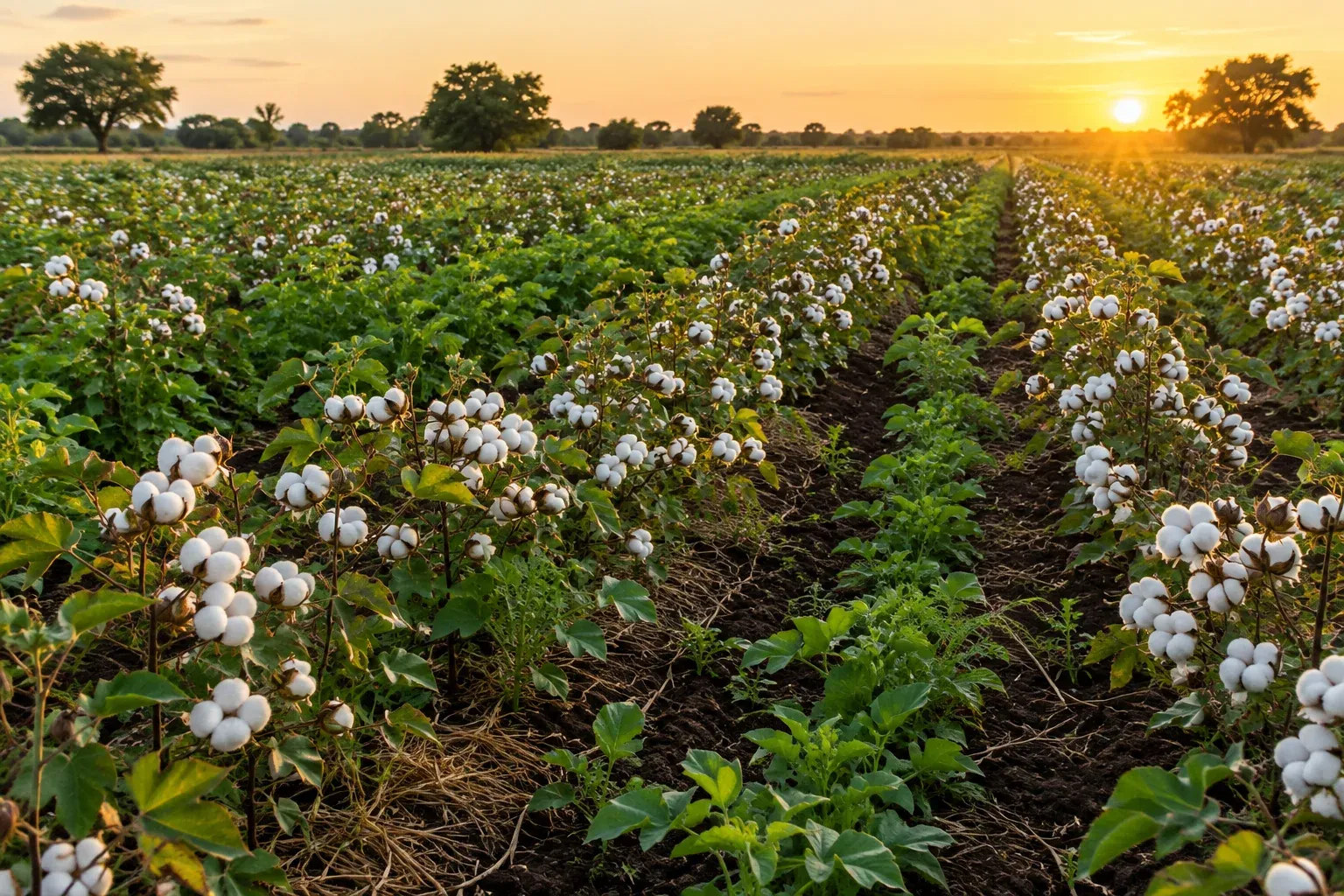
What Is the Difference Between Regenerative, Organic and Conventional Cotton?
Organic cotton is grown under organic standards that ban synthetic pesticides, fertilisers and genetically modified seed. Regenerative cotton is defined by outcomes: healthier soil, better water use, more biodiversity and lower emissions. Conventional cotton has no such requirement. A farm can be organic, regenerative, both or neither.
The simplest way to remember it: organic is a rulebook about inputs, regenerative is a scorecard about results. Both aim to reduce harm. They differ in what they measure and in what a brand can prove to a customer.
Feature | Organic cotton | Regenerative cotton | Conventional cotton |
|---|---|---|---|
Core logic | Restrict what goes into the field | Improve what the field becomes | Maximise output per acre |
Typical practices | No synthetic pesticides or fertilisers, organic seed, certified records | Reduced tillage, residue management, intercropping, organic amendments, biochar, boundary trees, water management | Synthetic fertiliser and crop protection, often monocropping |
Measurement | Audit of practices and inputs | Soil carbon, water use, input use, yield, emissions per hectare | Rarely measured beyond yield |
Traceability | Varies by chain of custody model | Can go to farm or farmer group when designed for it | Usually blended at the gin |
Typical weakness | Input rules do not guarantee soil or carbon outcomes | Needs consistent field support and data | Soil degradation and higher emissions are not priced in |
Where do organic and regenerative cotton overlap?
They overlap on practices. Both reduce or remove synthetic inputs, both value healthy soil, and both can be verified by a third party. A certified organic farm can also run reduced tillage, intercropping and biochar, which makes it regenerative in practice. The reverse is also true.
The difference is the promise. An organic certificate tells a buyer the cotton followed an input rulebook. A regenerative programme, if designed properly, tells the buyer what changed on the farm. Neither replaces the other, and some brands will want both on the same bale.
How is organic cotton certified in India?
In India, organic production is certified under the National Programme for Organic Production (NPOP), which the Agricultural and Processed Food Products Export Development Authority (APEDA) implements for the Ministry of Commerce and Industry. Certification bodies inspect farms and issue scope certificates. Grower group certification exists for small farmers.
You can see how the system is set up on the APEDA list of certification bodies. APEDA also publishes additional checks for organic cotton production, including verification of cotton production in an area with the district agriculture authority before certifying it.
Regenerative cotton has no single Indian government label of this kind. Brands rely instead on private or multi-stakeholder standards and on programme data. That is why the quality of evidence matters so much, and why the next question is the one buyers ask most.
Is Regenerative Cotton More Premium Than Organic Cotton?
Not by default. Regenerative cotton becomes premium when a buyer can see proof: farm-level records, a measured lower footprint and a secure supply. Where the programme is only a claim, brands treat it like any other marketing line. The premium follows the evidence, not the word "regenerative" on a tag.
Organic cotton remains a small share of the global crop, roughly 2.9% of production in the 2023/24 season. Industry press has described regenerative cotton as a possible "middle ground" between organic and conventional, and has reported brands paying green premiums for regenerative cotton. Interest is real. The size of any premium is set contract by contract.
What do brands actually pay for?
Brands pay for three things: data they can audit, a lower and measurable footprint, and a supply of cotton that will still be there in five years. A premium is the price of reducing risk, not of owning a logo.
Farm-level data: Which plots, which practices, which season. Without this, a Scope 3 or insetting claim cannot be defended.
A measured footprint: A product-level carbon number built from primary farm data instead of an industry average.
Supply security: Healthier soil, lower input dependence and trained farmers lower the risk of yield shocks. Farmers who earn more are also more likely to stay in cotton.
Claim safety: Regulators and customers are scrutinising green claims. A traceable record is the protection a brand has if challenged.
India's own policy points the same way. The Union Cabinet approved a Mission for Cotton Productivity with an outlay of ₹5,659.22 crore for 2026-27 to 2030-31, and our report notes the target of raising lint productivity from 440 kg per hectare to 755 kg per hectare by 2031. Productivity and sustainability are being discussed together, which is the argument regenerative programmes make.
Why does a label alone not hold a premium?
A label alone does not hold a premium because it describes a promise, not a result. When two bales carry the same label but only one can show farm records, a footprint method and farmer payments, a careful buyer will pay for the second and discount the first.
Traceability is where the gap shows. Many organic systems use mass balance or segregation models, which support large-scale sourcing but can limit how far cotton can be traced back to a specific farm or farmer group. Regenerative programmes built on identity-preserved records can go further. If you want the step-by-step version, our brand guide to supply chain traceability for regenerative cotton covers it.
How big is the regenerative cotton premium?
There is no single published number we can stand behind, and we do not quote one. The premium depends on the buyer, the verification level, the volume, whether cotton is segregated, and whether carbon insetting is bundled in. Treat any universal percentage with suspicion.
What we can say is how to judge it. Compare the premium with what the programme delivers: the data trail, the footprint reduction and the share reaching farmers. Our article on whether the regenerative cotton price premium is worth it for retailers works through that trade-off in more detail.
What Do Farmers Actually Gain From Growing Regenerative Cotton?
Farmers gain healthier soil, lower input costs, better resilience and, in our programme data, higher yield and income. Against control-group farmers in 2025-26, participating farmers saw about 18% higher yield and about 38% higher net annual income. These gains come from a bundle of practices, not one trick.
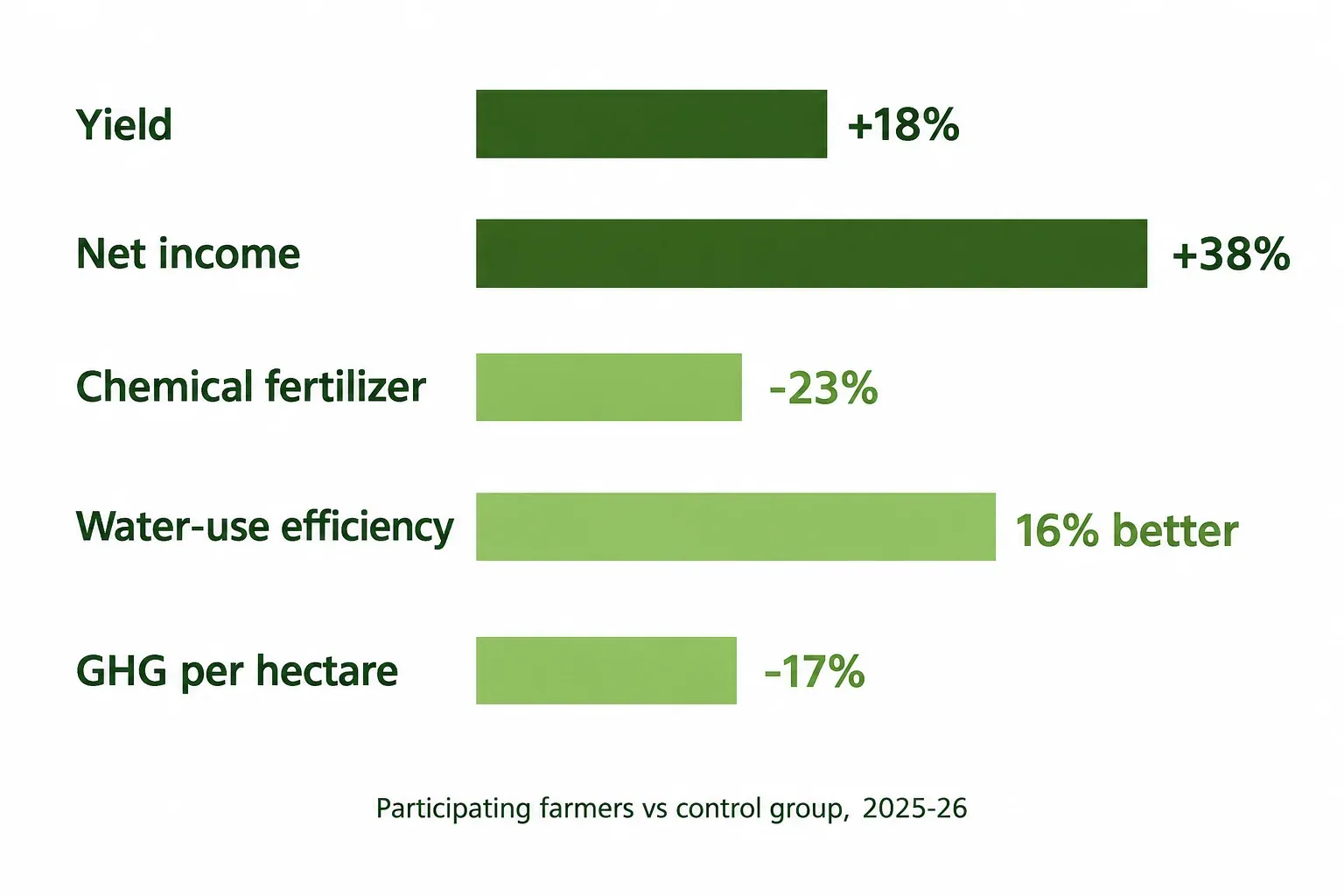
These figures come from our 2025-26 end-of-year report, which covers a programme that reaches approximately 120,000 farmers directly and indirectly. Each participating farmer adopted four to five regenerative practices. Direct outreach is 71,000 farmers, with about 50,000 more reached through partner-led capacity building.
Indicator (2025-26) | Outcome for participating farmers | Compared with |
|---|---|---|
Yield | About 18% higher | Control-group farmers |
Net annual farmer income | About 38% higher | Control-group farmers |
Chemical fertiliser use | About 23% lower | Reduction achieved |
Water-use efficiency in cotton | About 16% better | Control-group farmers |
Greenhouse gas emissions per hectare | About 17% avoided | Participating farmers |
Boundary plantation adopted | 29% of farmers | Alongside crop diversification |
Which practices drive the gains?
Four practices carry most of the weight in our cotton and rice programmes: high-density planting (HDPS), farmer-led biochar, reduced tillage with residue management, and, for paddy farmers, alternate wetting and drying (AWD). Each affects cost, yield or both, and they work best together.
HDPS: Sowing more plants per acre in narrower rows with matched seed. Participating farmers reported an average cotton yield increase of approximately 25% against conventional planting, across more than 2,800 farmers and 2,100 hectares in Madhya Pradesh and Maharashtra. Our CEO's foreword notes results across more than 2,000 hectares and a plan to scale to more than 20,000 hectares in the coming year.
Biochar: Cotton stalks are burned in a controlled, no-oxygen environment to make a stable carbon material. It improves soil fertility and water retention, and it gives farmers a use for residue that would otherwise be waste.
Reduced tillage: We anticipate a 30% reduction in tillage on our farms within the first two years. Less tillage protects soil structure and lowers fuel and labour use.
AWD in rice: In paddy farming, AWD can reduce the water footprint by up to 30%. Our AWD project helps paddy farmers improve water management in Andhra Pradesh.
For a deeper look at how these planting results translate, see our posts on HDPS in cotton. The key point here is that HDPS and biochar are spreading because farmers can see the effect on their own plots, not because a standard forced them to.
What are the limits of these results?
The limits are consistency and time. Our own report states that adoption varies across geographies and that continued handholding is needed to realise the full productivity and sustainability gains. Soil carbon builds slowly, and one season of data is not a trend.
Something remains unsettled too: how much of the income gain comes from yield, how much from lower input spend, and how much from price. We track all three, and we would not tell a brand to assume the split before seeing a programme's own data. The Cotton Special Project page describes how we structure the work on the ground.
Do women farmers share in these gains?
They can, if the programme is designed for it. In FY 2025-26 we launched the Women in Regenerative Cotton initiative with Vardhman Textiles for a leading global brand, recognising women as co-farmers, with financial and digital literacy training, self-help group formation and market linkages.
The initiative covers 103 villages and has engaged more than 620 women across 67 self-help groups, with more than 650 trained on financial literacy. Women play a major role in cotton cultivation but often have limited access to decisions, knowledge and finance, so inclusion is part of building a resilient system.
How Does Farmer Income Depend on How Value Is Shared?
Farmer income depends on three streams: the price paid for the cotton, the savings and yield gains from better practices, and any carbon-linked payment. Carbon revenue is the least certain of the three. It is shared among several parties after project costs, so the benefit-sharing terms matter more than any headline price.

Why is carbon income not automatic for farmers?
Carbon income is not automatic because credits are only issued after a project is designed, measured, verified and registered, and then sold at a market price. Joining a project does not by itself pay a farmer. Costs and agreed shares come out before any money reaches households.
The most common mistake we see is joining a carbon project without understanding how it works and what participation requires. A farmer may assume that joining means automatic earnings. In reality, carbon revenue depends on project design, verified outcomes, credit issuance, market value, project costs and the agreed benefit-sharing mechanism.
What should a farmer-first benefit-sharing mechanism disclose?
It should disclose who shares the revenue, which costs are deducted, and how the farmer's share is calculated. Revenue may be split among farmers, project developers, implementation partners and other stakeholders after development, monitoring, verification and registry costs. The question is not only what percentage goes to farmers.
Use this as a pass or walk-away check before enrolling farmers, or before a brand backs a project:
Pass: The deductions are listed, the formula for the farmer's share is written down and explained in the farmer's language, and the terms are shared before enrolment.
Walk away: The farmer is told only a percentage, costs are "to be decided", or terms arrive after sign-up.
What does a soil carbon project look like in practice?
A soil carbon project follows a defined method, a registry and a monitoring system. We are developing three soil carbon projects with carbon partners in Maharashtra and Madhya Pradesh, using practices like reduced tillage, residue incorporation, optimised nutrient use, intercropping and organic amendments.
Location | Carbon partner | Farmers | Area | Status |
|---|---|---|---|---|
Chhatrapati Sambhaji Nagar, Maharashtra | Kosher Climate | 4,315 | About 5,016 ha | Under Verra VM0042; estimated average of 28,504 tCO₂e a year and 570,075 tCO₂e over a 20-year crediting period |
Nagpur, Maharashtra | Asvata | 9,020 across 32 villages | About 10,253 ha | Under Verra VM0042; documentation and pre-validation stages |
Khargone, Madhya Pradesh | Boomitra | 1,440 | Mapped and onboarded under digital MRV | Registry under evaluation |
These projects are in development. They show the architecture, not payouts. The Verra method, VM0042 for improved agricultural land management, quantifies emission reductions and soil organic carbon removals from practices such as reduced tillage and better fertiliser use. Our soil carbon projects are in validation and documentation stages; no revenue should be assumed from them.
Where does carbon insetting fit?
Carbon insetting funds emission reductions inside a brand's own supply chain, so the payment reaches the farms that grow its cotton. For farmers it can sit alongside a fair cotton price, rather than replace it. Biochar is one insetting route, since it stores carbon and improves soil at the same time.
Our carbon insetting solutions page explains how this works for textile supply chains. The decision rule we would give a brand: pay a fair price for the cotton first, then treat carbon insetting as an additional payment for climate-positive practice, never as a substitute for farm-gate income.
What Should Brands Ask Suppliers About Regenerative Cotton?
Brands should ask three questions: can the cotton be traced back to the farm, how is the footprint measured, and how are farmers paid? Each answer should be specific, documented and checkable. Vague replies on any of the three are the clearest sign that a premium is paying for a label.
Question to ask | Good answer (pass) | Walk-away answer |
|---|---|---|
Can you trace cotton to the farm? | Farmer and plot IDs, practice records and consent, carried through gin and spinner | "We trace to the district" or only a batch certificate |
Is the chain segregated or mass balance? | The model is disclosed, and claims match it | Claims imply farm-level origin but the model is not stated |
How is the footprint measured? | Primary farm data, a stated system boundary and a named standard such as ISO 14067 for product carbon footprint | A single industry average presented as farm-specific |
Is there a life cycle assessment? | Cradle-to-gate study following ISO 14040 and ISO 14044 | No study, or no method named |
How are farmers paid? | Written benefit-sharing terms, deductions listed, shared before enrolment | Only a headline percentage, or terms not disclosed |
How are practices checked? | Field monitoring, sampling or digital MRV with control comparison | Self-declaration only |
We are carrying out a life cycle assessment for Texprocil in Jalgaon, Maharashtra. It is a cradle-to-gate study covering 1,200 farmers, built on primary data on inputs, nutrient management, irrigation, residue management and farm-level emissions, following ISO 14040, ISO 14044 and ISO 14067. This is the kind of evidence a footprint claim should rest on.
Should a brand choose organic, regenerative or both?
Choose by the claim you need to make. Pick organic when your customers or regulations require the organic label. Pick regenerative when you need outcome data, soil and carbon results, or farm-level insetting. Choose both when you need the certificate and the evidence, and can fund the extra verification.
Organic first: Your product is marketed as organic, or your retail customers require an organic certificate.
Regenerative first: You are building a Scope 3 reduction story, need product footprint data, or want farmers paid for climate outcomes.
Both: You want the input guarantee of organic and the outcome proof of regenerative on the same supply base.
Neither yet: You are early in sourcing. Start with a single-mill pilot and farm-level data before you make any public claim.
Our own view: for most brands with Scope 3 targets, regenerative with traceable data gives more usable evidence per rupee than a certificate alone. Brands with organic-labelled products should not drop certification to chase it. Whether regenerative will eventually be priced as its own category, or folded into organic and conventional sourcing, is not settled yet.
If you are weighing pilot risk, our guide to why regenerative cotton pilots fail lists the causes to design around.
How Does Beetle Regen Run Regenerative Cotton Programmes in India?
We run regenerative cotton programmes with smallholder farmers in India and Bangladesh, linking farm practice, traceability, carbon measurement and brand supply chains. Our work reaches approximately 120,000 farmers, with partners across the textile chain. We combine farmer training, biochar insetting and sustainability-as-a-service for brands.
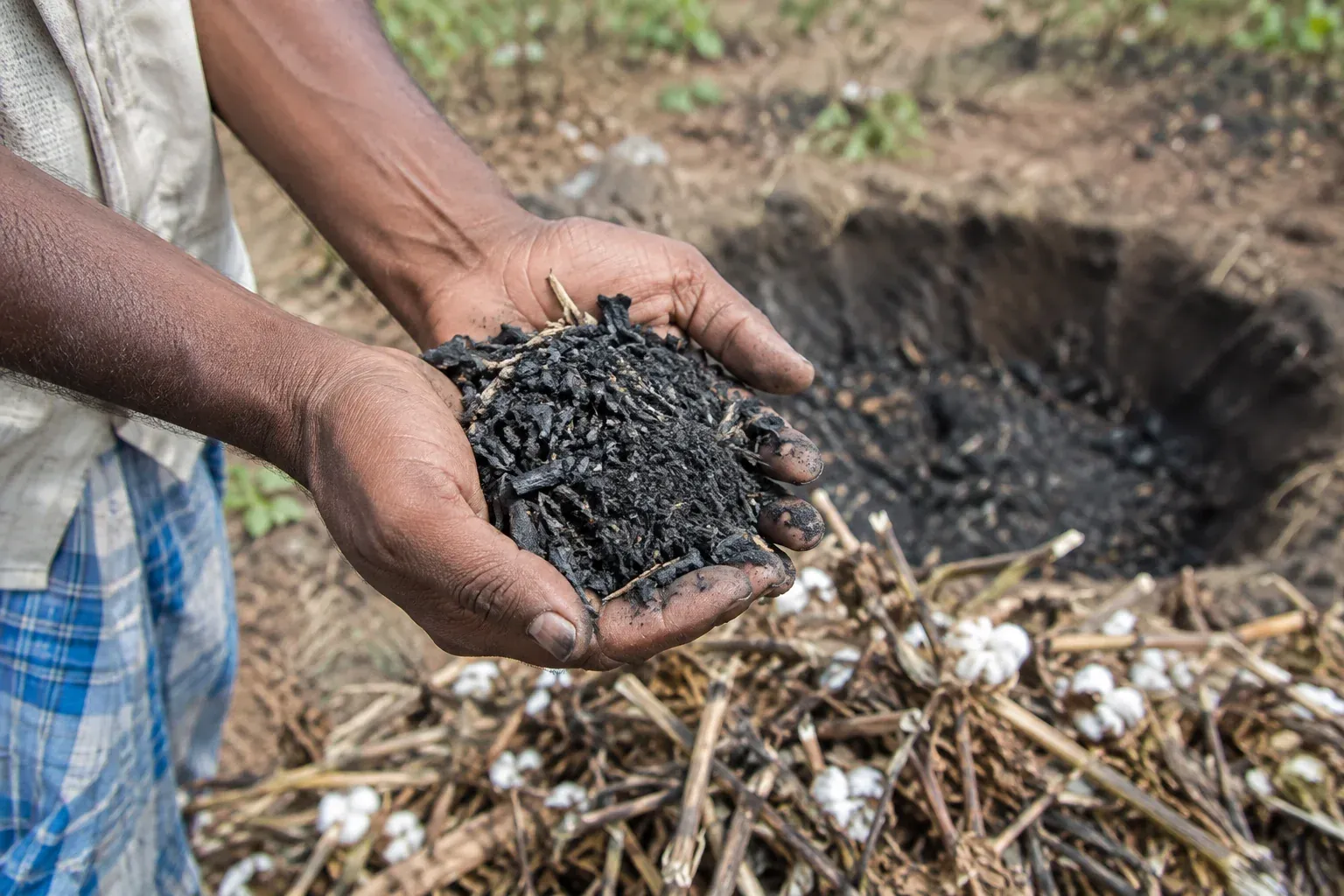
The 2025-26 snapshot shows 1,06,866 hectares of land coverage, 20+ supply chain partners and 9 corporate partners, with first pilot interventions in Bangladesh this year. Our fieldwork is delivered with local partners, including the Niranjanlal Agrawal Foundation, which leads farmer mobilisation, capacity building, demonstration plots and field monitoring across the intervention states.
What does the programme include?
The programme covers farmer training, practice adoption, monitoring and data capture, and the link to a buyer. For brands, our sustainability-as-a-service offering adds risk assessment, supply chain data gathering, traceability, carbon footprinting and reduction, and carbon credit monetisation and offsetting.
Farmer capacity building: Training on regenerative practices, including HDPS, biochar and AWD, with demonstration plots and follow-up.
Traceability: We track the origin and journey of cotton and other raw materials through the production process.
Standards and capacity work: We are a technical partner to IDH under the Regenerative Production Landscape Collaborative (RPLC) in Madhya Pradesh, supporting 10 partner organisations and co-developing a capacity framework with three pillars: regenerative practices, biochar systems and Bio-Resource Centres.
Carbon: Soil carbon projects and farmer-led biochar, aiming to sequester approximately 1 million tonnes of carbon over three years, including about 220,000 tonnes in the first year.
Customers who reviewed our work have described it as building farmer capacity for regenerative agriculture and biochar production. One reviewer, Vivekanand S., wrote of "improved soil health, biodiversity, and farmer well-being". Those are the outcomes we try to measure rather than assume. You can explore our current fieldwork on the Our Projects page.
Frequently Asked Questions
Is regenerative cotton better than organic cotton?
Neither is better in every case. Organic gives a clear input rulebook and a recognised certificate. Regenerative gives outcome data on soil, water and carbon, and can support insetting. The better choice depends on the claim a brand needs to make and the evidence it can verify.
What is the difference between regenerative cotton and regular cotton?
Regular, or conventional, cotton is grown for yield and cost with no sustainability test. Regenerative cotton uses practices such as reduced tillage, residue management, intercropping and organic amendments, and measures results like soil carbon, water use and input reduction. Our programme saw about 23% less chemical fertiliser use.
Is regenerative cotton always organic?
No. Regenerative programmes may reduce and optimise synthetic inputs without banning them, so the cotton is not necessarily organic. Some farms meet both: they hold organic certification and also follow regenerative practices. Always ask which certification or verification applies to the specific cotton you are buying.
Does regenerative cotton cost more?
Often yes, because verification, traceability and farmer support have a cost. The size of the premium is set per contract, and we do not publish a fixed figure. Judge it against what you receive: farm-level data, a measured footprint and a documented farmer share.
Can long staple cotton be regenerative?
Yes. Staple length is a fibre trait, while regenerative describes how the cotton was grown. A long staple variety can be grown with regenerative practices and traced to the farm. For buyers, the practical task is to confirm that the farm records match the fibre being sold.
Do farmers earn more from regenerative cotton?
In our 2025-26 programme, participating farmers reported about 38% higher net annual income than control-group farmers, alongside about 18% higher yield. Carbon revenue is separate and not guaranteed. It depends on verified outcomes, credit issuance, market value and the agreed benefit-sharing terms.
Turn the Premium Into Proof
If you are comparing regenerative cotton vs organic cotton for your next sourcing round, start with the three supplier questions: traceability, footprint method and farmer pay. We can help you test a supplier, or build a traceable, farmer-first programme in India. Contact our team to discuss a pilot, a footprint baseline or a carbon insetting plan for your cotton supply chain.